THE CLASSIC COLLECTION✦Andersonville diaryCLASSIC FREE BOOKS
Andersonville diary
John L. Ransom
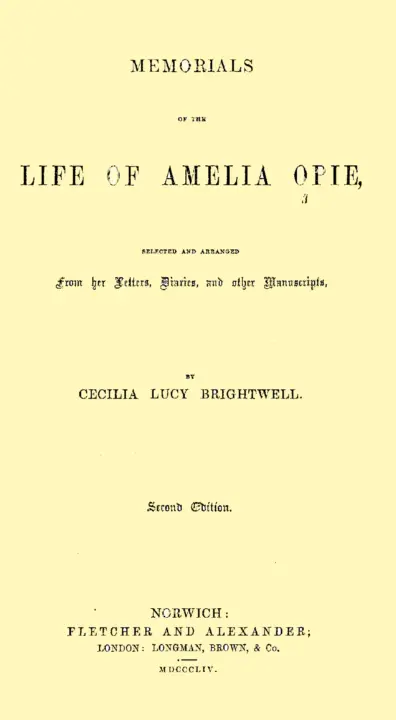
THE CLASSIC COLLECTION · 1854
"Memorials of the Life of Amelia Opie" by Amelia Opie is a biographical memoir written in the mid-19th century. The work compiles the life and experiences of Amelia Opie, detailing her upbringing, family influences, and significant events that shaped her character and artistic pursuits. Through this memoir, readers gain insight into her personal reflections, relationships, and the social context of her time. The opening of the memoir introduces the reader to Opie's early life, focusing on her birth, parentage, and formative years in Norwich. It emphasizes her close bond with her father, Dr. James Alderson, following the death of her mother when Amelia was a child. As she recounts her childhood experiences, including her early fears and her mother's methods of nurturing her, the foundation for Opie's lifelong values of compassion and benevolence emerges. The narrative sets the stage for exploring her interests in literature and social issues, as well as her eventual prominence as a writer and artist. This opening portion memorably blends personal narrative with broader themes of family, loss, and the shaping of one's character through early experiences.
Introduction adapted from the source catalogue; source summaries may be automatically generated.
Free to read · English · 139,153 words · No account needed
MAKE TIME FOR A GOOD BOOK
On by default. Untick to stop anonymous reading totals. Each page counts after 10 seconds in view. How this works.
Anonymous counting is on unless you have switched it off.
If I were now at my dear old house at Norwich, I should, perhaps, have the pleasure of passing this evening with thee; but as we are separated by a distance of nearly 400 miles, this pleasure I cannot have. I am therefore desirous to make myself amends for a privation which I frequently regret, by holding with thee that communication, imperfect though it be, I can enjoy through the medium of pen, ink, and paper. * * * One of the most interesting sights that I have seen, is THE PIT where Wesley, almost at the hazard of his life, addressed the Cornish men, for the first time. It is now an immense punch bowl of green turf, cut into circular seats from the top to the bottom; steps, left to ascend and descend, dividing the area into four parts; at the top of the last one are two posts of granite, on which, when any one preaches, there is laid a board, to support whatever the preacher may require. On every Whit Sunday one of their most distinguished ministers holds forth to an immense congregation—immense indeed! for the place holds above 10,000 persons, and it is often quite full. I could fancy, as I stood there, those thousands of uplifted faces, wrapt in devout attention, and, as I hope, drinking in waters from the well of salvation.
The greatest sight, and perhaps one of the most unique in Europe, is St. Michael’s Mount, as it is stupidly called, for the term mount, gives one no idea of vastness, but the contrary; and who would expect to find a place called a mount—a rock, a mountain, and a castle? Yet, such is St. Michael’s Mount; one of the seats of Sir John St. Aubyn; where I passed two days and two nights alone, last week; and where I had leave to stay as long as I liked, but I felt a scruple against taking possession of a man’s house in his absence, and putting his housekeeper to the trouble of waiting upon me, and cooking for me; she said she wished me to stay a week, but I thought she would, in her heart, be very glad to get rid of a crazy old gentlewoman, who came to look at the moon from the ramparts of the castle, as if she had no moon in her own country! and I don’t doubt but she fancied me moonstruck, which idea was, I dare say, confirmed, by her catching me drawing the faces and figures I saw in the fire; a new, but I assure thee, a very amusing occupation. I advise Lucy to set about it directly. The sea is closed round this magnificent mountain, with its masses of rock frowning midway down its verdant sides, during greater part of the day, and such a sea as it is in winter! They are shipless waters, for no vessel could live in them; and I did enjoy to see the waves of the Atlantic rolling proudly on, on one side of the castle, telling of greater and more fearful power beyond, where my eye could not penetrate. The first night I was there, the weather was so rough, that I went to bed supposing the moon would not shine; but when the tide unclosed, as the saying is, the moon shone, and I, on waking past midnight, saw her light, but could not see her; so the next night I sat up till she rose, and, leaning on the balcony, witnessed her fight with the wind and rain, and her ultimate victory. Such was the roughness of the sea, that the white foam made the “darkness light about it,” without the aid of the moon; but where she did not shine on their jutting points, dark as Erebus were the turrets, the ramparts, and the walls of the castle; while the little town at the foot of the mountain, and the more distant town beyond, lay in a sort of half tint of moonshine, and the noble rocks over which I leaned, were softened into beauty by the mellowing rays that rested on them! It was interesting to watch the lights from the habitations, far and near, as they gradually disappeared; and to feel that I, probably, was the only being awake and moving, in that vast space of land and water. I walked and gazed, and leaned on the ramparts, till the consciousness of my solitude became oppressive to me, and I hastened along that corridor, so often trodden, in times long past, by the monk or the warrior, to my repose. This castle was once a monastery, and I entered a dungeon which was found, a few years ago, bricked up, and the skeleton of a large man in it, no doubt that of an offending monk, left there to die by inches. * *
Your reading position is saved on this browser. Take it to another device with a library code. Reading pages adapt to text, rather than matching a printed edition.
BEHIND THE BOOK
This eBook is for the use of anyone anywhere in the United States and most other parts of the world at no cost and with almost no restrictions whatsoever. You may copy it, give it away or re-use it under the terms of the Project Gutenberg License included with this eBook or online at www.gutenberg.org. If you are not located in the United States, you will have to check the laws of the country where you are located before using this eBook. Read the source licence.
The original source file, including credits and licence, is retained by this library. Request an original-format copy at no charge. Please include the book title and Project Gutenberg identifier #47595.
KEEP YOUR CURIOSITY GOING
John L. Ransom

Herman W. Mudgett

Harriet Monroe
Daniel Dulany Addison
Charles Lanman

Harold Rosher