THE CLASSIC COLLECTION✦Andersonville diaryCLASSIC FREE BOOKS
Andersonville diary
John L. Ransom
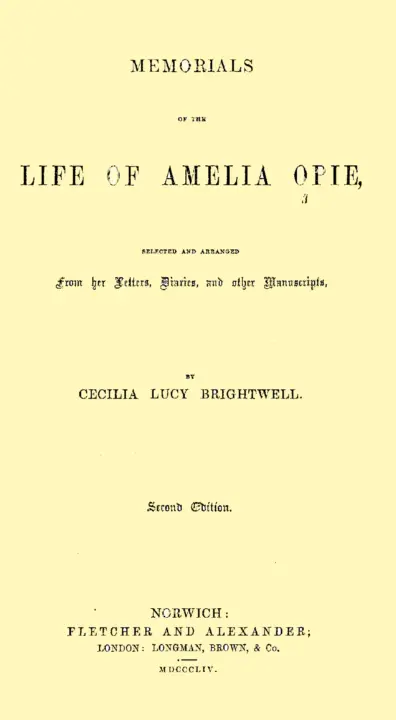
THE CLASSIC COLLECTION · 1854
"Memorials of the Life of Amelia Opie" by Amelia Opie is a biographical memoir written in the mid-19th century. The work compiles the life and experiences of Amelia Opie, detailing her upbringing, family influences, and significant events that shaped her character and artistic pursuits. Through this memoir, readers gain insight into her personal reflections, relationships, and the social context of her time. The opening of the memoir introduces the reader to Opie's early life, focusing on her birth, parentage, and formative years in Norwich. It emphasizes her close bond with her father, Dr. James Alderson, following the death of her mother when Amelia was a child. As she recounts her childhood experiences, including her early fears and her mother's methods of nurturing her, the foundation for Opie's lifelong values of compassion and benevolence emerges. The narrative sets the stage for exploring her interests in literature and social issues, as well as her eventual prominence as a writer and artist. This opening portion memorably blends personal narrative with broader themes of family, loss, and the shaping of one's character through early experiences.
Introduction adapted from the source catalogue; source summaries may be automatically generated.
Free to read · English · 139,153 words · No account needed
MAKE TIME FOR A GOOD BOOK
On by default. Untick to stop anonymous reading totals. Each page counts after 10 seconds in view. How this works.
Anonymous counting is on unless you have switched it off.
(14th.) A night of cough, but of comfort; and rose in spirits; a painfully windy walk to meeting; an agreeable surprise there. J. J. G. returned this morning unexpectedly from London. He was much favoured in his ministry to-day, morning and evening. Called on poor old B., and read the 43rd of Isaiah to him. Called on poor P. U., found her very low indeed, and no wonder; these are early times with her yet, poor bereaved being! The sight of such upsetting and destroying grief is very affecting, and I have only too much sympathy with her. We have both lost our earthly all! Was prevented, by the weather, from calling on the M.s, and it was fortunate, as the wind had brought down their chimnies in a most destructive manner, though providentially no lives were lost, as they had taken alarm and removed the children. “His tender mercies are over all his works!” A quiet evening; read to the servants; hope they understood. (15th.) Coughed all night, and unable, alas! to go to E., but when I had recovered the disappointment, passed some tranquil and agreeable hours. I read “Galt’s Life of Wolsey” with interest. To bed thankful, and rather better; could only read a psalm to the servants. (16th.) Rose rather better, but not well enough to go to E.; wrote a great deal of my book, to carry to-morrow, if well enough to go. Read through my own “Temper,” never saw so many faults in it before; still I like some of the remarks on detraction so well, that I think of inserting them in my new book. Shall lay my head on my pillow with less self-blame for the faults of the day than usual. (17th.) Rose refreshed, and better than for many days; went to E., and enjoyed being with my dear friends again. I had a long tête à tête with J. J. G., and read my MS. to him, he did not approve it as a whole; thought the tone too low generally, but liked parts of it; I shall leave out and amend much. Read a psalm in my own room to my maid, and went to bed full of good resolutions, and ardent desires and prayers to be satisfied in them. (18th.) Rose refreshed, not gay, but very peaceful; went to meeting, very still and solemn; a time of precious, conscious favour to me. J. J. G. spoke quite to my state, the first time he rose; and I felt the force of the admonition the second time; but I had had no work to do, and left meeting, so far, with a clean conscience. I called on friends, and sat some time with my aunt, E. A.; to bed with much comfort and thankfulness. (19th.) To Earlham with J. J. G., and read my MS. to him and the sisters; they were all very encouraging; with what a thankful heart I am going to rest! (21st.) Left Earlham grateful for many happy hours spent there. Came to meeting; J. J. G. particularly favoured in his ministry; painful to me to break up. Alone all the afternoon and evening; read in the Italian Bible; am going to bed comforted and thankful; but had, at morning meeting, one of my paroxysms of regret for ill-fulfilled duties, and was brought very low; “but He helped me,” and all is peace again, and I shall lie down in quiet. (22nd.) An unsatisfactory day, except as I read in my Italian Bible, and to the servants. (23rd.) Tranquil at rising, and wrote all the morning, till I went to E., where I met Lady H. G., D. G., and dear A. G.; a happy day! and am going to bed thankful. (24th.) Obliged to leave E., preferred doing so; I wanted to go home to draw U. M. for her dying lover; I succeeded entirely, they thought; felt thankful to be so enabled. (25th.) To meeting, a marriage there. I went a round of visiting invalid friends, and a poor woman; in the afternoon, went out again and visited another afflicted invalid. Felt my mind tenderly impressed with pity, and with thankfulness for my own health. Saw dear O. A. Woodhouse, glad to see him for many sakes; evening, wrote, and to bed at eleven, most thankful and peaceful. (26th.) Going to dine at E. with a crowd.—The party tolerably agreeable, considering its size; a day, not entirely lost, I trust. (27th.) Went to the jail, and had a satisfactory meeting with the women there. To bed not satisfied with myself. (28th.) Meeting a most favoured one; dear J. J. G. very impressive and affecting, with a view to his departure for Ireland; wrote to H. G., and received from him a most satisfactory answer, authorizing me to draw on him for ——’s wants; how kind! like him! thankful am I, that I have been the means of serving her! to bed peaceful and thankful. (30th.) Rose well and happy, and settled my weekly accounts; in the evening wrote letters. I have been comforted all day through the tender sorrowful remembrance of him who is gone; and the memory of his deep and ever-enduring and unselfish love, is frequently recurring and clinging to me; and death alone, I believe, can ever banish him from my daily and fond, grateful recollection; but, “it is well;” I can say so, from the bottom of my heart, and though I remain, I murmur not—now to bed, with thankfulness, though with tears.
Your reading position is saved on this browser. Take it to another device with a library code. Reading pages adapt to text, rather than matching a printed edition.
BEHIND THE BOOK
This eBook is for the use of anyone anywhere in the United States and most other parts of the world at no cost and with almost no restrictions whatsoever. You may copy it, give it away or re-use it under the terms of the Project Gutenberg License included with this eBook or online at www.gutenberg.org. If you are not located in the United States, you will have to check the laws of the country where you are located before using this eBook. Read the source licence.
The original source file, including credits and licence, is retained by this library. Request an original-format copy at no charge. Please include the book title and Project Gutenberg identifier #47595.
KEEP YOUR CURIOSITY GOING
John L. Ransom

Herman W. Mudgett

Harriet Monroe
Daniel Dulany Addison
Charles Lanman

Harold Rosher