THE CLASSIC COLLECTION✦Andersonville diaryCLASSIC FREE BOOKS
Andersonville diary
John L. Ransom
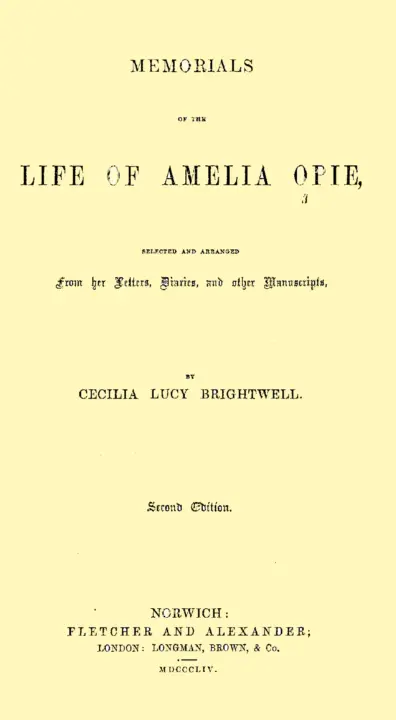
THE CLASSIC COLLECTION · 1854
"Memorials of the Life of Amelia Opie" by Amelia Opie is a biographical memoir written in the mid-19th century. The work compiles the life and experiences of Amelia Opie, detailing her upbringing, family influences, and significant events that shaped her character and artistic pursuits. Through this memoir, readers gain insight into her personal reflections, relationships, and the social context of her time. The opening of the memoir introduces the reader to Opie's early life, focusing on her birth, parentage, and formative years in Norwich. It emphasizes her close bond with her father, Dr. James Alderson, following the death of her mother when Amelia was a child. As she recounts her childhood experiences, including her early fears and her mother's methods of nurturing her, the foundation for Opie's lifelong values of compassion and benevolence emerges. The narrative sets the stage for exploring her interests in literature and social issues, as well as her eventual prominence as a writer and artist. This opening portion memorably blends personal narrative with broader themes of family, loss, and the shaping of one's character through early experiences.
Introduction adapted from the source catalogue; source summaries may be automatically generated.
Free to read · English · 139,153 words · No account needed
MAKE TIME FOR A GOOD BOOK
On by default. Untick to stop anonymous reading totals. Each page counts after 10 seconds in view. How this works.
Anonymous counting is on unless you have switched it off.
Two o’clock. I have lived more in two or three hours to-day than I usually live in a month. I have been to Peru, to Mexico, climbing the Table Mountain, besides hearing much on all subjects, amusing, instructive, and interesting. This charming Chamberlain of Frederick William (I mean the King of Prussia) goes to-day; but I am to see his brother, who is now appointed ambassador from Prussia to France, on Sunday certainly, if not before. * * *
(Rest of letter lost.)
Thursday, July 1st, 1814.
MY DEAR FATHER,
I would not write yesterday, that I might acknowledge the receipt of the parcel to-day. I had no idea they could all come together, meat and clothes. Gregory is not a Catholic. We may go in fancy dresses, but all must wear a mask; though no one is forced to assume a character. The verses I sent you were tame enough; but those I have since written, if I had not been forced to introduce the name of Wellington, with my own approbation, and at the suggestion of a very good critic, (Col. Barry,) are tolerably good, I think. Mrs. B. S. has undertaken to sing them, and, if she can’t adapt, to set them herself. Lady Cork has given me a most beautiful trimming for the bottom of a dress which I am to wear on the 4th. It is really handsome; a wreath of white satin flowers worked upon net.
Our day on Tuesday was delightful, the scene enchanting. My favourite companion there was Sir William Dunbar, more odd, but more amusing and original, than ever. Still, however pleasant the people at Fulham, M. and I enjoyed the drive to and fro, more than the day itself. James Smith went with us, and he sang funny songs, and repeated epigrams and bon mots all the way there. While waiting in the hall for the carriage, (for we wisely came away at eleven,) he gave us an extempore comedy; and, when in the carriage, on my telling him that Sir W. Dunbar had told me he was blasé with everything, and that he was a disappointed man; he said; “It is evident that he is so; I dare say there is something interesting and particular in his story; suppose I invent one for him.” So off he set, and gave us three letters of a novel in letters, and, without pausing a moment, beginning, “Sir W. Dunbar to General Evelyn.—When we last parted, my dear General, I was in the prime of life; every hope full of vigour,” &c., &c., and during the last mile or two, he relieved the monotony which was stealing over all this, by quotations from Young and Swift, well remembered and well repeated. Certainly, never did a man so completely pay, by his brains, for a seat in a carriage. I persuaded Edward to dance with Miss M., having vainly tried to persuade Sir W. D., though he owned her to be very pretty, as did Edward. We left them dancing. The baron, William de Humboldt, was forced to attend Lord Castlereagh in a conference of nine hours, yesterday; therefore he wrote me an elegant note of excuse for not going to see Mrs. Siddons with me, calling me “Mademoiselle Opie;”—no doubt from my juvenile appearance. So we walked over to tell Mrs. Siddons this, and she was somewhat mortified; but recovered herself, and was most delightful. We staid two hours and more, and we none of us knew how late it was. She said she had passed a most happy two hours, and had no regrets. M. came home raving all the way, saying she was the most beautiful, delightful, agreeable, and, I believe, even the youngest woman she ever saw; and she has put up in paper, the bud of a rose she gave her, to keep for ever. Yesterday we dined at H. G.’s, and went to the Maxwells’ in the evening. Old Albinia, of Buckinghamshire, has made me promise to go to her masquerade breakfast, and en masque. I owe her this, for her kindness to me, when I sang to the Prince. On Sunday we were to dine at the Solicitor-General’s, in Bloomsbury Square; but it is now put off to Sunday se’nnight, at Wimbledon. As I was offered a ticket for the ball to the Duke of Wellington for £4 7s., I accepted the offer, and wrote my last commands to Lord Tamworth; so I hope I did not write too late to prevent the exchange. I go full dressed, but no train, and high feathers; with a pink domino of calico, made high and long, to give me height and disguise me, thrown over all, that I may be incog., and be masked till I am tired, and then appear as myself. Mrs. P. goes with us. I have had the kindest letter from Mr. Coke! promising to do all he can for Mr. D., and entreating me to visit him in the winter, whenever I choose.[19]—I have just room to insert the lines.
Your reading position is saved on this browser. Take it to another device with a library code. Reading pages adapt to text, rather than matching a printed edition.
BEHIND THE BOOK
This eBook is for the use of anyone anywhere in the United States and most other parts of the world at no cost and with almost no restrictions whatsoever. You may copy it, give it away or re-use it under the terms of the Project Gutenberg License included with this eBook or online at www.gutenberg.org. If you are not located in the United States, you will have to check the laws of the country where you are located before using this eBook. Read the source licence.
The original source file, including credits and licence, is retained by this library. Request an original-format copy at no charge. Please include the book title and Project Gutenberg identifier #47595.
KEEP YOUR CURIOSITY GOING
John L. Ransom

Herman W. Mudgett

Harriet Monroe
Daniel Dulany Addison
Charles Lanman

Harold Rosher