THE CLASSIC COLLECTION✦Andersonville diaryCLASSIC FREE BOOKS
Andersonville diary
John L. Ransom
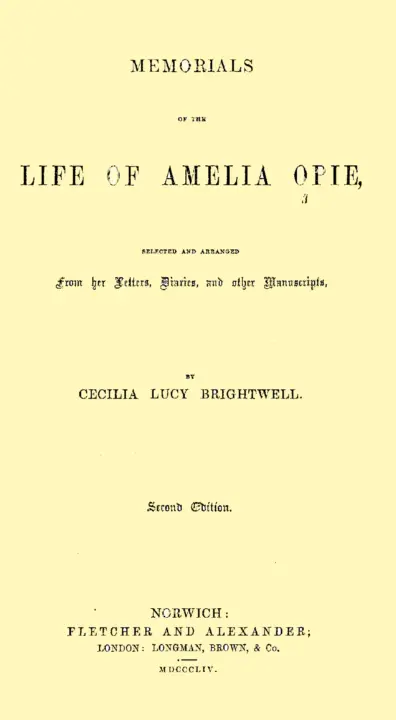
THE CLASSIC COLLECTION · 1854
"Memorials of the Life of Amelia Opie" by Amelia Opie is a biographical memoir written in the mid-19th century. The work compiles the life and experiences of Amelia Opie, detailing her upbringing, family influences, and significant events that shaped her character and artistic pursuits. Through this memoir, readers gain insight into her personal reflections, relationships, and the social context of her time. The opening of the memoir introduces the reader to Opie's early life, focusing on her birth, parentage, and formative years in Norwich. It emphasizes her close bond with her father, Dr. James Alderson, following the death of her mother when Amelia was a child. As she recounts her childhood experiences, including her early fears and her mother's methods of nurturing her, the foundation for Opie's lifelong values of compassion and benevolence emerges. The narrative sets the stage for exploring her interests in literature and social issues, as well as her eventual prominence as a writer and artist. This opening portion memorably blends personal narrative with broader themes of family, loss, and the shaping of one's character through early experiences.
Introduction adapted from the source catalogue; source summaries may be automatically generated.
Free to read · English · 139,153 words · No account needed
MAKE TIME FOR A GOOD BOOK
On by default. Untick to stop anonymous reading totals. Each page counts after 10 seconds in view. How this works.
Anonymous counting is on unless you have switched it off.
In the following year (1813) appeared the “Tales of Real Life;” they were published (unlike her former works) without a paragraph, introductory or dedicatory. There is, as usual, much inequality in the merits of the various stories composing the series; “Lady Anne and Lady Jane” occupies the whole of the first volume, and is, perhaps, on the whole, equal, or superior, to any tale she wrote. The one entitled, “Love and Duty,” was a favourite with herself.
In a former chapter, reference has been made to an interview Mrs. Opie had with Lord Erskine, at the house of Madame de Staël during this year; she has given another short account of an evening visit to that celebrated woman, which we subjoin:—
I had been spending the evening at a soirée, given by Madame de Staël, during the year 1813, which was particularly interesting, from its having been composed chiefly of the élite of London society. That admirable man, W. Wilberforce, had been among the dinner guests, but was gone before I arrived; there were, however, many still left, some of whom threw over the circle the spell of beauty, and others that of their high talents. Lady Crewe, Lord Dudley, William Spencer, the Mackintoshes, the Romillys, were among the brilliant group, who, witty themselves, were the cause of wit in others; and, while they grouped around her, called forth the ever-ready repartees, and almost unrivalled eloquence, of our hostess. She had recently left the court of Bernadotte, and from time to time indulged herself in descanting in his praise. At length she produced a portrait in miniature of her favourite, painted in profile; and, when it had gone round the greater part of the circle, she put it into the hand of Sir Henry Englefield, well known as a man of virtu, science, and taste for the fine arts; and, while she stood by the side of the chair on which he was indolently lounging, she evidently awaited, with much anxiety, the result of his examination. Carefully and long did he examine the painting, and then, holding it up to the light which hung near him, he observed with a slow distinct utterance, and in rather loud voice, “he is like a ferocious sheep!” on which, uttering an exclamation of justly indignant surprise, Madame de Staël snatched the miniature from him, and turned hastily away. I turned away also, for I could not help smiling because, though displeased at Sir Henry’s want of courtesy I felt the truth of the remark; for I had examined the picture, and seen, with no admiring eye, the long projecting nose, and the receding chin, so truly the profile of a sheep; the eye, too, was black, but it did not, like a sheep’s eye, resemble a blockhead when seen sideways; on the contrary, it was bright and piercing, as a friend would have said, but it was easy for an enemy of the Swedish Prince (and such I concluded Sir H. was) to have called the expression ferocious. But the incident and its effects were soon forgotten; and the circle had not lost its charm, when, reminded by a pendule of the lateness of the hour, I had placed myself near the door, and was watching an opportunity to retire unseen, as the door opened; and unannounced, and unattended, a shortish, middle-sized, and middle-aged man entered the room, and, finding himself unobserved, did not advance further than where I was. I was struck by the plainness of his dress and his unpretending appearance, altogether, yet his manner was dignified rather than otherwise; and I was wondering who he could be, when our hostess saw him, and ran up to him with a degree of delighted yet respectful welcome, which instantly proclaimed him to be somebody. In a short time he was seen by others, and he had soon a little court around him; but who he was I could not yet discover; however, I delayed my departure, and joining the circle, heard him converse with a simplicity consonant to his manner and appearance.
Your reading position is saved on this browser. Take it to another device with a library code. Reading pages adapt to text, rather than matching a printed edition.
BEHIND THE BOOK
This eBook is for the use of anyone anywhere in the United States and most other parts of the world at no cost and with almost no restrictions whatsoever. You may copy it, give it away or re-use it under the terms of the Project Gutenberg License included with this eBook or online at www.gutenberg.org. If you are not located in the United States, you will have to check the laws of the country where you are located before using this eBook. Read the source licence.
The original source file, including credits and licence, is retained by this library. Request an original-format copy at no charge. Please include the book title and Project Gutenberg identifier #47595.
KEEP YOUR CURIOSITY GOING
John L. Ransom

Herman W. Mudgett

Harriet Monroe
Daniel Dulany Addison
Charles Lanman

Harold Rosher