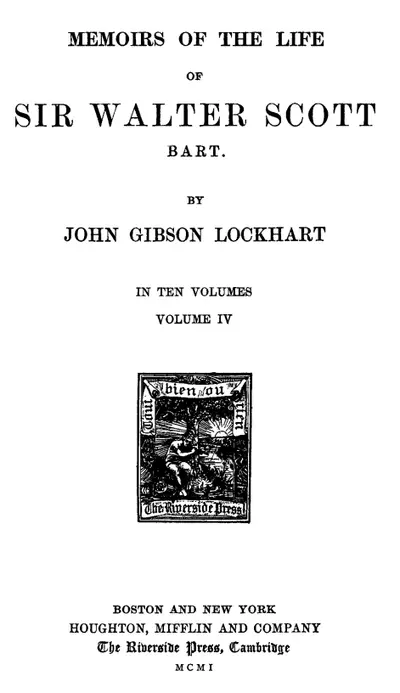
Memoirs of the Life of Sir Walter Scott, Volume 4 (of 10)
J. G. (John Gibson) Lockhart
THE CLASSIC COLLECTION · 1901
"Memoirs of the Life of Sir Walter Scott, Volume 6 (of 10)" by J. G. Lockhart is a biographical account written in the late 19th century. This volume chronicles significant events in the life of Sir Walter Scott, a prominent Scottish novelist, poet, and playwright. The text delves into various aspects of his life, including his declining health, personal relationships, and literary career, providing readers with a nuanced understanding of Scott's experiences during the periods of both triumph and adversity. At the start of this volume, the narrative introduces the troubling health of Charles, Duke of Buccleuch, a close friend of Scott, which sets a somber tone for the reflections ahead. Scott expresses deep concern for the Duke’s failing health in a letter, evidencing the profound bonds of friendship that he values. The opening also touches upon various literary endeavors Scott was engaged in, despite his own physical struggles, including mentions of upcoming works and collaborations, underscoring his devotion to his craft and his resilience in facing life’s challenges. This opening paints a picture of a man grappling with his mortality while remaining actively engaged in the world around him, leaving readers eager to explore more of his life story.
Introduction adapted from the source catalogue; source summaries may be automatically generated.
Free to read · English · 110,609 words · No account needed
MAKE TIME FOR A GOOD BOOK
On by default. Untick to stop anonymous reading totals. Each page counts after 10 seconds in view. How this works.
Anonymous counting is on unless you have switched it off.
Before this letter reached Lord Montagu, his brother had sailed for Lisbon. The Duke of Wellington had placed his house in that capital (the Palace das Necessidades) at the Duke of Buccleuch's disposal; and in the affectionate care and cheerful society of Captain Ferguson, the invalid had every additional source of comfort that his friends could have wished for him. But the malady had gone too far to be arrested by a change of climate; and the letter which he had addressed to Scott, when about to embark at Portsmouth, is endorsed with these words: "The last I ever received from my dear friend the Duke of Buccleuch.--Alas! alas!" The principal object of this letter was to remind Scott of his promise to sit to Raeburn for a portrait, to be hung up in that favorite residence where the Duke had enjoyed most of his society. "My prodigious undertaking," writes his Grace, "of a west wing at Bowhill, is begun. A library of forty-one feet by twenty-one is to be added to the present drawing-room. A space for one picture is reserved over the fireplace, and in this warm situation I intend to place the Guardian of Literature. I should be happy to have my friend Maida appear. It is now almost proverbial, 'Walter Scott and his Dog.' Raeburn should be warned that I am as well acquainted with my friend's hands and arms as with his nose--and Vandyke was of my opinion. Many of R.'s works are shamefully finished--the face studied, but everything else neglected. This is a fair opportunity of producing something really worthy of his skill."
I shall insert by and by Scott's answer--which never reached the Duke's hand--with another letter of the same date to Captain Ferguson; but I must first introduce one, addressed a fortnight earlier to Mr. Southey, who had been distressed by the accounts he received of Scott's health from an American traveller, Mr. George Ticknor of Boston--a friend, and worthy to be such, of Mr. Washington Irving.[18] The Poet Laureate, by the way, had adverted also to an impudent trick of a London bookseller, who shortly before this time announced certain volumes of Grub Street manufacture, as "A New Series of the Tales of my Landlord," and who, when John Ballantyne, as the "agent for the Author of Waverley," published a declaration that the volumes thus advertised were not from that writer's pen, met John's declaration by an audacious rejoinder--impeaching his authority, and asserting that nothing but the personal appearance in the field of the gentleman for whom Ballantyne pretended to act, could shake his belief that he was himself in the confidence of the true Simon Pure.[19] This affair gave considerable uneasiness at the time, and for a moment the dropping of Scott's mask seems to have been pronounced advisable by both Ballantyne and Constable. But he was not to be worked upon by such means as these. He calmly replied, "The author who lends himself to such a trick must be a blockhead--let them publish, and that will serve our purpose better than anything we ourselves could do." I have forgotten the names of the "tales," which, being published accordingly, fell still-born from the press. Mr. Southey had likewise dropped some allusions to another newspaper story of Scott's being seriously engaged in a dramatic work--a rumor which probably originated in the assistance he had lent to Terry in some of the recent highly popular adaptations of his novels to the purposes of the stage; though it is not impossible that some hint of the Devorgoil matter may have transpired. "It is reported," said the Laureate, "that you are about to bring forth a play, and I am greatly in hopes it may be true; for I am verily persuaded that in this course you might run as brilliant a career as you have already done in narrative--both in prose and rhyme;--for as for believing that you have a double in the field--not I! Those same powers would be equally certain of success in the drama, and were you to give them a dramatic direction, and reign for a third seven years upon the stage, you would stand alone in literary history. Indeed already I believe that no man ever afforded so much delight to so great a number of his contemporaries in this or in any other country. God bless you, my dear Scott, and believe me ever yours affectionately, R. S." Mr. Southey's letter had further announced his wife's safe delivery of a son; the approach of the conclusion of his History of Brazil; and his undertaking of the Life of Wesley.
Your reading position is saved on this browser. Take it to another device with a library code. Reading pages adapt to text, rather than matching a printed edition.
J. G. (John Gibson) Lockhart
J. G. (John Gibson) Lockhart
J. G. (John Gibson) Lockhart
BEHIND THE BOOK
This eBook is for the use of anyone anywhere in the United States and most other parts of the world at no cost and with almost no restrictions whatsoever. You may copy it, give it away or re-use it under the terms of the Project Gutenberg License included with this eBook or online at www.gutenberg.org. If you are not located in the United States, you will have to check the laws of the country where you are located before using this eBook. Read the source licence.
The original source file, including credits and licence, is retained by this library. Request an original-format copy at no charge. Please include the book title and Project Gutenberg identifier #37631.
KEEP YOUR CURIOSITY GOING
John L. Ransom

Herman W. Mudgett

Harriet Monroe
Daniel Dulany Addison
Charles Lanman

Harold Rosher