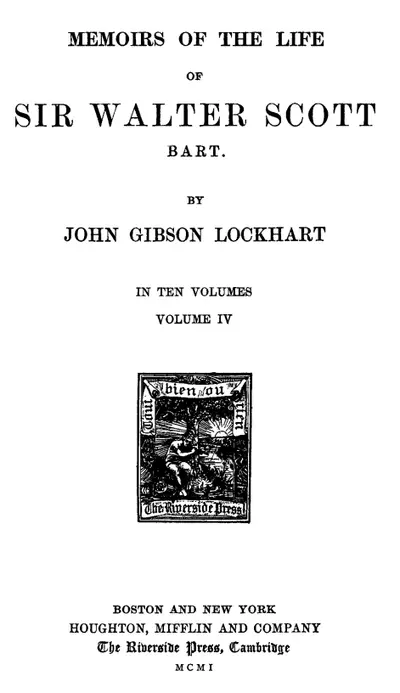
Memoirs of the Life of Sir Walter Scott, Volume 4 (of 10)
J. G. (John Gibson) Lockhart
THE CLASSIC COLLECTION · 1901
"Memoirs of the Life of Sir Walter Scott, Volume 5 (of 10)" by John Gibson Lockhart is a historical account written in the early 20th century. This volume delves into the life and works of Sir Walter Scott, a prominent Scottish novelist, poet, and playwright, chronicling significant events in his literary career and personal life during the early 19th century, particularly focusing on his ongoing writing projects and interactions with contemporaries like Lord Byron. The opening of this volume introduces readers to Scott's literary endeavors and correspondence as he progresses with "The Lord of the Isles" and begins a new novel, "Guy Mannering." It highlights his relationships with fellow writers, readers' responses to his works, and his participation in significant historical moments like the Battle of Waterloo. Lockhart sets the stage for a deeper exploration of Scott's influence on Scottish literature, his creative processes, and the challenges he faced as he balanced his literary ambitions with mounting personal and financial pressures.
Introduction adapted from the source catalogue; source summaries may be automatically generated.
Free to read · English · 106,746 words · No account needed
MAKE TIME FOR A GOOD BOOK
On by default. Untick to stop anonymous reading totals. Each page counts after 10 seconds in view. How this works.
Anonymous counting is on unless you have switched it off.
Before I ever met Scott in private, I had, of course, heard many people describe and discuss his style of conversation. Everybody seemed to agree that it overflowed with hearty good-humor, as well as plain unaffected good sense and sagacity; but I had heard not a few persons of undoubted ability and accomplishment maintain that the genius of the great poet and novelist rarely, if ever, revealed itself in his talk. It is needless to say, that the persons I allude to were all his own countrymen, and themselves imbued, more or less, with the conversational habits derived from a system of education in which the {p.244} study of metaphysics occupies a very large share of attention. The best table-talk of Edinburgh was, and probably still is, in a very great measure made up of brilliant disquisition--such as might be transferred without alteration to a professor's note-book, or the pages of a critical Review--and of sharp word-catchings, ingenious thrusting and parrying of dialectics, and all the quips and quibblets of bar pleading. It was the talk of a society to which lawyers and lecturers had, for at least a hundred years, given the tone. From the date of the Union, Edinburgh ceased to be the headquarters of the Scotch nobility--and long before the time of which I speak, they had all but entirely abandoned it as a place of residence. I think I never knew above two or three of the Peerage to have houses there at the same time--and these were usually among the poorest and most insignificant of their order. The wealthier gentry had followed their example. Very few of that class ever spent any considerable part of the year in Edinburgh, except for the purposes of educating their children, or superintending the progress of a lawsuit; and these were not more likely than a score or two of comatose and lethargic old Indians, to make head against the established influences of academical and forensic celebrity. Now Scott's tastes and resources had not much in common with those who had inherited and preserved the chief authority in this provincial hierarchy of rhetoric. He was highly amused with watching their dexterous logomachies--but his delight in such displays arose mainly, I cannot doubt, from the fact of their being, both as to subject-matter and style and method, remote a Scaevolae studiis. He sat by, as he would have done at a stage-play or a fencing-match, enjoying and applauding the skill exhibited, but without feeling much ambition to parade himself as a rival either of the foil or the buskin. I can easily believe, therefore, that in the earlier part of his life--before the blaze of universal fame had overawed {p.245} local prejudice, and a new generation, accustomed to hear of that fame from their infancy, had grown up--it may have been the commonly adopted creed in Edinburgh, that Scott, however distinguished otherwise, was not to be named as a table-companion in the same day with this or that master of luminous dissertation or quick rejoinder, who now sleeps as forgotten as his grandmother. It was natural enough that persons brought up in the same circle with him, who remembered all his beginnings, and had but slowly learned to acquiesce in the justice of his claim to unrivalled honor in literature, should have clung all the closer for that late acquiescence to their original estimate of him as inferior to themselves in other titles to admiration. It was also natural that their prejudice on that score should be readily taken up by the young aspirants who breathed, as it were, the atmosphere of their professional renown. Perhaps, too, Scott's steady Toryism, and the effect of his genius and example in modifying the intellectual sway of the long dominant Whigs in the north, may have had some share in this matter. However all that may have been, the substance of what I had been accustomed to hear certainly was, that Scott had a marvellous stock of queer stories, which he often told with happy effect, but that, bating these drafts on a portentous memory, set off with a simple old-fashioned naivete of humor and pleasantry, his strain of talk was remarkable neither for depth of remark nor felicity of illustration; that his views and opinions on the most important topics of practical interest were hopelessly perverted by his blind enthusiasm for the dreams of bygone ages; and that, but for the grotesque phenomenon presented by a great writer of the nineteenth century gravely uttering sentiments worthy of his own Dundees and Invernahyles, the main texture of his discourse would be pronounced, by any enlightened member of modern society, rather bald and poor than otherwise. I think the epithet most in vogue was commonplace.
Your reading position is saved on this browser. Take it to another device with a library code. Reading pages adapt to text, rather than matching a printed edition.
J. G. (John Gibson) Lockhart
J. G. (John Gibson) Lockhart
J. G. (John Gibson) Lockhart
BEHIND THE BOOK
This eBook is for the use of anyone anywhere in the United States and most other parts of the world at no cost and with almost no restrictions whatsoever. You may copy it, give it away or re-use it under the terms of the Project Gutenberg License included with this eBook or online at www.gutenberg.org. If you are not located in the United States, you will have to check the laws of the country where you are located before using this eBook. Read the source licence.
The original source file, including credits and licence, is retained by this library. Request an original-format copy at no charge. Please include the book title and Project Gutenberg identifier #24498.
KEEP YOUR CURIOSITY GOING
Cécile Tormay

Moritz Busch
John L. Ransom
Frances Wright
Cécile Tormay

Mabel Potter Daggett