THE CLASSIC COLLECTION✦The secrets of stage conjuringCLASSIC FREE BOOKS
The secrets of stage conjuring
Jean-Eugène Robert-Houdin
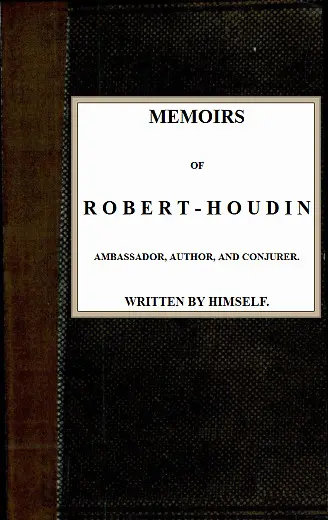
THE CLASSIC COLLECTION · 1859
"Memoirs of Robert-Houdin, Ambassador, Author, and Conjurer" by Robert-Houdin is an autobiographical account penned in the mid-19th century. The work chronicles the life of Jean-Eugène Robert-Houdin, a prominent magician who is often referred to as the father of modern magic. The memoir provides insight into his beginnings, passion for mechanical invention, and his rise to fame as he navigates the world of conjuring and magic performance." "The opening of the memoir introduces us to Robert-Houdin’s formative years in Blois, France. He reflects on the influence of his father, a skilled watchmaker, and shares anecdotes from his childhood, including a humorous account of attempting to capture a rat as a mechanical insect for his experiments. The narrative establishes a foundation for his deep interest in mechanics and magic. We see his early inclination toward invention and the support he received that would eventually lead him to pursue a career in conjuring, setting the stage for the subsequent unraveling of his journey into the world of illusions and performance."
Introduction adapted from the source catalogue; source summaries may be automatically generated.
Free to read · English · 125,724 words · No account needed
MAKE TIME FOR A GOOD BOOK
On by default. Untick to stop anonymous reading totals. Each page counts after 10 seconds in view. How this works.
Anonymous counting is on unless you have switched it off.
All eyes were naturally turned on the cardinal, who, it was known, set great value on the exaggerated size of his chronometer. He asserted, with some show of reason perhaps, that the works acted more freely in a large case. However, he hesitated to lend me his beloved watch, till Pius VII. said to him:
“Cardinal, I fancy your watch will suit exactly; oblige me by handing it
to M. de Grisy.”
His eminence assented, though not without numberless precautions; and when I had the chronometer in my hands, I drew the attention of the Pope and the cardinals to it, while pretending to admire the works and handsome chasing.
“Is your watch a repeater?” I then said to the cardinal.
“No, sir, it is a chronometer, and watches of that degree of accuracy are not usually encumbered with unnecessary machinery.”
“Indeed! a chronometer; then it must be English?” I said, with apparent
simplicity.
“What, sir?” the cardinal replied, as if stung by my remark, “do you think chronometers are only made in England? On the contrary, the best specimens have always been made in France. What English maker can be compared with Pierre Leroy, Ferdinand Berthoud, or Brèguet above all, who made that chronometer for me?”
The Pope began to smile at the cardinal’s energy.
“Well, then, we will select this chronometer,” I said, putting a stop to the conversation I had purposely started. “I have, then, gentlemen, to prove to you its solidity and excellent qualities. Now for the first trial.”
And I let the watch fall to the ground. A cry of terror rose on all sides, while the cardinal, pale and trembling, bounded from his seat, saying, with ill-suppressed wrath,
“You are playing a very sorry jest, sir.”
“But, monseigneur,” I said, with the greatest calmness, “you have no occasion to be frightened; I merely wish to prove to these gentlemen the perfection of your watch. I beg you not to be alarmed; it will escape scathless from all the trials I subject it to.”
With these words I stamped on the case, which broke, flattened, and soon presented but a shapeless mass. At first, I really fancied the cardinal was going into a fit; he could scarcely restrain his passion; but the Pope then turned to him:
“Come, cardinal, have you no confidence in our sorcerer? For my part, I laugh like a child at it, being convinced there has been some clever substitution.”
“Will your Holiness permit me to remark,” I said, respectfully, “that there has been no substitution? I appeal to his eminence, who will recognise his own watch.”
Your reading position is saved on this browser. Take it to another device with a library code. Reading pages adapt to text, rather than matching a printed edition.
BEHIND THE BOOK
This eBook is for the use of anyone anywhere in the United States and most other parts of the world at no cost and with almost no restrictions whatsoever. You may copy it, give it away or re-use it under the terms of the Project Gutenberg License included with this eBook or online at www.gutenberg.org. If you are not located in the United States, you will have to check the laws of the country where you are located before using this eBook. Read the source licence.
The original source file, including credits and licence, is retained by this library. Request an original-format copy at no charge. Please include the book title and Project Gutenberg identifier #42916.
KEEP YOUR CURIOSITY GOING
John L. Ransom

Herman W. Mudgett

Harriet Monroe
Daniel Dulany Addison
Charles Lanman

Harold Rosher