THE CLASSIC COLLECTION✦The secrets of stage conjuringCLASSIC FREE BOOKS
The secrets of stage conjuring
Jean-Eugène Robert-Houdin
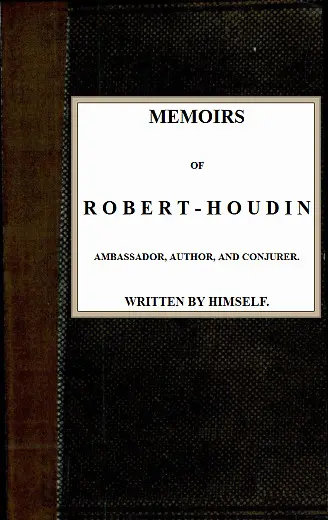
THE CLASSIC COLLECTION · 1859
"Memoirs of Robert-Houdin, Ambassador, Author, and Conjurer" by Robert-Houdin is an autobiographical account penned in the mid-19th century. The work chronicles the life of Jean-Eugène Robert-Houdin, a prominent magician who is often referred to as the father of modern magic. The memoir provides insight into his beginnings, passion for mechanical invention, and his rise to fame as he navigates the world of conjuring and magic performance." "The opening of the memoir introduces us to Robert-Houdin’s formative years in Blois, France. He reflects on the influence of his father, a skilled watchmaker, and shares anecdotes from his childhood, including a humorous account of attempting to capture a rat as a mechanical insect for his experiments. The narrative establishes a foundation for his deep interest in mechanics and magic. We see his early inclination toward invention and the support he received that would eventually lead him to pursue a career in conjuring, setting the stage for the subsequent unraveling of his journey into the world of illusions and performance."
Introduction adapted from the source catalogue; source summaries may be automatically generated.
Free to read · English · 125,724 words · No account needed
MAKE TIME FOR A GOOD BOOK
On by default. Untick to stop anonymous reading totals. Each page counts after 10 seconds in view. How this works.
Anonymous counting is on unless you have switched it off.
“Yes, gentlemen, yes; you can go in,” Génet replied, making an imperceptible grimace. And he led them in complacently, while striving to explain the emptiness of the room by saying it was only momentary. He had hardly returned to the box-office, when a gentleman of a certain age hurried up the steps, and rushed towards the pay place with a haste my previous success probably justified.
“Is there any room left?” he asked, in a panting voice.
My poor Génet did not know how to reply to this question, which seemed a jest; he, therefore, merely muttered one of those common-place phrases usually employed to gain time.
“Well, sir, to tell you the truth--I should say----“
“I know--I know: there are no places left. I expected it. But be kind enough to let me go in, and I will find some corner to stand in.”
“But, sir, allow me to tell you----“
“No matter.”
“But if, on the contrary----“
“All the better. There, give me a stall-ticket, and I will see if I can find room in the passage.”
Being at the end of his arguments, Génet supplied the ticket.
You can imagine the surprise of the eager visitor when, on entering the house, he found that he formed in his own person exactly a third of the audience.
For my own part, I soon made up my mind. After compounding with my conscience, by granting the usual quarter of an hour’s grace to the laggards, and seeing no one come, I informed my three spectators that, being only anxious to be agreeable to them, I would perform.
This unexpected news produced a triple hurrah in the house in the shape
of thanks.
My orchestra consisted of eight amateurs of the town; and these gentlemen, as a compliment to my French origin, always played as overture the “Girondins” and the “Marseillaise,” with the assistance of the big drum, and never failed to terminate the performance with “God save the Queen.”
The patriotic introduction over, I began my performance.
My audience were collected on the first row of stalls, so that, in order to address my explanations to them, I should have had to keep my head constantly down, which would have eventually become troublesome. Hence I determined to look round the house, and address the benches just as if they were well covered.
For their part, my audience made all possible row to prove their satisfaction. They stamped, applauded, shouted, so as almost to make me believe the house full.
Your reading position is saved on this browser. Take it to another device with a library code. Reading pages adapt to text, rather than matching a printed edition.
BEHIND THE BOOK
This eBook is for the use of anyone anywhere in the United States and most other parts of the world at no cost and with almost no restrictions whatsoever. You may copy it, give it away or re-use it under the terms of the Project Gutenberg License included with this eBook or online at www.gutenberg.org. If you are not located in the United States, you will have to check the laws of the country where you are located before using this eBook. Read the source licence.
The original source file, including credits and licence, is retained by this library. Request an original-format copy at no charge. Please include the book title and Project Gutenberg identifier #42916.
KEEP YOUR CURIOSITY GOING
John L. Ransom

Herman W. Mudgett

Harriet Monroe
Daniel Dulany Addison
Charles Lanman

Harold Rosher