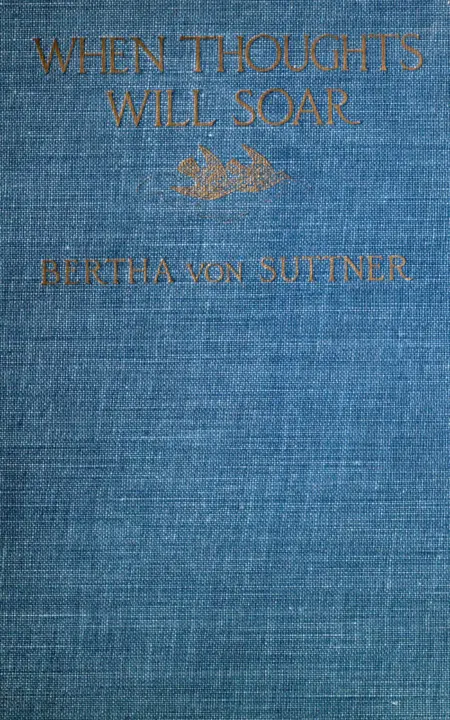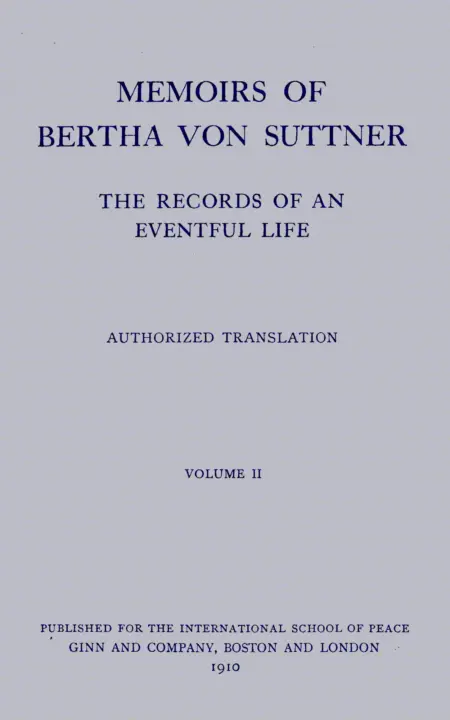
Memoirs of Bertha von Suttner: The Records of an Eventful Life (Vol. 2 of 2)
Bertha von Suttner
THE CLASSIC COLLECTION · 1910
"Memoirs of Bertha von Suttner: The Records of an Eventful Life (Vol. 1 of 2)" is a historical account likely written in the early 20th century. This memoir presents the life story of Bertha von Suttner, a prominent peace activist and writer, intertwining her personal experiences with her involvement in the global peace movement of her time. The book serves as a reflection on her formative years, friendships, and the influences that shaped her views on peace and human rights. At the start of the memoir, Bertha von Suttner shares her baptism certificate and reflects on her childhood memories, including her first awareness of a revolutionary moment in her homeland. She portrays her upbringing in a noble family and describes the various influential figures in her early life, including her guardian, Landgrave Fürstenberg, and her mother. We learn about her developing self-awareness, her interests in literature and music, and her foray into personal relationships, especially her close bond with her cousin Elvira. The opening portion sets the stage for a life marked by a quest for identity and purpose amidst historical upheavals, hinting at her future advocacy for peace.
Introduction adapted from the source catalogue; source summaries may be automatically generated.
Free to read · English · 114,281 words · No account needed
MAKE TIME FOR A GOOD BOOK
On by default. Untick to stop anonymous reading totals. Each page counts after 10 seconds in view. How this works.
Anonymous counting is on unless you have switched it off.
I looked to the future now not with quietude, to be sure, but still with joyful anticipation. Not with quietude—for what if Adolf failed in his plans, or what if he should change his mind while over there ... such things do happen! And with joyous anticipation—for it would be likely to be an interesting, happy life by the side of a fellow-artist, who bore a great name, too, and was a dear, poetic, good-hearted man, to whom I was, if not indeed passionately, yet cordially, attached!
From Bremen had come a farewell telegram full of love, and now several weeks must pass before I could get a letter from New York.
But news of him reached me sooner than I expected,—terrible news. I found in the paper an item only a few lines long, with the heading:
A cable dispatch received by the family of Fürst Wittgenstein, at Castle Wittgenstein, reports that Prince Adolf Wittgenstein, who was on his way to America, suddenly died on board and was buried at sea.
I uttered a shriek, and spent the whole night kneeling by my bed and
sobbing.
The next morning, with the forlorn hope that possibly the tidings were false, I wrote to the family, and received from Adolf’s twin brother the following reply:
Schloss Wittgenstein, November 20, 1872
Liebe verehrte Gräfin Bertha,
How infinitely hard it is for me to send you these lines, for they are to tell you that the report which you read in the papers is true.
Alas, you cannot believe, dear Countess, what unspeakable grief we all, and I especially, feel at the tidings of the sudden death of our dear, good, generous-hearted brother. His heart has ceased to beat! Poor Adolf died, as we learn through the office of the Imperial Chancery, suddenly, on the 30th of October, in consequence of some physical injury apparently caused by terrible seasickness; his dear body was buried at sea. So runs the fatal telegram which reached Berlin from New York on the 6th of November and was transmitted to us on the following day. I cannot tell you, dear Countess, what we felt and suffered at this report; and even now I am not able to realize and believe the frightful fact. I do not know why the God of infinite goodness summons my dearest-beloved twin brother, now in the full bloom of his youth, just as he was on the point of attaining the goal of his desires! O God, how infinitely painful for us who are left bereaved! I know, dear Countess, what grief will fill your heart at these tidings. You too loved my good brother so dearly. Ah, if he had listened to me, he would have remained in Europe and gone to Italy, and later to London. I had all but brought it about. You may perhaps remember, in his letters, how inconsolably he wrote that people did not want him to be happy. One who has no firm faith, and does not assure himself that whatever God does is well done, could not but despair at this so unspeakably sad event. If we might only call our dear Adolf back, if only he could be with us again! The last token of life that my father received from him was from Southampton. On the 23d, I believe, the ship went on from there; on the 28th it reached New York, but without our dear brother—we have not even his beloved body; that thought, that it is in the depths of the sea, is terrible! Three days before the ship arrived, our dear brother departed. I cannot write any more to-day, forgive me, honored Countess. This very week we expect details from the captain and the ship’s surgeon; perhaps also a message of farewell from dear, good-hearted Adolf. My mother has just received your letter; she will certainly write you. I should have been glad to write you, but I did not know your address.
Your reading position is saved on this browser. Take it to another device with a library code. Reading pages adapt to text, rather than matching a printed edition.
BEHIND THE BOOK
This eBook is for the use of anyone anywhere in the United States and most other parts of the world at no cost and with almost no restrictions whatsoever. You may copy it, give it away or re-use it under the terms of the Project Gutenberg License included with this eBook or online at www.gutenberg.org. If you are not located in the United States, you will have to check the laws of the country where you are located before using this eBook. Read the source licence.
The original source file, including credits and licence, is retained by this library. Request an original-format copy at no charge. Please include the book title and Project Gutenberg identifier #66279.
KEEP YOUR CURIOSITY GOING
Cécile Tormay

Moritz Busch
John L. Ransom
Frances Wright
Cécile Tormay

Mabel Potter Daggett