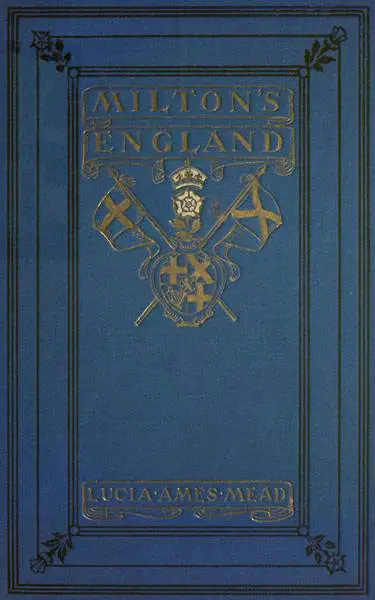
Milton’s England
Lucia True Ames Mead
THE CLASSIC COLLECTION · 1889
"Memoirs of a Millionaire" by Lucia True Ames Mead is a novel written in the late 19th century. The narrative centers around Mildred Brewster, a young woman who unexpectedly inherits a vast fortune, which brings both excitement and a set of new responsibilities. As Mildred navigates her newfound wealth, she grapples with societal expectations and her own ideals about philanthropy and citizenship in America. The opening portion introduces Mildred amid an intimate evening gathering, highlighting her strong character against the backdrop of wealthy yet apathetic young men discussing politics and societal issues. This dynamic sets the stage for a clash of values, particularly when Mildred boldly confronts the indifference of her peers, revealing her passionate convictions about civic duty and responsibility. As Mildred prepares to handle her inheritance, she is portrayed as a person combating societal norms with a desire to use her wealth for the greater good, a theme that foreshadows her philanthropic ambitions while also hinting at the challenges she will face in balancing personal ideals with social realities.
Introduction adapted from the source catalogue; source summaries may be automatically generated.
Free to read · English · 83,081 words · No account needed
MAKE TIME FOR A GOOD BOOK
On by default. Untick to stop anonymous reading totals. Each page counts after 10 seconds in view. How this works.
Anonymous counting is on unless you have switched it off.
“That is to say,” answered Mildred, “can people of different social rank, education, and employments meet socially with mutual profit and pleasure? That, I am convinced, depends entirely upon the tact and spirit of genuine friendliness which is exercised by those of the higher rank.
“Anything that is done perfunctorily is sure to fail, but genuine interest will create genuine interest. It all depends, you see, upon my helpers. Without them my money can do nothing. I can only organize; they must execute. But I am convinced that it is an experiment worth trying.”
“So you are contemplating a social revolution,” said I, as Mildred paused, her cheeks glowing with the excitement of the thought. “Well, sister mine, if ever one is brought about, I think it will be by your way of doing, by trying to put the right people in the right place. After all, I suppose this one little scheme of yours and Ralph’s, that may help to start thousands of lives in a different direction, probably costs no more to permanently endow than what some families would pay for diamonds and horses and yachts for themselves alone.”
“By the way, Ruby,” asked Mildred the next day, as we sat sipping our after-dinner coffee, while Ralph had gone out to see some lawyers, “do you remember the first time I saw you, a little more than a year ago, at aunt Madison’s?”
“Remember? I wonder if I shall ever forget it, or what you said to those three rich good-for-nothing”—
“No,” broke in Mildred, “not ‘good-for-nothing,’ though I fear I thought them so at the time. I fancy I must have spoken pretty savagely, didn’t I?” Then, without waiting for an answer, she continued: “I felt sure, as I thought it over afterwards, that they would hate me, that is, if they took the trouble to think about me at all. But, do you know, I think it really startled them into asking themselves some pretty plain questions.
“It set them to thinking, and” —she continued with a laugh— “I verily believe that I was in a measure the humble means of grace which brought two of them to conviction of sin and led to their conversion.
“Let me read to you part of a letter which cousin Will received and which he forwarded to me,” said she, drawing an envelope from her pocket. “It is from Ned Conro, the one with the blond mustache, you remember.
“He says,—let me see,”—and she glanced down the first page, and, turning the leaf, read aloud:—
“I began for the first time to do a little thinking that last six
months at Cambridge.
Your reading position is saved on this browser. Take it to another device with a library code. Reading pages adapt to text, rather than matching a printed edition.
Lucia True Ames Mead
BEHIND THE BOOK
This eBook is for the use of anyone anywhere in the United States and most other parts of the world at no cost and with almost no restrictions whatsoever. You may copy it, give it away or re-use it under the terms of the Project Gutenberg License included with this eBook or online at www.gutenberg.org. If you are not located in the United States, you will have to check the laws of the country where you are located before using this eBook. Read the source licence.
The original source file, including credits and licence, is retained by this library. Request an original-format copy at no charge. Please include the book title and Project Gutenberg identifier #69678.
KEEP YOUR CURIOSITY GOING
Coulson Kernahan

Maurice Baring
Frances Wright
Cécile Tormay

Frederic Jesup Stimson

W. H. P. (William Henry Pope) Jarvis