THE CLASSIC COLLECTION✦An outlaw’s diary: the CommuneCLASSIC FREE BOOKS
An outlaw’s diary: the Commune
Cécile Tormay
THE CLASSIC COLLECTION · 1820
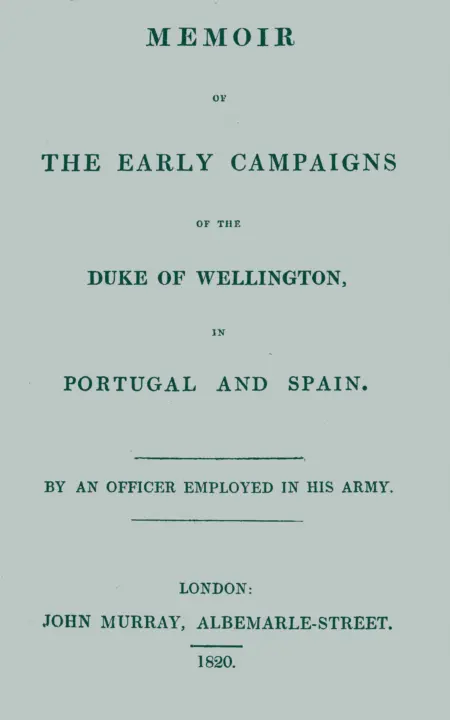
"Memoir of the Early Campaigns of the Duke of Wellington, in Portugal and Spain" by an officer employed in his army is a historical account written in the early 19th century. The book details the initial military efforts under the command of Sir Arthur Wellesley, later known as the Duke of Wellington, during the Peninsular War against French forces. It aims to provide an accurate recounting of the significant events and strategies of the British campaign in Portugal and Spain, which were pivotal in the fight for independence. The opening of the memoir introduces the author, who positions himself as a participant in the campaigns, emphasizing the importance of conveying the experiences and challenges faced during this tumultuous period. It outlines the circumstances leading up to British involvement in the Peninsular War, including the state of Portuguese resistance against French occupation and the initial strategies employed by Wellesley. Highlighting moments of bravery and critical decisions, the beginning chapters set the stage for a gripping historical narrative that reveals not only military maneuvers but also the spirit of resilience among the soldiers and local populations affected by the conflict.
Introduction adapted from the source catalogue; source summaries may be automatically generated.
Free to read · English · 46,628 words · No account needed
MAKE TIME FOR A GOOD BOOK
On by default. Untick to stop anonymous reading totals. Each page counts after 10 seconds in view. How this works.
Anonymous counting is on unless you have switched it off.
The battle commenced by a fire from the light troops of both armies, in advance of the position which was occupied by the allies; a detachment from the corps of Marshal Ney next made an attack upon a village in front of the light division, which was ceded with little opposition; this village, although of importance to the allied army, was without the position in which Lord Wellington had determined to receive the enemy’s attack; he therefore abandoned it, choosing rather to suffer some annoyance from its possession by the enemy, than risk the chance of an action to maintain it, in less advantageous ground than the position he had fixed upon. Marshal Massena was now convinced that he must fight Lord Wellington upon his own ground; he therefore directed General Regnier to advance to the assault of the position in his front, while the 1st division of Marshal Ney’s corps, supported by the other two, and a great proportion of artillery, was ordered to establish itself upon the heights occupied by the light division. General Regnier first brought his corps into action; the British regiments opposed to him had not reached the positions that were assigned to them; and, for a moment, a considerable column of French possessed itself of a point within our line. Major General Picton instantly marched against this column with a few companies which he had collected; Major General Lightburne’s brigade, directed by Lord Wellington, moved upon its right, while the 88th, 45th, and Colonel Douglass’s Regiment of Portuguese, attempted to gain its left; the troops with Major General Picton, however, first dislodged the enemy by a most brilliant attack with the bayonet, driving him, though infinitely superior in numbers, from the strong ground he had got possession of; the other regiments came up in time to harass him in his retreat; and the arrival of Major General Leith’s division, which took place at this moment, convinced General Regnier that he had better discontinue a contest, in which he had so little prospect of success. He withdrew his divisions, therefore, and formed upon the ground from which he had originally moved. During this attack, Marshal Ney formed a part of his corps in column of mass, and directed it to ascend the height upon the right of the village, of which he had before obtained possession. The ground was extremely steep, and the column was but little annoyed in its ascent; as soon, however, as it had gained the summit, the guns attached to the light division opened a most destructive fire upon it, and the division charged it with the bayonet. The column was overthrown in an instant; the riflemen charged its flanks while Major General Crawford pursued it down the hill; the foremost regiments of the column were almost totally destroyed, General Simon wounded and taken and the whole division completely routed. The expression of a French soldier engaged in this attack, who was afterwards taken, “Qu’il se laissa rouler du haut en bas de la montagne, sans savoir comment il échappa,” best explains the mode in which the remnants of this column escaped. The allies pursued it across the valley, and thus put an end to the sanguine expectations of the enemy, and to their boasted promise, of driving us like sheep from our position. The rest of the day was occupied by an incessant fire between the light troops of the two armies; Marshal Massena had placed a considerable number of battalions in the road, which extended along the ravine, at the foot of the ridge on which we were formed; and he had hoped to induce Lord Wellington to reinforce the troops that were engaged with these battalions, and by that means to get him into an action of some consequence, out of the position which he occupied. This system had frequently been successful to the French; the commanders who have been opposed to them have been unwilling to allow their too near approach to their army, and have continued to reinforce the advanced posts, till the greater part of their troops had been drawn into an action, away from the ground on which they had decided to accept a battle; but Lord Wellington was not thus to be imposed upon; he directed the light troops, when pressed, to retire, and to give the enemy an opportunity of attacking his position, if he could persuade himself to do so. At the approach of night, Marshal Massena having lost all hopes of succeeding against the allies, withdrew his troops from the advanced positions he occupied, and placed them at some distance in the rear, near the ground which was occupied by General Junot. Major General Crawford then sent to the officer who commanded in the village, which had been ceded in the morning, telling him that the possession of it was necessary to his corps, and therefore directing him to abandon it. The officer refused, with a declaration that he would die in defence of the post he was intrusted with. Major General Crawford immediately ordered six guns to open upon him, and some companies of the 43d and Rifle Corps to charge the village. The French were instantly driven out of it, and the advanced post of the light division put in possession of it.
Your reading position is saved on this browser. Take it to another device with a library code. Reading pages adapt to text, rather than matching a printed edition.
BEHIND THE BOOK
This eBook is for the use of anyone anywhere in the United States and most other parts of the world at no cost and with almost no restrictions whatsoever. You may copy it, give it away or re-use it under the terms of the Project Gutenberg License included with this eBook or online at www.gutenberg.org. If you are not located in the United States, you will have to check the laws of the country where you are located before using this eBook. Read the source licence.
The original source file, including credits and licence, is retained by this library. Request an original-format copy at no charge. Please include the book title and Project Gutenberg identifier #63792.
KEEP YOUR CURIOSITY GOING
Cécile Tormay

Moritz Busch
John L. Ransom
Frances Wright
Cécile Tormay

Mabel Potter Daggett