THE CLASSIC COLLECTION✦An outlaw’s diary: the CommuneCLASSIC FREE BOOKS
An outlaw’s diary: the Commune
Cécile Tormay
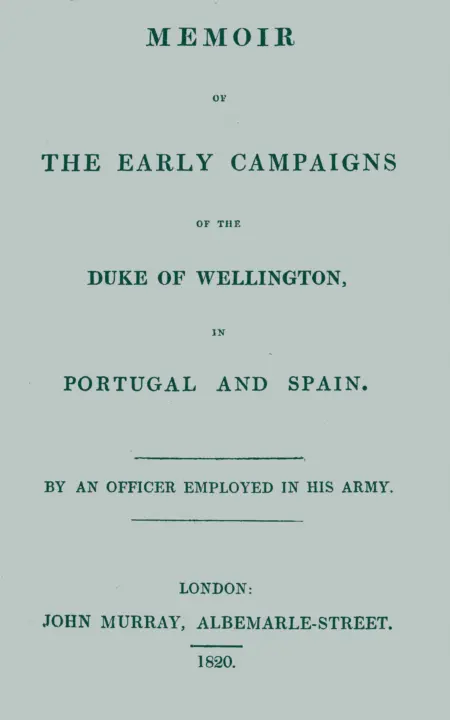
THE CLASSIC COLLECTION · 1820
"Memoir of the Early Campaigns of the Duke of Wellington, in Portugal and Spain" by an officer employed in his army is a historical account written in the early 19th century. The book details the initial military efforts under the command of Sir Arthur Wellesley, later known as the Duke of Wellington, during the Peninsular War against French forces. It aims to provide an accurate recounting of the significant events and strategies of the British campaign in Portugal and Spain, which were pivotal in the fight for independence. The opening of the memoir introduces the author, who positions himself as a participant in the campaigns, emphasizing the importance of conveying the experiences and challenges faced during this tumultuous period. It outlines the circumstances leading up to British involvement in the Peninsular War, including the state of Portuguese resistance against French occupation and the initial strategies employed by Wellesley. Highlighting moments of bravery and critical decisions, the beginning chapters set the stage for a gripping historical narrative that reveals not only military maneuvers but also the spirit of resilience among the soldiers and local populations affected by the conflict.
Introduction adapted from the source catalogue; source summaries may be automatically generated.
Free to read · English · 46,628 words · No account needed
MAKE TIME FOR A GOOD BOOK
On by default. Untick to stop anonymous reading totals. Each page counts after 10 seconds in view. How this works.
Anonymous counting is on unless you have switched it off.
While these changes were effecting, the people of Seville reinstated the former Junta of their province, and added the Marquis of Romana, the Duke of Albuquerque, and some English to its number; but this body had not time to act; Marshal Soult was already within a few days’ march of the town: it constituted, however, the Marquis of Romana Captain-General of Estremadura; and directed the Duke of Albuquerque, who had brought his corps with him from Estremadura, to take up a position at Carmona, to defend the approach to Seville. The army which the duke commanded was, however, too weak to resist the French; he therefore fell back upon their approach; and, in spite of their efforts to prevent it, retired to the Isla de Leon. To this place Marshal Soult pursued him, and thus, in one movement, without a single action, reduced the whole of the southern provinces of Spain to the subjection of France. He extended his army to the walls of Gibraltar; he occupied Malaga, Granada, Jaen, Cordova, and Seville, and he prepared for the siege of Cadiz, which was the only bar to the complete reduction of Andalusia.
This operation was as rapid and as successful, as it was possible to execute. The great resources of the Spanish monarchy were reduced at one blow; the riches of Andalusia were abandoned to the enemy without a struggle; and the great nursery of the Spanish armies, the provinces from which innumerable bands of patriots might have been drawn, were at once delivered into the hands of the invader. Some persons thought, that, in the tame relinquishment of these treasures, they perceived a readiness in the Spaniards to abandon the cause for which they had, till that moment, so gloriously been struggling; but the fallacy of that opinion has since been proved. The revolution in Spain had found that country merged in all the vices of its former weak and imbecile governments. Spain had not for many years been called into any extensive warfare; it was without any military organization; it was unused to great exertions; yet the people were proud of their former exploits; and, without adverting to the changes which had taken place, believed themselves and their armies as invincible, as they had been during the most brilliant periods of their history. The nation had been long sunk in ignorance and oppression; it had no military science, no commanders to whom it could look for assistance, no army that could defend it; yet it had universally risked a contest with the greatest military power the world had ever seen; and which had armies, more powerful than any the nation could oppose to them, within its territory. Elated by the first successes at Baylen and Saragossa, the Spaniards afterwards sunk into their former habits of indolence. Pride dictated to them a feeling of security, which reason would have made them doubt; but their succeeding reverses never changed their first opinions; although the total want of confidence, in their generals or their governments, made them little anxious to place themselves under their directions. The Supreme Junta, which had been established to rule the country in circumstances of the greatest difficulty, was totally unable to call forth the energies of the nation. The same intrigues, which had existed under the long reign of the Prince of the Peace, continued under its auspices. The want of money was soon felt throughout the country, the Junta was unacquainted with the means of obtaining it, and was not very scrupulous in the application of the sums it received. The army was unpaid, and was consequently without discipline. The generals were unsupported by the government, which was too weak to uphold them in the execution of their duty. The Juntas of the different provinces yielded but a limited obedience to the central one; they were composed of persons who looked most to their own advantage in the high situations to which they had been called, and who were unwilling to make exertions, the burthen of which would fall upon themselves. In this state of things, the declaration that Spain was invincible, was the readiest mode of abstaining from those efforts which were necessary to make her so, but which accorded too little with the character of the people who were to make them. Andalusia was in consequence totally unprepared for the blow which was struck at her, her population however was not the less hostile to the invaders; there was no point round which it could rally in the hour of danger, the people sunk under the power of their enemies, but they still were Spaniards; they moaned the cruel fate which had attended them, but they remained steadfast through all their misery to the great cause of their nation and their independence.
Your reading position is saved on this browser. Take it to another device with a library code. Reading pages adapt to text, rather than matching a printed edition.
BEHIND THE BOOK
This eBook is for the use of anyone anywhere in the United States and most other parts of the world at no cost and with almost no restrictions whatsoever. You may copy it, give it away or re-use it under the terms of the Project Gutenberg License included with this eBook or online at www.gutenberg.org. If you are not located in the United States, you will have to check the laws of the country where you are located before using this eBook. Read the source licence.
The original source file, including credits and licence, is retained by this library. Request an original-format copy at no charge. Please include the book title and Project Gutenberg identifier #63792.
KEEP YOUR CURIOSITY GOING
Cécile Tormay

Moritz Busch
John L. Ransom
Frances Wright
Cécile Tormay

Mabel Potter Daggett