THE CLASSIC COLLECTION✦An outlaw’s diary: the CommuneCLASSIC FREE BOOKS
An outlaw’s diary: the Commune
Cécile Tormay
THE CLASSIC COLLECTION · 1820
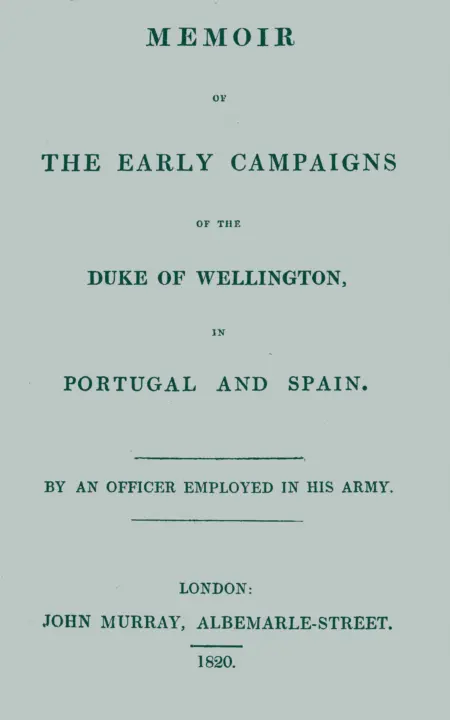
"Memoir of the Early Campaigns of the Duke of Wellington, in Portugal and Spain" by an officer employed in his army is a historical account written in the early 19th century. The book details the initial military efforts under the command of Sir Arthur Wellesley, later known as the Duke of Wellington, during the Peninsular War against French forces. It aims to provide an accurate recounting of the significant events and strategies of the British campaign in Portugal and Spain, which were pivotal in the fight for independence. The opening of the memoir introduces the author, who positions himself as a participant in the campaigns, emphasizing the importance of conveying the experiences and challenges faced during this tumultuous period. It outlines the circumstances leading up to British involvement in the Peninsular War, including the state of Portuguese resistance against French occupation and the initial strategies employed by Wellesley. Highlighting moments of bravery and critical decisions, the beginning chapters set the stage for a gripping historical narrative that reveals not only military maneuvers but also the spirit of resilience among the soldiers and local populations affected by the conflict.
Introduction adapted from the source catalogue; source summaries may be automatically generated.
Free to read · English · 46,628 words · No account needed
MAKE TIME FOR A GOOD BOOK
On by default. Untick to stop anonymous reading totals. Each page counts after 10 seconds in view. How this works.
Anonymous counting is on unless you have switched it off.
On the morning of the 26th General Cuesta’s advance was attacked by the advanced guard of the French army. It appeared that Joseph had called General Sebastiani from La Mancha to Toledo; that with all the force he could withdraw from Madrid, he had marched himself to join him; and that he had formed a junction with these two corps and the corps of General Victor, at or near Torrijos; that he had immediately advanced upon General Cuesta; and was in hopes of beating him before he should be joined by the British. General Cuesta, however, upon learning the force of the enemy, retired to Talavera. Sir Arthur Wellesley had endeavoured to find a situation in which to fight a battle in front of the Alberche; but not having succeeded, determined to take up a position, the right upon the town of Talavera, the left upon some heights, about a mile to the northward of it. The Spanish army retired during the 26th and 27th, and took up the ground marked out for it about the town of Talavera. On the morning of the 27th Sir Arthur Wellesley sent a brigade of cavalry and two brigades of infantry; the whole under the orders of Major General Mackenzie, to watch the enemy upon the left of the Alberche, and to protect the retreat of the Spaniards.
Towards two o’clock in the afternoon the French advance of cavalry began to skirmish with the British. Major General Mackenzie soon after retired, and about four o’clock passed the Alberche with the whole of his corps. He took up a position in a wood upon the right bank of it, from which he could observe the movements of the enemy.
Joseph had brought the whole of his army to the opposite side of the river; and believing (from the small number of troops that were to be seen upon the right bank,) that the allies were retreating, he determined to push in their advanced guard immediately, with the hope of falling upon their army on its march to the bridge of Almaraz; to which place alone, after abandoning the line of the Alberche, he thought it could be retiring. The French infantry passed the river; the brigade of Colonel Donkin, which was posted to defend it, was to a certain degree surprised. The river was fordable at all points, and the French advanced guard fell upon this brigade and caused it considerable loss. Sir Arthur Wellesley (who had just arrived upon the ground) ordered the whole of Major General Mackenzie’s division to retire from the wood, and to fall back upon the position in the rear, into which the army was at this time moving. The French, elated with their first, successes, pushed forward as rapidly as the passage of their troops would allow, and threw their right forward, with the view of turning the town of Talavera. The Duke of Albuquerque shewed, however, so good a front with the cavalry under his orders (which was in a plain upon the left of the British,) that this movement was considerably delayed. Sir Arthur Wellesley was tempted, (while a part only of the French army had passed the Alberche), to attack it with the whole of the allies; but upon considering the lateness of the hour, he continued his movement to the position he had fixed upon. The British advanced guard retired under cover of the cavalry, and took up the ground allotted to it. The French continued to press forward; and, at last, when it was nearly dark, brought a battery of six guns, supported by a considerable corps of infantry, to some high ground opposite the height upon which the left of the British was to rest. The troops destined for this point had not at that moment reached it. Colonel Donkin’s brigade, which was retiring near it, was ordered to form at the foot of the hill upon the left of the Germans under General Sherbrooke. But the French, supported by their guns, attacked these corps, drove them from the ground they occupied, and carried the height. Lieutenant General Hill’s and Major General R. Stewart’s brigades were at that moment ascending it from the other side; their advance found the French upon the top. The battalion of detachments under Colonel Bunbury wheeled into line, charged, and retook the hill. The French, however, returned to the attack, but were finally driven to the foot of it. The action upon this point was severe; Major General Hill was at one moment mixed with the French soldiers; several men of both armies were killed or wounded with the bayonet, but the gallantry of British soldiers, and the intrepidity of their officers, prevailed.
Your reading position is saved on this browser. Take it to another device with a library code. Reading pages adapt to text, rather than matching a printed edition.
BEHIND THE BOOK
This eBook is for the use of anyone anywhere in the United States and most other parts of the world at no cost and with almost no restrictions whatsoever. You may copy it, give it away or re-use it under the terms of the Project Gutenberg License included with this eBook or online at www.gutenberg.org. If you are not located in the United States, you will have to check the laws of the country where you are located before using this eBook. Read the source licence.
The original source file, including credits and licence, is retained by this library. Request an original-format copy at no charge. Please include the book title and Project Gutenberg identifier #63792.
KEEP YOUR CURIOSITY GOING
Cécile Tormay

Moritz Busch
John L. Ransom
Frances Wright
Cécile Tormay

Mabel Potter Daggett