THE CLASSIC COLLECTION✦A journey in search of ChristmasCLASSIC FREE BOOKS
A journey in search of Christmas
Owen Wister

THE CLASSIC COLLECTION · 1901
"Members of the Family" by Owen Wister is a novel written in the early 20th century. This work explores themes of Western life and identity through the experiences of its characters, particularly focusing on the humorous and insightful interactions among them in a frontier setting, bringing to life the essence of Western American culture. The opening features Scipio Le Moyne, a character who undergoes a comical and multifaceted journey, dealing with his own aspirations and mishaps in a world transitioning from the rugged individualism of the cowboy era. At the start of the novel, we meet Scipio Le Moyne, who is recovering from injuries sustained in a rodeo accident and is witfully musing over the complexities of communication and social interaction. His humorous conversations with a visiting friend known as the Virginian reveal his knack for storytelling and sharp observations about others, especially concerning a comical figure named Horacles. As Scipio recuperates, he wrestles with a mix of pride and insecurity about his place in this new and evolving Western society, all while building a tapestry of relationships that shape his journey. The engaging dynamics among characters provide a vivid window into life on the frontier, blending humor with underlying social commentary.
Introduction adapted from the source catalogue; source summaries may be automatically generated.
Free to read · English · 64,886 words · No account needed
MAKE TIME FOR A GOOD BOOK
On by default. Untick to stop anonymous reading totals. Each page counts after 10 seconds in view. How this works.
Anonymous counting is on unless you have switched it off.
“We like buy everything you, we like buy everything cheap.”
“You make cheap, we buy heap shirts.”
“Buy heap tobacco.”
“Heap cartridge.”
“You not sell cheap, we go.”
“Ah!”
The chorus laughed like pleased children.
Scipio looked at them solemnly. He explained how much he would like to sell cheap, if only he were a medicine-man like Horacles.
“You medicine-man?” they asked the assistant clerk.
“Yes,” said Horacles, pleased. “I big medicine-man.”
“Ah, nah!” The soft, mocking words ran among them like the flight of a
moth.
Soon with their hoods over their heads they began to go home on their ponies, blanketed, feathered, many-colored, moving and dispersing wide across the sage-brush to their far-scattered tepees.
High Bear lingered last. For a long while he had been standing silent and motionless. When the chorus spoke he had not; when the chorus laughed he had not. Now his head moved; he looked about him and saw that for a moment he was alone in a way. He saw the Virginian reading a newspaper, and his friend “Sippo” bending down and attending to his leg. Horacles had gone into an inner room. Left on the counter lay the pack of cards. High Bear went quickly to the cards, touched them, lifted them, set them down, and looked about him again. But the Virginian was
reading still, and Scipio was still bent down, having some trouble with his boot. High Bear looked at the cards, shook his head sceptically, laughed a little, grunted once, and went out where his pony was tied. As he was throwing his soft buckskin leg over the saddle, there was Scipio’s head thrust out of the door and nodding strangely at him.
“Good night, High Bear. He big medicine-man.”
High Bear gave a quick slash to his pony, and galloped away into the
dusk.
Then Scipio limped back into the store, sank into the first chair he came to, and doubled over. The Virginian looked up from his paper at this mirth, scowled, and turned back to his reading. If he was to be “left out” of the joke, he would make it plain that he was not in the least interested in it.
Scipio now sat up straight, bursting to share what was in his mind; but he instantly perceived how it was with the Virginian. At this he redoubled his silent symptoms of delight. In a moment Horacles had come back from the inner room with his hair wet with ornamental brushing.
“Well, Horacles,” began Scipio in the voice of a purring cat, “I expect y’u have me beat.”
The flattered clerk could only nod and show his bright, false teeth.
Your reading position is saved on this browser. Take it to another device with a library code. Reading pages adapt to text, rather than matching a printed edition.
Owen Wister

Caspar Whitney & George Bird Grinnell & Owen Wister
Owen Wister
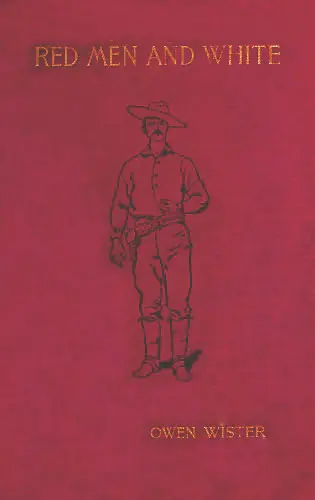
Owen Wister
BEHIND THE BOOK
This eBook is for the use of anyone anywhere in the United States and most other parts of the world at no cost and with almost no restrictions whatsoever. You may copy it, give it away or re-use it under the terms of the Project Gutenberg License included with this eBook or online at www.gutenberg.org. If you are not located in the United States, you will have to check the laws of the country where you are located before using this eBook. Read the source licence.
The original source file, including credits and licence, is retained by this library. Request an original-format copy at no charge. Please include the book title and Project Gutenberg identifier #56717.
KEEP YOUR CURIOSITY GOING
Coulson Kernahan

Maurice Baring
Frances Wright
Cécile Tormay

Frederic Jesup Stimson

W. H. P. (William Henry Pope) Jarvis