THE CLASSIC COLLECTION✦An outlaw’s diary: the CommuneCLASSIC FREE BOOKS
An outlaw’s diary: the Commune
Cécile Tormay
THE CLASSIC COLLECTION · 1889
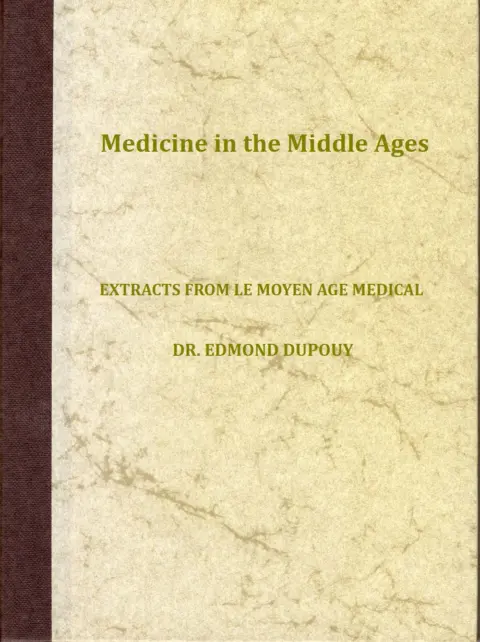
"Medicine in the Middle Ages" by Edmond Dupouy is a historical account written in the late 19th century. The book explores the evolution of medical practices and beliefs during the Middle Ages, focusing on the influence of religion, the role of prominent physicians, and the impact of significant epidemics on society. It aims to provide a comprehensive overview of how medicine was perceived and practiced in this pivotal period of history. At the start of the work, Dupouy introduces the decline of Roman civilization in the 4th century and the subsequent rise of the Middle Ages, where medical knowledge regressed as the Church imposed its doctrines on the practice of health care. He discusses the contributions of both Greek and Arab physicians who attempted to preserve and expand medical knowledge amidst widespread superstition. The opening portion also highlights the tensions between religious beliefs and scientific inquiry, as well as the emergence of various medical schools and hospitals throughout Europe, setting the stage for the eventual revival of medicine in the later centuries.
Introduction adapted from the source catalogue; source summaries may be automatically generated.
Free to read · English · 73,669 words · No account needed
MAKE TIME FOR A GOOD BOOK
On by default. Untick to stop anonymous reading totals. Each page counts after 10 seconds in view. How this works.
Anonymous counting is on unless you have switched it off.
[23] Aaron, a contemporary of Paulus d’Aegineta, speaks only briefly of the malady in his works. Rhazes mentions measles in his works, giving a clear account of its diagnosis and treatment. He says that when the patient experiences great anxiety and falls into a syncope, he should be plunged into a cold bath and then be vigorously rubbed over the skin to the end of provoking the eruption. Avicenna did not recognize measles, considering it only a billious fever or small pox. Constantine, the African, follows the example of Avicenna and reproduces the opinion of the Arabian School without comments.
[24] Johannis Philipi Ingrassiae. “De tumoribus praeter naturam.” Cap.
I.
[25] Fernelli. “Universa Medico.”
[26] “Brief recit et succinte narration de la navigation faicte en ysles de Canada.” Paris, 1545.
[27] Gregory of Tours says that in Paris they had a place of refuge, where they cleaned their bodies and dressed their sores.
[28] They designated by the name of borde, bordeau, bordell, bordette, bourde, or bourdeau, a small house or cabin built on the edge of town; a cabin intended to contain lepers. The word bordell, a house of ill-fame, as used even in modern days, takes its origin from borde, an asylum for lepers.
[29] Etienne Barbazin, erudite and historian, born in 1696, author of a number of works on the History of France: “Recueil alphabetique de pieces historiques”; “Tableaux et Contes Francais, des XII., XIII., XIV., et XV. centuries”; “The Orders of Chivalry, etc.” He also left numerous manuscripts on the origin of the French language. See “Bibliotheque de l’Arsenal.”
[30] Pierre Andre Mathiole, “De Morbo Gallico.”
[31] Note sur la syphilis au XIII. siecle, “Gazette Medicale de Paris.”
[32] “Cyrurgia,” Magistri Guilielmi de Saliceti, 1476.
[33] Michel Scott: “De procreatione hominis physionomia.” Work published in 1477, but written in 1250, for the author was born in 1210.
[34] It was Fracastor who gave venereal diseases the name of syphilis in his poem “Syphilis sive Morbus Gallicus,” published at Verona in 1530. According to Ricord, syphilis is derived from the Greek words sus, pork, and philia, love (love for pork). Gorre in the Romanesque language long before had the same signification.
[35] The Provencal text in the original reads as follows: “La reino vol que toudes lous samdes la Baylouno et un barbier deputat des consouls visitoun todos las filios debauchados, que seran au Bourdeou; et si sen trobo qualcuno qu’abia mal vengut de paillardiso, que talos filios sion separados et lougeados a part afin que non las counougoun, por evita lou mal que la jouinesso pourrie prendre.”
[36] Astruc: “De Morbis Venereis,” chap. viii.
[37] Jean de Gaddesen: “De concubitu cum muliera leprosa, in Rosa
Anglica.”
[38] “Cyrurgia Guidonis de Cauliaco.”
[39] Torella: “De Pudendagra Tractatus.”
Your reading position is saved on this browser. Take it to another device with a library code. Reading pages adapt to text, rather than matching a printed edition.
BEHIND THE BOOK
This eBook is for the use of anyone anywhere in the United States and most other parts of the world at no cost and with almost no restrictions whatsoever. You may copy it, give it away or re-use it under the terms of the Project Gutenberg License included with this eBook or online at www.gutenberg.org. If you are not located in the United States, you will have to check the laws of the country where you are located before using this eBook. Read the source licence.
The original source file, including credits and licence, is retained by this library. Request an original-format copy at no charge. Please include the book title and Project Gutenberg identifier #63938.
KEEP YOUR CURIOSITY GOING
Cécile Tormay

Moritz Busch
John L. Ransom
Frances Wright
Cécile Tormay

Mabel Potter Daggett