
The Writing of News A Handbook with Chapters on Newspaper Correspondence and Copy Reading
Charles G. (Charles Griffith) Ross
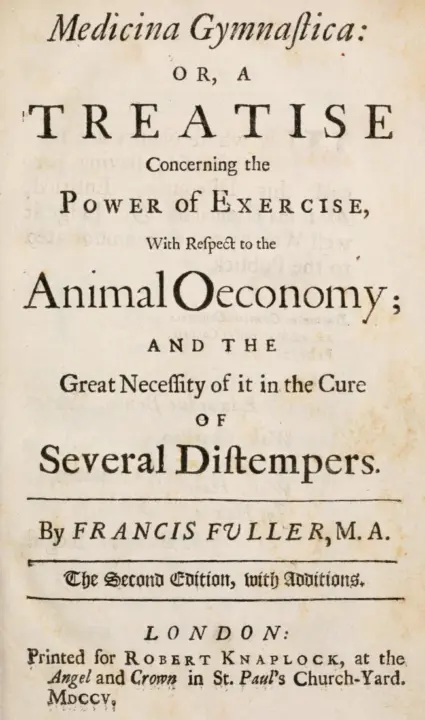
THE CLASSIC COLLECTION · 1705
"Medicina Gymnastica" by Francis Fuller is a scientific treatise written in the early 18th century. The book focuses on the importance of exercise in maintaining health and treating various ailments, emphasizing the interconnection between physical activity and the body's overall functioning. Fuller challenges the prevailing belief that medicine revolves primarily around internal remedies, advocating for a more holistic approach that includes physical exercise. At the start of the treatise, Fuller provides an insightful preface discussing the misconceptions surrounding physical health and medicine. He argues against the limited view of pharmacy as solely reliant on internal medications, instead highlighting the body's need for diverse methods to achieve wellness. He introduces the concept of exercise as an essential aspect of health, able to stimulate healing processes and enhance the efficacy of medicines. Fuller's observations draw on historical practices and personal experiences, setting the stage for a more comprehensive exploration of how exercise can play a pivotal role in treating specific diseases, particularly those affecting the lungs, and encouraging a shift in medical philosophy toward a balance between internal and external methods of healing.
Introduction adapted from the source catalogue; source summaries may be automatically generated.
Free to read · English · 42,831 words · No account needed
MAKE TIME FOR A GOOD BOOK
On by default. Untick to stop anonymous reading totals. Each page counts after 10 seconds in view. How this works.
Anonymous counting is on unless you have switched it off.
As for the Fluids; One would think the Shape and Make of the Blood-Vessels were sufficient alone to lead us into an Opinion of the Necessity of Exercise; by reason they all terminate in a Cone, they must needs resist the Passage of the Blood incomparably more than they would have done if they had been Cylindrical; and tho’ all the Branches of the Capillary Arteries, would, if taken Collectively, make a greater Diameter than that of the great Artery, yet the Consistence of the Blood, and the extreme Fineness of those invisible Meanders, require the frequent Pressure and Assistance of the Muscles to encrease the Circulation, which accordingly we always find very much augmented by those Means; yet ’tis the Result of this swifter Current of the Blood, which should be most valuable to us, I mean the better Digestion and Mixture of the various Particles convey’d into the Blood. I believe it will be allowed on all hands, that the best way to bring an Animal Fluid to a greater degree of Perfection, is Digestion; and the Excellency of that Operation consists in the just Degree of Heat which causes it; or, to speak perhaps more properly, in the just Agitation or intestine Motion of the Particles which may be suppos’d to occasion that Heat. The Standard or Measure of this Heat or Agitation in the Animal Oeconomy, is to be taken from what we observe in a Man in perfect Health, and in the Prime of his Age; when his Blood flows with its due Velocity, when there is an uninterrupted Secretion of all that is disagreeable to it, and it is wrought up to its florid Consistence, and a just proportion between the Serous and Grumous parts. Now this we may successfully imitate by repeated Exercise, when the Blood happens to be impoverish’d and Languid, we may encrease the Velocity of the Circulation, and consequently the Heat following upon it, by which a great many crude Particles will be attenuated and ripen’d, either for Mixture or Secretion, and there will be an equal Distribution of the attenuated Particles to the several Emunctories of the whole Body, by reason of the Solids co-operating with the Fluids; whereas it is often quite otherwise, when an internal Medicine is given design’d for one Secretion only, which may promote that, and perhaps hinder another; as a Medicine which agrees with the Stomach, sometimes offends the Head; for the Nervous Parts being, as it were, Passive in the Case, the Secretions cannot be so equally performed as when the whole Body is exercis’d. I would not be here mis-understood, as if I suppos’d that this first Effect of Motion, this Digestion, would avail in many Cases, as where an ill Ferment is lodg’d in the Glands, or where the Morbifick Particles have been long a forming, and are strongly combin’d in the Blood, but this may take place where a greater degree of Agitation is absolutely necessary; as when the Blood is Effete and Languid, when the Chyle comes into it dispirited, and when even a proper Medicine proves offensive and burthensome, and there is scarce Power enough left in the Blood to master its Particles, and apply ’em to their proper Uses; then, I say, ’tis time to make the Solids assist the Fluids in the dispensing of this Load which lies so hard upon ’em, which by gentle and close Exercise may be more easily done than many imagine; besides there may be a Distemper occasion’d by Particles of a looser Texture in the Blood, than is usual in most Cases, where Nature may contend and struggle with the hostile Particles, and yet not be able to get the Victory; where there may not be a perfect Fever, nor yet a quiet Coalition between the Blood and those foreign Particles. In such a Distemper as this, it must needs be very proper to give a due Agitation to the Blood, to prepare those Particles for the several Emunctories that are ready to receive ’em: and this may be perform’d by a just Digestion, if we do but consider how much the Body is adapted to it, and how much more Noble the Digestions are in the Animal Oeconomy, than those produc’d by humane Contrivance. In all artificial Digestions the Particles which are to be separated by the Agitation of the Liquor, must either evaporate, or subside; but in the Body there are a multitude of excretory Ducts ready to receive the Particles, of such a determinate Figure, as renders ’em excrementitious, and proper to be cast off; so that nothing is left but what is proper to the Animal Fluids, and which the Vehemence of the Motion mixes and unites at the same time that it breaks and moulds the others for their proper excretory Chanels; so that the Agitation is in this Case (as Dr. Grew very well expresses it in his Treatise of Mixture) as “carrying the Key to and fro, till it hit the Lock; or within the Lock, till it hit the Wards.” How do we know the exact Degree of Agitation, that is requisite to unite the Particles of the Fat, which are continually flowing in a very great quantity into the Blood, with the Aqueous, by the Means of sulphureous or saline Particles? Do we not frequently observe in scorbutick Persons, who have lead a sedentary Life, that their Urines are cover’d with an oily Film of several Colours? and is it not very natural to suppose from thence, that the Blood wants a due Motion to keep those oily Parts united with the others? But it is no wonder, if these things are not well consider’d, when there is scarce any who makes Allowance enough for the quantity of the fat Particles, which are continually passing into the Blood, which must needs be very great, seeing the whole Skin is lin’d with its Vessels, besides what is heap’d up about the Omentum and the Kidneys; so that Unctuous Medicines are copiously intruded upon the Habit of the Body when there is a great Wasting of the Flesh, without regarding that the Blood is not able to master the natural Pinguedo, but gives it down daily, in all probability, for want of a just degree of Agitation or Digestion, to keep it suspended in the Blood, and to apply it to its proper Uses, and prepare it for its proper Vessels.
Your reading position is saved on this browser. Take it to another device with a library code. Reading pages adapt to text, rather than matching a printed edition.
BEHIND THE BOOK
This eBook is for the use of anyone anywhere in the United States and most other parts of the world at no cost and with almost no restrictions whatsoever. You may copy it, give it away or re-use it under the terms of the Project Gutenberg License included with this eBook or online at www.gutenberg.org. If you are not located in the United States, you will have to check the laws of the country where you are located before using this eBook. Read the source licence.
The original source file, including credits and licence, is retained by this library. Request an original-format copy at no charge. Please include the book title and Project Gutenberg identifier #63497.
KEEP YOUR CURIOSITY GOING
Charles G. (Charles Griffith) Ross
Hannah Webster Foster

Emily Lawless
Edwin Hamlin Carr

Charles De Lano Hine
Andrew Ure