
The Writing of News A Handbook with Chapters on Newspaper Correspondence and Copy Reading
Charles G. (Charles Griffith) Ross
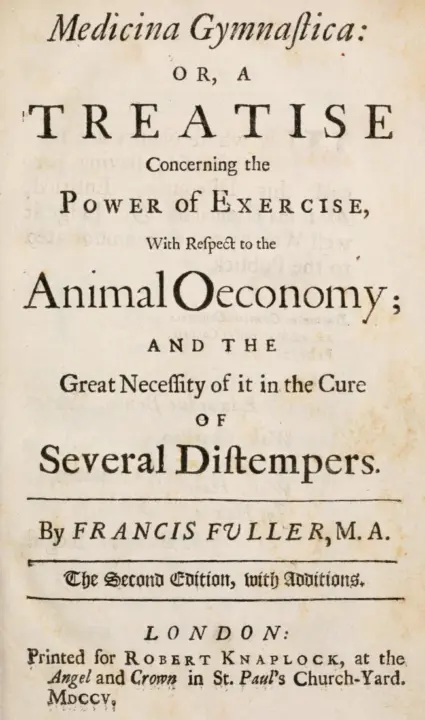
THE CLASSIC COLLECTION · 1705
"Medicina Gymnastica" by Francis Fuller is a scientific treatise written in the early 18th century. The book focuses on the importance of exercise in maintaining health and treating various ailments, emphasizing the interconnection between physical activity and the body's overall functioning. Fuller challenges the prevailing belief that medicine revolves primarily around internal remedies, advocating for a more holistic approach that includes physical exercise. At the start of the treatise, Fuller provides an insightful preface discussing the misconceptions surrounding physical health and medicine. He argues against the limited view of pharmacy as solely reliant on internal medications, instead highlighting the body's need for diverse methods to achieve wellness. He introduces the concept of exercise as an essential aspect of health, able to stimulate healing processes and enhance the efficacy of medicines. Fuller's observations draw on historical practices and personal experiences, setting the stage for a more comprehensive exploration of how exercise can play a pivotal role in treating specific diseases, particularly those affecting the lungs, and encouraging a shift in medical philosophy toward a balance between internal and external methods of healing.
Introduction adapted from the source catalogue; source summaries may be automatically generated.
Free to read · English · 42,831 words · No account needed
MAKE TIME FOR A GOOD BOOK
On by default. Untick to stop anonymous reading totals. Each page counts after 10 seconds in view. How this works.
Anonymous counting is on unless you have switched it off.
Thus I have given a succinct and true Account, of a Long and Severe Distemper, which it has pleas’d Almighty God to lay upon me; by which it is plain, that as some Men are distinguish’d by Riches, Honours, and the like; others may be as remarkable in the Degrees of their Affliction and Anguish, and may be forc’d to pass not only Days, but Years of that which we call Life, after such a Manner, that if it were not for higher Considerations, it would be far better not to be. That in the very best of a Man’s Years, in the time of Hopes, Prospects, and Advantages, a Man may be so wretched as to be debar’d the Capacity of making use of ’em, and in a Sense, Buried Alive.
But since I have offer’d the World a Relation of my Distemper, I shall make bold to take Notice of two or three things observable in it, which may perhaps be of use to some, tho’ the very same Distemper, I hope will never be the Lot of any one. And this the rather, because those Remarks are agreeable to my Subject.
First then, I think it is very clear, from the Circumstances of my Case, that where Indications arise, which run Counter to one another, which every one knows is the worst of Difficulties a Physician meets with, in such an Emergency, nothing can be so lively to balance between ’em, as the having recourse to some proper Exercise, if possible; for it is hard but it will suit with one of those Circumstances, and not improbable, that it will give help in both.
Secondly, From the Cessation of my Gripes as soon as ever I got on Horseback, I am convinc’d that Pain may be very much obviated or mitigated by the Motion of the Body, that is, by those Means a Man may make a shift to set loose from it. It was a piece of Extravagant Nonsense in the Scepticks, to pretend to Reason with Pain, and account it no Evil; a Man might as well pretend to Fence against Hunger with Resolution, and be accounted blameable for Starving through Want of Victuals; undoubtedly Pain is the greatest of Evils to the Body, and that which we cannot but endeavour to free our selves from; but till that can be done, it will be a Happiness, if we can so manage things, as to perceive less of it, or as I said before, sit loose from it; and that I think may certainly be obtain’d from the Motion of the Individual, of such or such a kind, as the Pain will best admit of. Not only Thought, but the Perception of a Pain, may be in some Measure interrupted by a swift Motion, for that Perception cannot strike so strong at such a time; a Man that should let himself to Muse on a full Gallop, would think but very incoherently, and if Thought it self may be thus broke off, certainly the Sensation of Pain, which can be no quicker than Thought, may be likewise happily interrupted and rendered more Dull. These Considerations would be of real Service to Persons afflicted with Scorbutick Pains, if they could induce ’em to a Resolute Practice of Riding; for all those Pains in the Shoulders, Back, or Hips, would gradually abate in the time of that Exercise, as well as by the Habit of it, the Cause would be remov’d. But moreover there are other Sorts of Gestation or Voiture, that are suitable with the keenest Pains, as the Motion of a Boat, a Litter, a Chair, a Swing, and the like, in these there are no Motûs Contrarietas, as Dr. Sydenham calls it, no Jolting, which in some Cases, as in the Gout, is not tolerable; but they may be apply’d to the severest Cases, and I doubt not would sooth the Spirits, and give great Relief. And here I cannot but think that a good Mechanick might invent some Machine, after the manner of the Petaurus, or the great Swing of the Ancients, which might be of the greatest Service to People in the Extremities of the Gout, by diverting the Sensation, and turning the Edge of the Pain: A Man that has been laid up for several Weeks, would certainly find by such a Motion, as great an Alteration, as one who has been confin’d to his Bed for some time does upon his first getting up, which is very great; and certainly if the Romans, out of Luxury and Wantonness, could be Swung to Sleep in Hanging Beds of Silver, it may be allow’d, that a Person in Torment may use the same Means to obtain Ease. I don’t know why a Motion upon a Round, should not do some Service in this Case, for there would be a sort of Sickness in the Stomach, caus’d by the Rotation, which would withdraw the Spirits from the Place of the Pain; and moreover undoubtedly dispose to Sleep. These things cannot be thought Extravagant, if they can suffice to give any the least Ease to Men under such Pains, as those of the Gout, when the Carnificina lasts so long, as to exceed in some Measure all Humane Patience; when Non rectius Podagræ quam Iracundiæ Paroxysmus omnis did potest, as Dr. Sydenham, who knew too well what it was, says of it; I say, in such Extremities, nothing ought to be thought Ridiculous, that can afford the least Ease. I could say; much more on this Subject; I could Name a very Worthy Gentleman, who not long ago had such an odd sort of a Colick, that he found nothing would relieve him in the Fits of it, so much as lying with his Head downwards; which Posture prov’d always so Advantageous to him, that he caus’d a kind of Frame to be made, to which he caus’d himself to be fastned with Bolts, and then his Servants were to turn him with his Head downwards; after which manner, he hung till his Pain went off: And I hope none will say it was unbecoming a Grave and Wise Man, to make use of such odd Means to get rid of an unsupportable Pain. But I have perhaps already said more than will be relish’d by some of those Gentlemen, who are so happy as to be really Ignorant, or to have but very slight, and imperfect Notions of the Nature of Pain; and before they censure me, they would do well to peruse Mr. Collier’s Excellent Essay upon Pain; where they will find such an Account of it, and such Instances of the Behaviour of Healthy and Strong Men under it, that they will the more easily admit, that for the Sick and Infirm, it may be in some Measure feasible to avoid, as it were, the Sensations of Pain, and, as much as can be, sit loose from it.
Your reading position is saved on this browser. Take it to another device with a library code. Reading pages adapt to text, rather than matching a printed edition.
BEHIND THE BOOK
This eBook is for the use of anyone anywhere in the United States and most other parts of the world at no cost and with almost no restrictions whatsoever. You may copy it, give it away or re-use it under the terms of the Project Gutenberg License included with this eBook or online at www.gutenberg.org. If you are not located in the United States, you will have to check the laws of the country where you are located before using this eBook. Read the source licence.
The original source file, including credits and licence, is retained by this library. Request an original-format copy at no charge. Please include the book title and Project Gutenberg identifier #63497.
KEEP YOUR CURIOSITY GOING
Charles G. (Charles Griffith) Ross
Hannah Webster Foster

Emily Lawless
Edwin Hamlin Carr

Charles De Lano Hine
Andrew Ure