
The Writing of News A Handbook with Chapters on Newspaper Correspondence and Copy Reading
Charles G. (Charles Griffith) Ross
THE CLASSIC COLLECTION · 1705
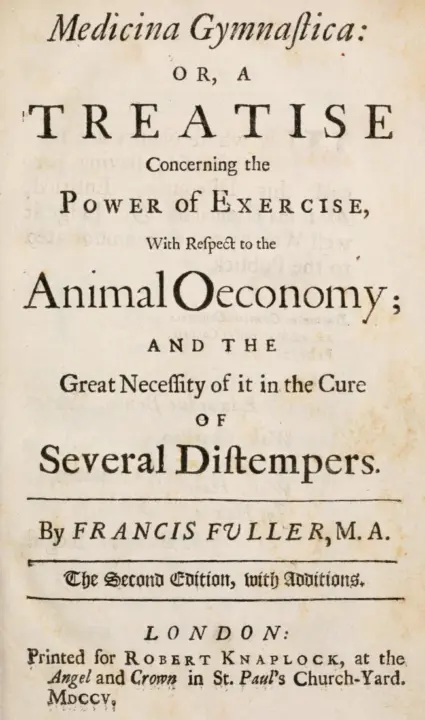
"Medicina Gymnastica" by Francis Fuller is a scientific treatise written in the early 18th century. The book focuses on the importance of exercise in maintaining health and treating various ailments, emphasizing the interconnection between physical activity and the body's overall functioning. Fuller challenges the prevailing belief that medicine revolves primarily around internal remedies, advocating for a more holistic approach that includes physical exercise. At the start of the treatise, Fuller provides an insightful preface discussing the misconceptions surrounding physical health and medicine. He argues against the limited view of pharmacy as solely reliant on internal medications, instead highlighting the body's need for diverse methods to achieve wellness. He introduces the concept of exercise as an essential aspect of health, able to stimulate healing processes and enhance the efficacy of medicines. Fuller's observations draw on historical practices and personal experiences, setting the stage for a more comprehensive exploration of how exercise can play a pivotal role in treating specific diseases, particularly those affecting the lungs, and encouraging a shift in medical philosophy toward a balance between internal and external methods of healing.
Introduction adapted from the source catalogue; source summaries may be automatically generated.
Free to read · English · 42,831 words · No account needed
MAKE TIME FOR A GOOD BOOK
On by default. Untick to stop anonymous reading totals. Each page counts after 10 seconds in view. How this works.
Anonymous counting is on unless you have switched it off.
If any one should ask me how it comes to pass that Riding, which I have substituted as equivalent to any or all the Exercises of the Ancients, in the Case of Sickness, was so little regarded by their Physicians, but other less valuable Exercises insisted on; it may be reply’d, that the Ancients could not recommend Riding to weak People, because of their manner of Riding; they had not the same convenience, as we have; for in those days they rode without Stirrups, which must needs be tiresome to weak Persons. We find by comparing of Medals, that the Stirrup was an Invention of a much later date, than any of the Authors I have quoted, I think by about Seven Hundred Years; so that Riding was only an Exercise for Healthy and strong Men; besides Horses were not so common in the Levant, or in Italy, as they are with us; they were reserv’d for Military Men, or at least for Men of Plentiful Fortunes, and the Ass and the Mule serv’d for common Carriage; the Horse was a formidable Creature to People that were not accustom’d to him, and especially to weak Persons. We see such a Jolly Fellow as Martial, could advise his Friend Priscus, to have a Care how he hunted, Lib. 12. Epig. 14.
Parcius utaris, moneo, rapiente Veredo
Prisce, nec in Lepores tam violen ter eas.
And in the Close of the Epigram,
Quid te fræna juvant temararia! Sæpius illis, Prisce, datum est equitem rumpere, quam Leporem.
And that this Humour still remains in those Countries, tho’ we have a better way of Riding, is evident from Dr. Baglivi, who tells us in the Corollaries of the 8th Chapter of his first Book, de Fib. Motrice, That he Cur’d two Hypochondriacal Persons, Hominem Nobilem ac alium Divitem, a Gentleman and another rich Man, that he says were desperately Ill, by Riding on Asses in the Country Air; and I believe all will agree to think they were desperately Ill, who could despense with the Ass-trot, when their Circumstances would have afforded them the Carriage of a better Creature. The Italians plainly discover likewise, how little they are addicted to Horsemanship, in that Proverb of theirs which says, That a Galloping Horse is an open Sepulchre; and according to this Opinion, they manage their Horse-Races at Florence, for they make their Horses run without Riders upon ’em, something after the manner of a Paddock-Course; and to make ’em run the faster, they clap a Saddle upon ’em, cover’d with a Sort of Tinsey Stuff, that may make a fluttering with the Motion of the Horse, and fright him that he may run the faster; and instead of Stirrups, there hangs down Straps from the Saddle, at the end of which, there are Balls full of sharp Spikes, which leap up and down, and prick the Horse as he runs. This ridiculous way of Running their Horses, shews how great is the Prevalence of that habitual Timorousness, which keeps ’em from the Enjoyment of the best and most useful sort of Riding, as the Ancients could distinguish very well, as we find by Oribasius, in his Chapter de Equitatione, who after he has said, that Riding slowly was tiresome, (which was for want of Stirrups) he goes on to tell you, Si vehementer impellatur (viz. Equus) quamvis totum corpus laboriosè concutiat, tamen aliquid utilitatis affert, siquidem magis quam omnes aliæ Exercitationes, Corpus et præsertim Stomachum firmat, et sensuum instrumenta purgat, eaque reddit acutiora. This is a sufficient Encomium of Riding, coming from the Mouth of one of the Ancients, who relied so much upon other Exercises, tho’ we in these Northern Parts want no Recommendation from them, of a thing so much experienc’d by our selves; only we slight and neglect this Advantage, as we do many others, because it is common.
Your reading position is saved on this browser. Take it to another device with a library code. Reading pages adapt to text, rather than matching a printed edition.
BEHIND THE BOOK
This eBook is for the use of anyone anywhere in the United States and most other parts of the world at no cost and with almost no restrictions whatsoever. You may copy it, give it away or re-use it under the terms of the Project Gutenberg License included with this eBook or online at www.gutenberg.org. If you are not located in the United States, you will have to check the laws of the country where you are located before using this eBook. Read the source licence.
The original source file, including credits and licence, is retained by this library. Request an original-format copy at no charge. Please include the book title and Project Gutenberg identifier #63497.
KEEP YOUR CURIOSITY GOING
Charles G. (Charles Griffith) Ross
Hannah Webster Foster

Emily Lawless
Edwin Hamlin Carr

Charles De Lano Hine
Andrew Ure