
The Writing of News A Handbook with Chapters on Newspaper Correspondence and Copy Reading
Charles G. (Charles Griffith) Ross
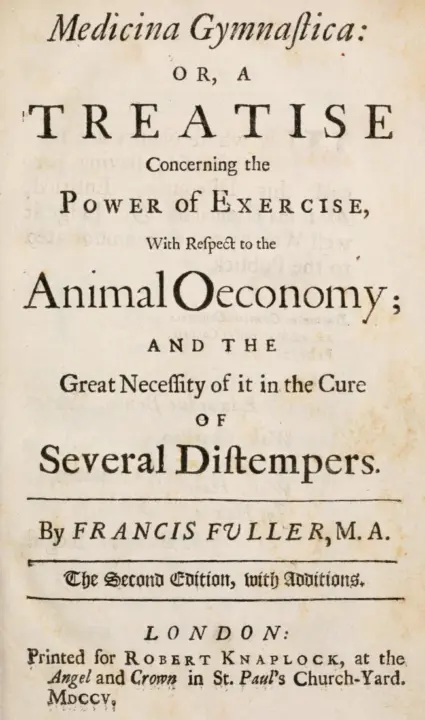
THE CLASSIC COLLECTION · 1705
"Medicina Gymnastica" by Francis Fuller is a scientific treatise written in the early 18th century. The book focuses on the importance of exercise in maintaining health and treating various ailments, emphasizing the interconnection between physical activity and the body's overall functioning. Fuller challenges the prevailing belief that medicine revolves primarily around internal remedies, advocating for a more holistic approach that includes physical exercise. At the start of the treatise, Fuller provides an insightful preface discussing the misconceptions surrounding physical health and medicine. He argues against the limited view of pharmacy as solely reliant on internal medications, instead highlighting the body's need for diverse methods to achieve wellness. He introduces the concept of exercise as an essential aspect of health, able to stimulate healing processes and enhance the efficacy of medicines. Fuller's observations draw on historical practices and personal experiences, setting the stage for a more comprehensive exploration of how exercise can play a pivotal role in treating specific diseases, particularly those affecting the lungs, and encouraging a shift in medical philosophy toward a balance between internal and external methods of healing.
Introduction adapted from the source catalogue; source summaries may be automatically generated.
Free to read · English · 42,831 words · No account needed
MAKE TIME FOR A GOOD BOOK
On by default. Untick to stop anonymous reading totals. Each page counts after 10 seconds in view. How this works.
Anonymous counting is on unless you have switched it off.
A great deal more might be added on this neglected Subject; but I think I have said enough to prove what I above asserted, viz. The exquisite Agreement, between the Practice of the Ancients, and our Theory of the Cutaneous Parts; and if this will not encourage any to hope for the like Advantage from the same Methods now in our days, nothing that I can say more will avail.
Of being Exercis’d to bear COLD.
The next and last Gymnastick Method I proceed to, is the Use of the Cold Bath; if any should wonder to find me rank this, among the several sorts of Exercise, they may consider, that it was ever reputed for one among the Ancients, and not without Reason; since it makes the Spirits recoil, and act with more united Vigour, upon the Subject-matter of the Disease, and so a Cure may be made by them alone, without any Medicinal Virtue, receiv’d through the Pores, as in other outward and Topical Applications; this comes up to the Notion of an Exercise, because it enables Nature to accomplish the Work of Healing her self.
I shall not attempt to account for the Advantages of this Practice, because that has been done already so copiously by Sir John Floyer and Dr. Baynard, and the World has already begun to experience the good Effects of it, and there are Examples enough, every where known, to justifie the recourse to it, in the Cases to which I apply it; and ’tis to be hop’d now, that Men will begin to consider the Folly and Mischief of the too warm Regimen, which in health does often prepare ’em for Sickness, and in Sickness does often increase the Disease, and hasten Death, a Regimen which would be much more proper, for one that is to have a sudden passage into a warm Country, than for us who are to prepare our selves for the bearing of the Cold; a thing which we cannot fly from, and therefore ought to resist it; and which is not so formidable or dangerous, as for a great while has been thought. The Inhabitants of this Nation formerly went Naked, and were more Healthy than we are now; and the People of Canada, and all the Cold Continent behind Newfoundland, go much after the same manner, without any Inconvenience from it, but are rather fortifi’d against the Accidents they would be subject to, if their Pores were too much open’d and relax’d by too much warmth; and we may very well distinguish the Rational, from the Savage Part, by as thin a Habit as Decency will permit. It is a strange thing, that People should be fond of suppling their Skins, and keeping their Pores too open; as if a Man did not as really perspire, when there is no sensible Moisture upon the Skin, tho’ not so much, as when he is all bedew’d with Exhalations, which should not be sent out in so great Quantity, but upon brisk Exercise. If Men knew how much Sweat impairs the Skin, and inclines it to wrinkle, as Sanctorius tells us in one of his Aphorisms, they would be fully perswaded, that Nature can make her Discharges by finer and better ways, than those which are so perceptible, and that Flannel is scarce necessary or convenient on this side Old Age. The nervous parts of the Skin have certainly a very great Elasticity, and are capable of being strengthned by good and suitable Management, even to a Habit, as well as those of other Parts; and we see, that when the Glands of the Skin do throw out a very sensible quantity of Sweat in some particular Parts, these Parts grow accustom’d to the Air, or other Moisture, and receive little or no hinderance in their discharges from it; as we see the Palms of the Hands shall sweat copiously, notwithstanding the External Air immediately striking upon ’em; and none are more Strong and Healthy, than those who are wont to have their Feet wet without changing their Shooes and Stockings for it. The Stomach plac’d in the midst of the Body, and consequently exquisitely warm, is so adapted, as to bear large Draughts of the Coldest Liquor, without the least Damage, unless the Body has been extremely heated; and tho’ its Office seems to require great and continual Heat, yet it is not obstructed in it, by the admission of Cold things, nor are its Glands benumn’d or constring’d, so as to hinder the Secretion of digesting Juices; and can we suppose the Fabrick of the Skin less perfect, and exquisite, when by its position it is to be immediately subject to the effects of the External Air? Can we think its Vessels are not endu’d with a strength sufficient to answer the Force and Weight of the incumbent Air? And its Glands of such a make, as that the Particles they strain shall be of so fine a Texture as to pass the Skin, when it seems to us to be too close to permit any transition? We make but indifferent use of a very good Theory, that Sanctorius has furnish’d us with, if we give way to these Thoughts, and encourage too frequently the promoting of Sensible Perspirations; which, be they in never so small a degree, are the effect of some Violence upon Nature, and consequently not to be compar’d with the other more Even and Regular Secretion.
Your reading position is saved on this browser. Take it to another device with a library code. Reading pages adapt to text, rather than matching a printed edition.
BEHIND THE BOOK
This eBook is for the use of anyone anywhere in the United States and most other parts of the world at no cost and with almost no restrictions whatsoever. You may copy it, give it away or re-use it under the terms of the Project Gutenberg License included with this eBook or online at www.gutenberg.org. If you are not located in the United States, you will have to check the laws of the country where you are located before using this eBook. Read the source licence.
The original source file, including credits and licence, is retained by this library. Request an original-format copy at no charge. Please include the book title and Project Gutenberg identifier #63497.
KEEP YOUR CURIOSITY GOING
Charles G. (Charles Griffith) Ross
Hannah Webster Foster

Emily Lawless
Edwin Hamlin Carr

Charles De Lano Hine
Andrew Ure