
The Writing of News A Handbook with Chapters on Newspaper Correspondence and Copy Reading
Charles G. (Charles Griffith) Ross
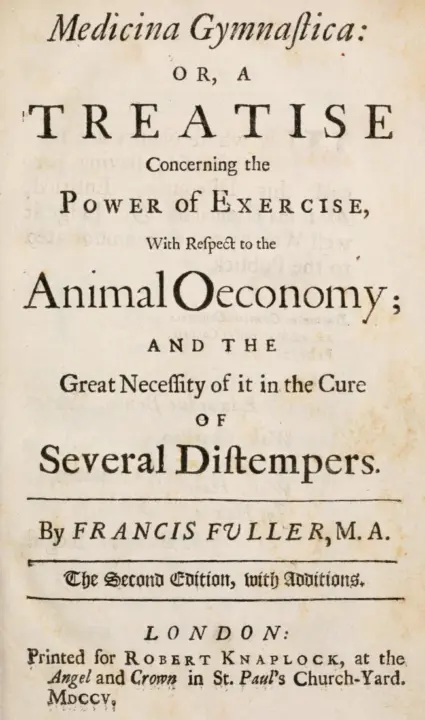
THE CLASSIC COLLECTION · 1705
"Medicina Gymnastica" by Francis Fuller is a scientific treatise written in the early 18th century. The book focuses on the importance of exercise in maintaining health and treating various ailments, emphasizing the interconnection between physical activity and the body's overall functioning. Fuller challenges the prevailing belief that medicine revolves primarily around internal remedies, advocating for a more holistic approach that includes physical exercise. At the start of the treatise, Fuller provides an insightful preface discussing the misconceptions surrounding physical health and medicine. He argues against the limited view of pharmacy as solely reliant on internal medications, instead highlighting the body's need for diverse methods to achieve wellness. He introduces the concept of exercise as an essential aspect of health, able to stimulate healing processes and enhance the efficacy of medicines. Fuller's observations draw on historical practices and personal experiences, setting the stage for a more comprehensive exploration of how exercise can play a pivotal role in treating specific diseases, particularly those affecting the lungs, and encouraging a shift in medical philosophy toward a balance between internal and external methods of healing.
Introduction adapted from the source catalogue; source summaries may be automatically generated.
Free to read · English · 42,831 words · No account needed
MAKE TIME FOR A GOOD BOOK
On by default. Untick to stop anonymous reading totals. Each page counts after 10 seconds in view. How this works.
Anonymous counting is on unless you have switched it off.
Lastly, I know these are hard Sayings to some People, who send for a Physician, as for one that deals in Charms, and can remove all their Afflictions, while they are wholly Passive; and they would take it very ill that they should be compell’d to a sort of Labour, while they carry about ’em a Load in their Limbs; but yet for all this, Nature will be Nature still; and if this be her Voice it must be obey’d. He that is in a Dropsie ought to be Alarm’d, and look upon himself as in something the like Case with those Criminals whom the Dutch, upon their refusing to Work, confine to a Cellar, and let the Water in upon ’em, that they may be in a Necessity either of Pumping or Drowning. And I believe there are but few, but who, upon their being convinc’d of the real and surprising Benefit of these Means, would readily undergo the Fatigue of ’em; and things may be so manag’d, that Exercise may not be so troublesome as the Sick imagine; an easie Pad will quickly grow familiar; and where the Legs happen to be so very much distended, that there may be some danger, lest the Skin should be rub’d off, a Chaise may serve the turn.
OF THE Hypochondriacal DISTEMPER.
The third and last Case, which I shall expresly consider, is the Hysterick or Hypochondriacal Case; in the Cure of which the several Exercises, which I shall hereafter Recommend, may all be us’d. This Distemper falls the most under a Gymnastick Method, because the least proper to be treated with much Internal Physick; this is a Distemper which will not drive, as we say, but if kindly treated will lead, that is, will not be expell’d by Purging, Bleeding, Sweating or the like, but must be treated by more gentle and leisurely Methods; ’tis a Distemper of the Spirits, and the Vessels which immediately convey ’em; and therefore those means by which they are more immediately affected, are the most likely to prove beneficial. Here it is, if ever, strictly true, that a little Matter gives the turn, but then that little matter must be equally apply’d; we must give an equal lift to all the Parts of the Oeconomy at the same time, we must not apply to the Fluids, and neglect the Solids. ’Tis the want of this Distinction, which I take to be the Ground of all our mistakes in the Cure of this Distemper; we cure but half the Man, When I meet with a Languid Hysterick Pulse, I can easily raise it, and give a full Beat to the Artery, by Anti-Hysterick Medicines; but then what becomes of the Nerves, they are not much help’d by this, But sometimes impair’d by it? but then let the same Person have Recourse to some moderate Exercise, his Pulse shall rife as high as upon the use of Internals, but with this Difference, that the Nerves as well as the Blood partake of the Benefit. For we may distinguish between this natural advance of the Bodily heat, which is procur’d by Exercises, and that which is acquir’d by Medicines, just as we may between the Effects of the Kindly Heat of the Sun, and those of an Artificial Fire: Now in the matter of the Vegetation of Plants, and the Management of some sorts of nicer Workmanship, tho’ the greatest Care and Industry be us’d to raise a gentle heat, which to our Senses and even to the Measure of the Thermometer, may seem equal to that of the Sun, yet it shall never be able to produce the same exquisite effects, as the heat of the Sun does. And so we see in this Case the mildest and seemingly most agreeable Gumms prove Purgers to some of these People, others again can’t bear Castor, without some troublesome inconveniences; and how much soever some People may be Rapt up with their Sal Volatile, and such like Preparations, I can perhaps give an instance of more wonderful Relief given in this Case, by a more Common Cordial, than ever those splendid Medicines could produce; it may not be amiss to relate it in this place, because it serves to illustrate my Design in shewing that nothing that has the least seeming Violence in it, or rather that nothing, which is not very mild and agreeable to Nature, can be of very great moment in the Cure of this Distemper. The Instance then I mean, was communicated to me by an Eminent Physician, and very Learned Writer, and is this; He was call’d to see a Maid which had been severely Tormented with Hysterick Fits for several days, and had taken plenty of the Remedies usual in that Case, without any effect; upon which he was resolv’d to try, what a good large Dose of a true generous Wine would do, considering she was a Servant, and consequently could not be suppos’d to be accustom’d to that Liquor, which would have render’d his attempt fruitless; he therefore prescrib’d some Pouders of no Efficacy, to obviate the Phancy of the By-standers, and order’d the Apothecary to ply her with some Wine of his own procuring, that he could depend upon, till she had taken a quantity, which to her might be reckon’d very large; this succeeded like a Charm, after a good Sleep, she was freed of all her terrible Symptoms the next Morning, tho’ before she could scarce stir her head from the Pillow, but she fell into a Fit. And I have twice had the Occasion, to see something of the like nature my self; the first was, where a large Dose of Wine took off some very ill Symptoms, occasion’d by strong Purgers, erroneously repeated in a certain Nervous Case. But the Person had not been us’d to drink Wine, otherwise it could not have produc’d such a happy effect. I instance in these things only to shew, that the Remedies which are most proper and adequate to this Case, must be such as have something of an inimitable Mediocrity in ’em; and that Exercises do produce Alterations in the Body, which resemble the effects of such a singular and Noble Mean, is not improbable, in regard they act so equally (as I observ’d before) both upon the Solids and Fluids. And one would think the Ill Success of any thing, but like Violence, should lead us to some such Measures as these. One would be apt to think that when a Distemper, which carries as little, or may be, the least danger of Life in it, of any whatsoever, tho’ so very troublesome, when this nevertheless becomes one of the most difficult to be perfectly rooted out, one would think, I say, that this odd Circumstance, so like to Contradiction, should prompt us to look out for the real Reason of it.
Your reading position is saved on this browser. Take it to another device with a library code. Reading pages adapt to text, rather than matching a printed edition.
BEHIND THE BOOK
This eBook is for the use of anyone anywhere in the United States and most other parts of the world at no cost and with almost no restrictions whatsoever. You may copy it, give it away or re-use it under the terms of the Project Gutenberg License included with this eBook or online at www.gutenberg.org. If you are not located in the United States, you will have to check the laws of the country where you are located before using this eBook. Read the source licence.
The original source file, including credits and licence, is retained by this library. Request an original-format copy at no charge. Please include the book title and Project Gutenberg identifier #63497.
KEEP YOUR CURIOSITY GOING
Charles G. (Charles Griffith) Ross
Hannah Webster Foster

Emily Lawless
Edwin Hamlin Carr

Charles De Lano Hine
Andrew Ure