
The Writing of News A Handbook with Chapters on Newspaper Correspondence and Copy Reading
Charles G. (Charles Griffith) Ross
THE CLASSIC COLLECTION · 1705
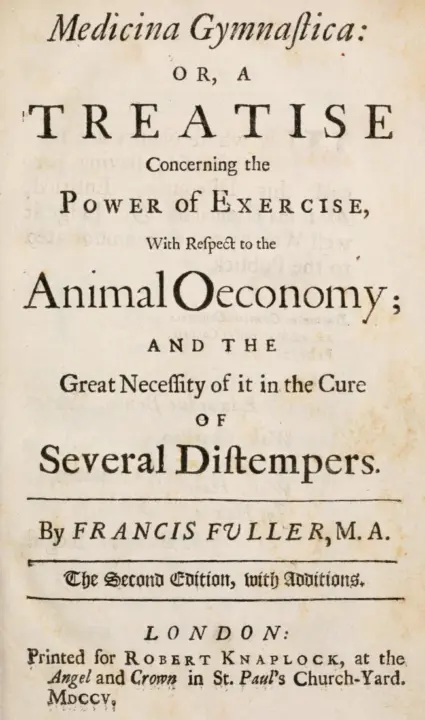
"Medicina Gymnastica" by Francis Fuller is a scientific treatise written in the early 18th century. The book focuses on the importance of exercise in maintaining health and treating various ailments, emphasizing the interconnection between physical activity and the body's overall functioning. Fuller challenges the prevailing belief that medicine revolves primarily around internal remedies, advocating for a more holistic approach that includes physical exercise. At the start of the treatise, Fuller provides an insightful preface discussing the misconceptions surrounding physical health and medicine. He argues against the limited view of pharmacy as solely reliant on internal medications, instead highlighting the body's need for diverse methods to achieve wellness. He introduces the concept of exercise as an essential aspect of health, able to stimulate healing processes and enhance the efficacy of medicines. Fuller's observations draw on historical practices and personal experiences, setting the stage for a more comprehensive exploration of how exercise can play a pivotal role in treating specific diseases, particularly those affecting the lungs, and encouraging a shift in medical philosophy toward a balance between internal and external methods of healing.
Introduction adapted from the source catalogue; source summaries may be automatically generated.
Free to read · English · 42,831 words · No account needed
MAKE TIME FOR A GOOD BOOK
On by default. Untick to stop anonymous reading totals. Each page counts after 10 seconds in view. How this works.
Anonymous counting is on unless you have switched it off.
These four different Circumstances of this Distemper, may suffice to shew that I have Colour enough for my calling in the Gymnastick Method into this Case, and ’tis the first of the Exceptions, I mean the ill Effects, which sometimes follow upon the Use of Purgatives, which have chiefly occasion’d me to inquire, whether we ought in this plain Case, thus circumstantiated to halt between two Opinions, between Purgatives and Diureticks, without endeavouring to establish a certain Praxis upon Just Foundations.
There are none will deny, but Diureticks are the most proper and natural Remedies in this Case, if they would always succeed, because directed to the proper Emunctory, the Kidneys, and because they can go hand in hand, with the Corroborative Medicines to be given at the same time; I take it for granted therefore, that whenever Purgatives are us’d in this Case, it is because the Diureticks don’t take quick enough, or in order to carry off the load of Serum, that the Diureticks may the sooner display their good effects, because it will be alledg’d that the Serum becomes so Ropy and Glutinous in the Passages and Capillary Parts, that the Diuretick cannot always act upon it. But tho’ this is granted, it will not suffice to warrant the Use of the stronger Purgatives, because their manner of Acting cannot agree with this Distemper, and because those difficulties objected, may be overcome by other means.
First, the very Nature of strong Purgers, makes against this Case, it seems very preposterous, to have recourse to such Deleterious Drugs, to those Mortis Catapultæ (as Ludovicus calls the Esula’s and such like Purgatives) in Order to the Restoring an impoverish’d Blood; if they acted only by Stimulating the Intestines, something might be said; but since it is indisputable that they pass into the Blood, and act powerfully upon it, there is no doubt to be made, but they fuze and divide it, and break its Globules, and consequently make as much Water as they carry off, which is the very Reason why Sweating is laid aside, and Salivation, tho’ they both seem so proper to carry off Watery Humours; I know it may be alledg’d in Defence of these Medicaments, that the 36th and 37th Aphorisms, of the Second Section seem to imply, that a Sick Person would receive less Harm from ’em, than one that is in Health; but yet this will not excuse their Use in our Case, because tho’ the Viscousness of the Serum, may blunt the Particles of those Drugs for a time, and hinder ’em from working so quickly, yet when once they are throughly imbib’d, and begin to exert their Force, they ravage the very Principles of Life, and can by no means be fit for a Person in so low a condition. But admit that the Water is carry’d off by these means, the Blood will be left as poor at least as it was before the Dropsie first appear’d; and then how can we be sure the Waters will not rise again? Suppose an Anasarca follows upon an Hæmorrhage, which is very common, and you draw off the Water by Purging; will not the Person be just in Statu quo, upon supposition that the Medicines in their working did not impair Nature? but that is not to be granted, because it is impossible to suppose, that such Drastick Medicines, should not prey upon Nature, even while they are assisting her; and can we be assur’d that the Blood will not run into the same Colliquation it did before? Besides, may there not be some reason to suspect that the very quantity of the Serum, supposing it is not too Turgid indeed, may sometimes be serviceable, to the promoting the activity of the Diuretick, even as we find in the true Ascites, it is of some use in the Cavity of those Persons, because they often can’t spare it, without certain Ruine? We don’t know how much the confidence of the Fluid may conduce to the keeping its homogeneous Particles combin’d, and we ought to be very tender of doing any thing, that might tend to dissolve the Crassamentum, the Globules, which are as it were the very Semen Sanguinis (if I may so speak); for how far Nature would endure such measures, before the Sanguification would be totally subverted, would require a Dissertation, longer than my Scope will permit; but that this is sometimes done is not improbable, and I take this to be the Case of a Young Fellow I knew, who falling into a slight Dropsie, goes to an Empirick somewhere about White-Chappel, from whom he had a Dose of Pills, which gave him about 30 Stools, which sunk him so much that his Nails turn’d black, and he died in two or three days time; Here ’tis very likely the Signification was entirely extinct, and the Blood chang’d into a Preternatural Fluid, and all by the great Power of these Deleterious Drugs; and tho’ ’tis likely the Quack did not know the proper Dose of his Medicines, yet one would think, this was no more than what might be expected from Ten Grains of Elaterium, which yet has been allow’d by an Eminent Writer.
Your reading position is saved on this browser. Take it to another device with a library code. Reading pages adapt to text, rather than matching a printed edition.
BEHIND THE BOOK
This eBook is for the use of anyone anywhere in the United States and most other parts of the world at no cost and with almost no restrictions whatsoever. You may copy it, give it away or re-use it under the terms of the Project Gutenberg License included with this eBook or online at www.gutenberg.org. If you are not located in the United States, you will have to check the laws of the country where you are located before using this eBook. Read the source licence.
The original source file, including credits and licence, is retained by this library. Request an original-format copy at no charge. Please include the book title and Project Gutenberg identifier #63497.
KEEP YOUR CURIOSITY GOING
Charles G. (Charles Griffith) Ross
Hannah Webster Foster

Emily Lawless
Edwin Hamlin Carr

Charles De Lano Hine
Andrew Ure