
The Writing of News A Handbook with Chapters on Newspaper Correspondence and Copy Reading
Charles G. (Charles Griffith) Ross
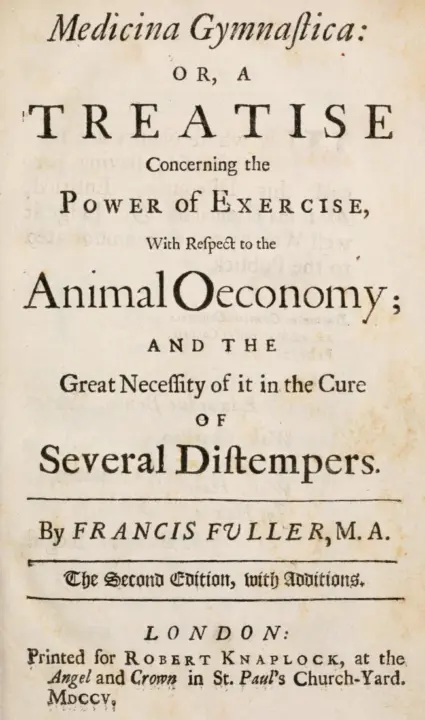
THE CLASSIC COLLECTION · 1705
"Medicina Gymnastica" by Francis Fuller is a scientific treatise written in the early 18th century. The book focuses on the importance of exercise in maintaining health and treating various ailments, emphasizing the interconnection between physical activity and the body's overall functioning. Fuller challenges the prevailing belief that medicine revolves primarily around internal remedies, advocating for a more holistic approach that includes physical exercise. At the start of the treatise, Fuller provides an insightful preface discussing the misconceptions surrounding physical health and medicine. He argues against the limited view of pharmacy as solely reliant on internal medications, instead highlighting the body's need for diverse methods to achieve wellness. He introduces the concept of exercise as an essential aspect of health, able to stimulate healing processes and enhance the efficacy of medicines. Fuller's observations draw on historical practices and personal experiences, setting the stage for a more comprehensive exploration of how exercise can play a pivotal role in treating specific diseases, particularly those affecting the lungs, and encouraging a shift in medical philosophy toward a balance between internal and external methods of healing.
Introduction adapted from the source catalogue; source summaries may be automatically generated.
Free to read · English · 42,831 words · No account needed
MAKE TIME FOR A GOOD BOOK
On by default. Untick to stop anonymous reading totals. Each page counts after 10 seconds in view. How this works.
Anonymous counting is on unless you have switched it off.
Thus I have consider’d how the Use of Moderate Riding will conduce to the conveying off the Subject matter of the Disease. The next Indication is the Strengthning the Tone of the Lungs and Muscular Parts, which in this Distemper grow Flaccid, I might add of the Stomach too, but that we can help that Bowel by many excellent Internal Remedies. Now I would fain know of any Man, how we can reach the Flaccidity of the Lungs, by Internal means, till the Distemperature of the Blood is remov’d, when it will go off in Course, but would be done much sooner, if we assisted both the Solids and Fluids at the same time; now that the very Lungs itself may appear, not to be out of the reach of a Habit of Exercise, let any one consider the strength of that Part, which Divers acquire by frequent Diving; or to come nearer to our Purpose, take any two Men equally, us’d to Hard Labour, of equal strength as near as we can guess whereof one has accustom’d himself to Running, the other never done so, all the World knows that the Practis’d Footman shall Run a great deal farther, and much faster than the other can do: Tho’ in the Common Sense of the Expression, this latter has a Clear Wind as we say, and is in perfect Health; which invincibly proves, that the Lungs tho’ a Bowel, are capable of a Habit, and that with a Proportional Allowance, the gentle, easie Exercise, of Riding, must introduce a New Habit, into the Lungs of a Consumptive Person, and so recover the Tone of that Bowel.
I know it will be reply’d here, that Balsamick and healing Medicines are suppos’d to strengthen the Parts they are directed to, that they are generous Medicines, of fine Parts, and consequently fitted to Communicate a firmness, a Spring to the Nervous and Membranous Parts of the Lungs; and if it could be prov’d that they did Heal so much as they have been pretended to do; I would readily allow they did Strengthen those Parts, but I have had some considerable Opportunity, to observe the Use of those Medicines, and I never could find that if Alteratives fail’d, Balsamicks would do any great good; that is, taken strictly as Balsamicks, upon a Healing Intention. I doubt not, but in the beginning of the Distemper, as Alteratives they may be of Service, especially the milder sort; by the pleasant sensation they Create, and the Consent of the Parts they will give present Abatement of the Cough, and when brought into the Blood, may by Promoting a Diurisis, or by precipitating some of the Acrimony, help to carry off the Cause of the Cough, after the Alterative way, but that when there is any Ulceration in the Lungs, and the Blood is loaded with Hot and fretting Particles, they should then heal so much, I cannot conceive. If we will but give our selves leave to examine a little closely how they act, when externally apply’d to a Sore, we shall not perhaps find, that they are all of ’em such immediate Healers; some of ’em are too fine and Stimulating to be us’d as Eupoloticks, but rather prove Digestives, and therefore must be more likely to cause a too great Agitation in the Blood of these People, than a healing of the Ulcer; I know it may be here reply’d; that they are very proper to cleanse the Ulcerated parts of the Lungs in order to their better healing; but I can’t imagine how it should come about, that there should be such great need of cleansing the Ulcuscula in a part of so Spongy and Membranous a Substance as the Lungs, where there can be no redundancy of Parenchymatous Juices to feed the Ulcers; besides it is to be consider’d, that the constant Motion of the Lungs, will help so deterge the Ulcerated part, just as if we should suppose a Man, that has an Ulcer in his Leg, should be squeezing the Lips of it together all day long, we can’t doubt but he would by that means work out the Pus, the Slough, and all the mispurities of the Sore, and in like manner, the Heaving and Subsiding of the Lungs will hinder any thing from Bedding or Lodging it self long in a part that is really Ulcerated. And alass! here is the grand difficulty in a way to a Cure, we can’t easily bring so arid a Substance, as that of the Lungs to unite, when lacerated, because of its continual Motion; so that there is all the reason in the World, for us to heap in only healing Medicines, strictly taken, without any thing that may prove in the least stimulating. Therefore, wherever Balsamicks have done any great good; I cannot think it has been any other way, than by deriving of the Acrimony from the Blood, and not by immediately healing the Part affected; so that tho’ these are Noble Medicines in Colicks and Simple Affects of the Stomach, where the State of the Blood is quite different, yet here they are too Generous. They are like the Sword of a Gyant, in the Hands of a Dwarf, that will not help but Oppress. And as for the Oily Medicines, which may be call’d a sort of milder and Artificial Balsamicks, we ought to consider, that the Blood is Replenish’d with a better Oyl than any we can immediately supply it with; I mean the Fat, which to the quantity of a Pint at least is continually passing, into, and out of the Blood: And yet in this Ill Habit of Body it wasts daily, and does not Unite with the other Fluids as in a state of Health. What then can we do by the Poor Addition of a few Drachms of Unctuous Stuff, which after it has pass’d the Stomach enters the Blood, to the quantify of a few Grains, and does not the least good, in Reparation for the unpleasantness in the Taking, and the Uneasiness it sometimes causes in the Stomach of the Sick Person?
Your reading position is saved on this browser. Take it to another device with a library code. Reading pages adapt to text, rather than matching a printed edition.
BEHIND THE BOOK
This eBook is for the use of anyone anywhere in the United States and most other parts of the world at no cost and with almost no restrictions whatsoever. You may copy it, give it away or re-use it under the terms of the Project Gutenberg License included with this eBook or online at www.gutenberg.org. If you are not located in the United States, you will have to check the laws of the country where you are located before using this eBook. Read the source licence.
The original source file, including credits and licence, is retained by this library. Request an original-format copy at no charge. Please include the book title and Project Gutenberg identifier #63497.
KEEP YOUR CURIOSITY GOING
Charles G. (Charles Griffith) Ross
Hannah Webster Foster

Emily Lawless
Edwin Hamlin Carr

Charles De Lano Hine
Andrew Ure