
The Writing of News A Handbook with Chapters on Newspaper Correspondence and Copy Reading
Charles G. (Charles Griffith) Ross
THE CLASSIC COLLECTION · 1705
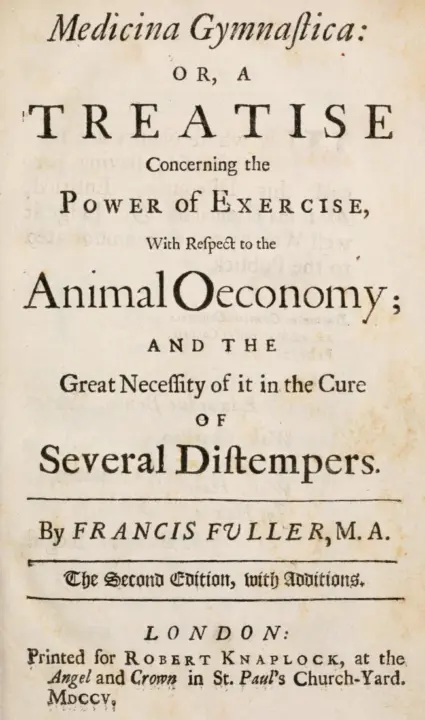
"Medicina Gymnastica" by Francis Fuller is a scientific treatise written in the early 18th century. The book focuses on the importance of exercise in maintaining health and treating various ailments, emphasizing the interconnection between physical activity and the body's overall functioning. Fuller challenges the prevailing belief that medicine revolves primarily around internal remedies, advocating for a more holistic approach that includes physical exercise. At the start of the treatise, Fuller provides an insightful preface discussing the misconceptions surrounding physical health and medicine. He argues against the limited view of pharmacy as solely reliant on internal medications, instead highlighting the body's need for diverse methods to achieve wellness. He introduces the concept of exercise as an essential aspect of health, able to stimulate healing processes and enhance the efficacy of medicines. Fuller's observations draw on historical practices and personal experiences, setting the stage for a more comprehensive exploration of how exercise can play a pivotal role in treating specific diseases, particularly those affecting the lungs, and encouraging a shift in medical philosophy toward a balance between internal and external methods of healing.
Introduction adapted from the source catalogue; source summaries may be automatically generated.
Free to read · English · 42,831 words · No account needed
MAKE TIME FOR A GOOD BOOK
On by default. Untick to stop anonymous reading totals. Each page counts after 10 seconds in view. How this works.
Anonymous counting is on unless you have switched it off.
As for what I have said, relating to the Balsamick Method in the Cure of Consumptions, tho’ I may perhaps give Offence to many, yet I am sure I speak the Thoughts of some of the greatest of the Profession, if not of the generality of Physicians, who have for a great while, had a secret Regret, at the ill Success of those Means, which nothing could have stifl’d and suppress’d, but the Difficulty of agreeing to substitute better. This I do not pretend to do neither, this would be too daring an Enterprize for me; I only point out some few Mistakes, which one of my little Consideration, may sometimes discern in the Actions of those of greater Condition. And perhaps when these Mistakes are rectified, the Business is done, as well as if I had discovered to the World, some wondrous Medicine, dignifi’d with as many and as swelling Titles, as an Eastern Monarch; for it seems to me to be a great Mistake, to wait for some Medicine of a great Character, to be the Specifick, or Certain or Adequate Remedy of this Disease. I am inclin’d to think, that the Cure must result as much from some Circumstances of Management, as from any Medicine. ~I~ believe we have the best of Medicines for this Case, in our Hands, if we did but take Pains to obviate some minute Circumstances, that make those Medicines often prove deficient; if the Success did not vary by Reason of such small Emergencies, ~I~ don’t know how we should account for what we find to be true, ~viz.~ that some common and despicable Medicines shall in one Person produce a wonderful Cure, and in another do nothing at all, tho’ as far as Humane Wisdom can discern, the Case is exactly the same in both; and why should it seem strange, if this should happen in Cases, so fine as those of the Lungs, when we see in several Manufactures the Accuracy and Perfection of an Operation shall depend upon a certain ~Finesse~, the ~Criterion~ of which is scarce to be describ’d, but to be learn’d only by Numerous Repetitions. A Man may be told the Ingredients of a Composition, and the way of working ’em up; may see it done, and not be able to distinguish the Nicety of the Circumstances, which conspire to make the Work consummate. Do not we know, that in the ~Dyers~ Trade, (to give but one Instance) their Mixtures shall sometimes miscarry, and the best Artist not be able to shew a Reason for it; now if it is thus in matters of Artifice, I think we may with great reason suspect something of a like Nature, in some few Cases of the Humane Body; in these Maladies of the Breath, there is a ~Finesse~ peculiarly distinguish’d from the Circumstances of any other Diseases, as is apparent from the Power of so fine a Body as the Air; and therefore we need not think it so strange, that a little matter should be able to give a good or bad turn. And if this will be allow’d to be good Reasoning; what can be so likely to obviate such Miscarriages, as a due application to that most moderate and easie Exercise, which I have apply’d to the Cure of this Distemper? That a mild Exercise will do something like this, may be learnt from the Effects of those which are more violent; we know very well what has follow’d upon going into the ~Bagnio~, after violent Exercises, the Blood of those Persons who have done so, has so been exalted in its Crasis, as to be upon that very account, fatally Preternatural; tho’ upon the first Thought, One would be apt to conclude, that such violent Perspirations should rather impoverish the Blood; but it is quite contrary, just as in Hot Climates, tho’ People Sweat profusely, yet they are rather the more Brisk and Lively for it. And thus Moderate Exercise, by Augmenting the Natural Heat of the Body, will enrich the Fluids, and by encreasing the Velocity of the Circulation, every the minutest Particle will be brought much oftner to the Test of the Strainers, than otherwise it would have been; so that both the Venous Fluid and the Spirits will after an Eminent Manner be exalted, and as it were Rectifi’d in the making. Therefore it cannot be a doubt, that these means may improve a Medicine, when it comes into the Blood, supply its deficiency, and remove the Inscrutable Inpediments in the Cure of so nice a Disease, as this I am speaking of.
Your reading position is saved on this browser. Take it to another device with a library code. Reading pages adapt to text, rather than matching a printed edition.
BEHIND THE BOOK
This eBook is for the use of anyone anywhere in the United States and most other parts of the world at no cost and with almost no restrictions whatsoever. You may copy it, give it away or re-use it under the terms of the Project Gutenberg License included with this eBook or online at www.gutenberg.org. If you are not located in the United States, you will have to check the laws of the country where you are located before using this eBook. Read the source licence.
The original source file, including credits and licence, is retained by this library. Request an original-format copy at no charge. Please include the book title and Project Gutenberg identifier #63497.
KEEP YOUR CURIOSITY GOING
Charles G. (Charles Griffith) Ross
Hannah Webster Foster

Emily Lawless
Edwin Hamlin Carr

Charles De Lano Hine
Andrew Ure