
The Writing of News A Handbook with Chapters on Newspaper Correspondence and Copy Reading
Charles G. (Charles Griffith) Ross
THE CLASSIC COLLECTION · 1705
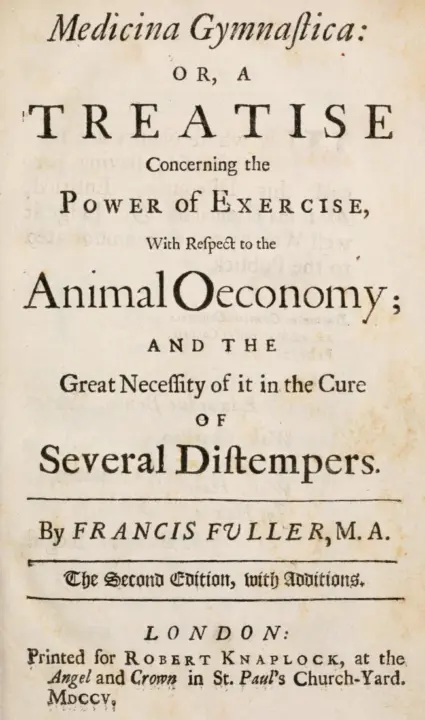
"Medicina Gymnastica" by Francis Fuller is a scientific treatise written in the early 18th century. The book focuses on the importance of exercise in maintaining health and treating various ailments, emphasizing the interconnection between physical activity and the body's overall functioning. Fuller challenges the prevailing belief that medicine revolves primarily around internal remedies, advocating for a more holistic approach that includes physical exercise. At the start of the treatise, Fuller provides an insightful preface discussing the misconceptions surrounding physical health and medicine. He argues against the limited view of pharmacy as solely reliant on internal medications, instead highlighting the body's need for diverse methods to achieve wellness. He introduces the concept of exercise as an essential aspect of health, able to stimulate healing processes and enhance the efficacy of medicines. Fuller's observations draw on historical practices and personal experiences, setting the stage for a more comprehensive exploration of how exercise can play a pivotal role in treating specific diseases, particularly those affecting the lungs, and encouraging a shift in medical philosophy toward a balance between internal and external methods of healing.
Introduction adapted from the source catalogue; source summaries may be automatically generated.
Free to read · English · 42,831 words · No account needed
MAKE TIME FOR A GOOD BOOK
On by default. Untick to stop anonymous reading totals. Each page counts after 10 seconds in view. How this works.
Anonymous counting is on unless you have switched it off.
These are some familiar Instances of the Sense we have, after what manner we come to acquire more Strength upon the Use of Exercise, and which every Man almost may recollect, that he has experienc’d more or less in himself; tho’ in other Cases the solid Parts are always strengthening by Exercise, without so plain a Sense of it, as in the Instances above mention’d; as we see what excessive Strength some Men gradually acquire by a constant Practice of vehement Motions, begun when they are young, which growing upon ’em by degrees, they are not so sensible of the Encrease of it. This is the Case of Tumblers, Rope-dancers, and the like, in whom the Nervous and Solid Parts must be incomparably more wound up, more tense than in other People; and thus we see the strongest Men are often thin and Raw-bon’d, as we call it; that is, tho’ daily hard Labour, and great Perspiration carry off a great deal of the grosser Fluids of the Body; yet are the Muscles not Flaccid, but Tense and Firm, capable of greater Actions than the Muscles of those who seem to have a better Habit of Body; which plainly indicates, that Exercise does communicate some Strength to the Nervous Parts, which cannot be any other way procur’d; and that we may argue from the greater to the less; that if healthy Persons may acquire such monstrous Strength by Use, People that are Valetudinary may, by setting themselves upon a resolute and diligent Practice of moderate Exercise, obtain a proportionable Increase of Strength.
It may be expected, perhaps, that I should endeavour to explain, how the Fibres come to receive a greater Power to act, by being often put upon Action, and to shew wherein the Elater, the Spring of the Solids, does consist; but this has been attempted so largely by an Eminent Author, Dr. Baglivi, and so much to the Disgust of very many, that it’s better to rest contented with plain Experience, than to frame an Hypothesis for the Modus of so abstruse a Method of Nature, which, in all likelyhood, Mankind will ever be ignorant of; but as far as we may reasonably guess, by frequent Distension the Nerves receive a greater quantity of Animal Spirits, because the Limb which is most us’d, grows biggest; and there is reason to induce us to suspect, that the Fibre it self strengthens by Use, has a peculiar Faculty to exert it self more and more, as often as the Imperium Voluntatis, the Fiat of the Will, sets it upon Motion. But unless we knew the Bond of Union, and understood how the Rational Soul acts upon the Animal Powers, we must be content to be most ignorant, the nearer we approach in our Disquisitions to that Union; but the Experimental Knowledge of these Parts sufficiently reproves those who hope to be deliver’d from some Distempers seated in the Solids, without acting suitably to the Nature of the Solids, the Subject of their Distempers: As for Instance; Suppose a Person, by frequent and unnecessary Use of the Bagnio, and more unnecessary Bleedings; by the Use of hot Liquors, and a perfect Disuse of all Bodily Exercise; by Passions of the Mind, and other Irregularities, is brought into the very worst of Hysterick Symptomes, with a Flaccidity and Relaxation of the whole Nervous System; How ridiculous is it, for such a Person to expect to be perfectly restor’d to a firm Habit of Body by internal Alteratives, and Methods little different from those things which occasion’d the Distemper; which tho’ they may give wonderful Relief in the Paroxysm, yet can never restore the Tone of the Solids, which must be treated in a manner proper to themselves, by Frictions, Exercise of the Body, the Cold Bath, and the like; which are very likely to be able to succeed to a perfect Cure? For why ought we not to suppose, that as all Fluids have more or less a Tendency to purifie and exalt themselves by Fermentation, the Solids should otherwise have a Propensity proper to their Make, to recover themselves by a due Tension? And what can be more reasonable and natural, than to conclude, that if a Supine and Luxurious Course of Life has enervated the Body, an Active and Vigorous one should restore it? If it be objected, That gentle Emeticks have gone a great way towards procuring a perfect Recovery from some Hysterick Cases; I have premis’d already, that they act upon the Fibres, and put ’em upon frequent Contractions, much after the same manner as a total Exercise of the Body; and therefore in this last Case, where the first Passages are not in Fault, their way of acting illustrates what I assert, that the Solids must be made to strengthen themselves, and recover their Spring by frequent Endeavours. But for Alteratives, strictly taken, I think it may be justly a Question, Whether there is that Medicine in Nature, that can remove this Distemper, when it has been of long continuance, tho’ the World has been taught above an Age ago by Paracelsus and his Followers, to expect what I fear is not within the Extent of Nature; and the Impudence of Empiricks is so great, as to promise every thing that is absurd and Romantick; which keeps People up with hopes, that they may be so happy as to meet with that mighty Secret, which even in the quantity of a few drops, shall as it were charm away the most troublesome and riveted Distemper, and so instead of being Cur’d, they are Kill’d by Expectation; when the Power of Recovering their Health was in their own hands, if they had resolutely set about the proper means; like the Country-Fellow in the Fable, who when his Cart stuck fast in the Mire, must needs be calling upon Hercules to come and help him, when with setting his own Shoulders to the Wheels, he might easily have got clear.
Your reading position is saved on this browser. Take it to another device with a library code. Reading pages adapt to text, rather than matching a printed edition.
BEHIND THE BOOK
This eBook is for the use of anyone anywhere in the United States and most other parts of the world at no cost and with almost no restrictions whatsoever. You may copy it, give it away or re-use it under the terms of the Project Gutenberg License included with this eBook or online at www.gutenberg.org. If you are not located in the United States, you will have to check the laws of the country where you are located before using this eBook. Read the source licence.
The original source file, including credits and licence, is retained by this library. Request an original-format copy at no charge. Please include the book title and Project Gutenberg identifier #63497.
KEEP YOUR CURIOSITY GOING
Charles G. (Charles Griffith) Ross
Hannah Webster Foster

Emily Lawless
Edwin Hamlin Carr

Charles De Lano Hine
Andrew Ure