THE CLASSIC COLLECTION✦Sketches in BedlamCLASSIC FREE BOOKS
Sketches in Bedlam
John Haslam
THE CLASSIC COLLECTION · 1817
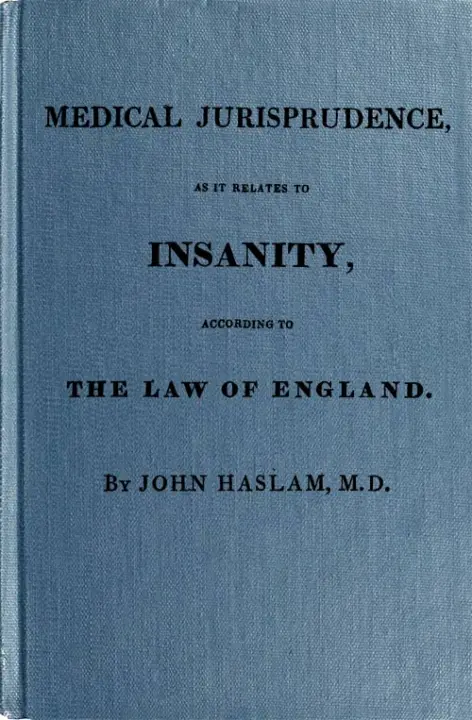
"Medical Jurisprudence as it Relates to Insanity, According to the Law of England" by John Haslam, M.D. is a scientific publication written in the early 19th century. The book delves into the intersection of medical knowledge and legal principles concerning the concept of insanity, particularly in the context of criminal behavior. Haslam aims to clarify the role of medical evidence in legal proceedings involving defendants who claim insanity as a defense, outlining the responsibilities of medical practitioners and the implications of their findings on the administration of justice. In his work, Haslam explores various aspects of insanity, discussing its manifestations, definitions, and the challenges faced by medical professionals when testifying in court. He emphasizes the complexities involved in distinguishing between sane and insane behavior, particularly when individuals are capable of rational thought on some topics while remaining deluded on others. The book further examines significant case studies that illustrate these complexities, such as the psychological profiles of those accused of crimes under delusions, as well as practical considerations for assessing a person's legal responsibility for their actions. Haslam's work remains a crucial resource for understanding the legal and medical nuances of insanity in the 19th century, providing a thorough examination of the obligations that medical experts have when interfacing with the legal system.
Introduction adapted from the source catalogue; source summaries may be automatically generated.
Free to read · English · 16,539 words · No account needed
MAKE TIME FOR A GOOD BOOK
On by default. Untick to stop anonymous reading totals. Each page counts after 10 seconds in view. How this works.
Anonymous counting is on unless you have switched it off.
There is another form of this disorder under the influence of which some insane persons become highly dangerous; but which has not been hitherto sufficiently noticed, although it deserves the fullest consideration. As several instances of this state have fallen under my own observation I shall beg to relate two or three cases with as much brevity as may adequately suffice to convey the facts. It has been already remarked that some insane persons who have recovered the proper direction of their intellects have thoroughly remembered the particulars of their diseased state:—in the instances to be related they have retained no trace of their disorder, nor any of the circumstances which occurred during its continuance.
A very powerful man, above the ordinary stature, who in his youth had been subject to epileptic attacks, and frequently to intervals of sullen abstraction, which increased after the epileptic fits had subsided, became suddenly furious, and during the transports of his disorder destroyed two children and a woman. For this act there appeared to be no motive. He was ordered to be confined, where he continued until his death. For many years during his seclusion I had constant opportunities of seeing and conversing with him. He was ordinarily in a very tranquil state, and did not discourse irrationally;—indeed there was no particular subject on which his mind appeared to be disarranged, nor were there any persons against whom he entertained an aversion. Much of his time was passed in reading, which he said afforded him great consolation. On many occasions I endeavoured to draw from him some account of the motives which induced him to destroy the persons above-mentioned; but he uniformly and steadily persisted that he had no recollection whatever of such occurrence. He said, he understood he had done something which was very wicked, and for which he was confined; and which he had no doubt was true, from the respectability of the persons who informed him of his crime; but he thanked God he had no more memory of what had passed than if it had been committed in his sleep.—During the years of his confinement he had many furious paroxysms, and in order to be fully satisfied of the truth of his asseverations as to his want of recollection during these attacks, he was once blooded at the commencement of the paroxysm, although with considerable difficulty, and on another occasion cupped when its violence was subsiding,—yet when he was restored to his ordinary state of tranquility he neither recollected the persons who were present nor the operations which had been performed.—Of the same class of mental affection was the case of a young lady, who became insane in consequence of having experienced some severe disappointments. She attempted to destroy herself in various ways, and was therefore obliged to be strictly restrained; but to others she manifested no evil intentions. When spoken to, she returned correct answers, although she never began a conversation. During the day she sat apparently sullen and abstracted, and seemed to take no notice of what was passing. After the elapse of three weeks, as she was sitting in her usual manner, she uttered a shriek, appeared for a few moments in a state of alarm and confusion, and suddenly recovered.—Of her repeated attempts at suicide she had not the slightest recollection.—When I visited her the following day she received me as a perfect stranger; and was not conscious she had ever seen me before; and during several subsequent interviews, in order to be certain of her recovery, I was persuaded she did not retain the slightest remembrance of any of the circumstances of her malady. A third case of this nature lately occurred. A young man with hereditary predisposition to insanity, his mother and grandmother having been so disordered; in consequence of severe losses, was seized with a paroxysm of furious madness, which continued without abatement for four months. At the expiration of three months he had a considerable mortification on the lower part of the back, which required surgical attention during three weeks. When the sore was healed he was removed to another situation for the treatment of his insanity, where he perfectly recovered. After his complete restoration he neither recollected the asylum where he was first placed, the disease of his back, nor his removal to the situation where he ultimately regained his reason.
Your reading position is saved on this browser. Take it to another device with a library code. Reading pages adapt to text, rather than matching a printed edition.
John Haslam
John Haslam
John Haslam
John Haslam
BEHIND THE BOOK
This eBook is for the use of anyone anywhere in the United States and most other parts of the world at no cost and with almost no restrictions whatsoever. You may copy it, give it away or re-use it under the terms of the Project Gutenberg License included with this eBook or online at www.gutenberg.org. If you are not located in the United States, you will have to check the laws of the country where you are located before using this eBook. Read the source licence.
The original source file, including credits and licence, is retained by this library. Request an original-format copy at no charge. Please include the book title and Project Gutenberg identifier #56656.
KEEP YOUR CURIOSITY GOING

Charles G. (Charles Griffith) Ross
Hannah Webster Foster

Emily Lawless
Edwin Hamlin Carr

Charles De Lano Hine
Andrew Ure