THE CLASSIC COLLECTION✦Sketches in BedlamCLASSIC FREE BOOKS
Sketches in Bedlam
John Haslam
THE CLASSIC COLLECTION · 1817
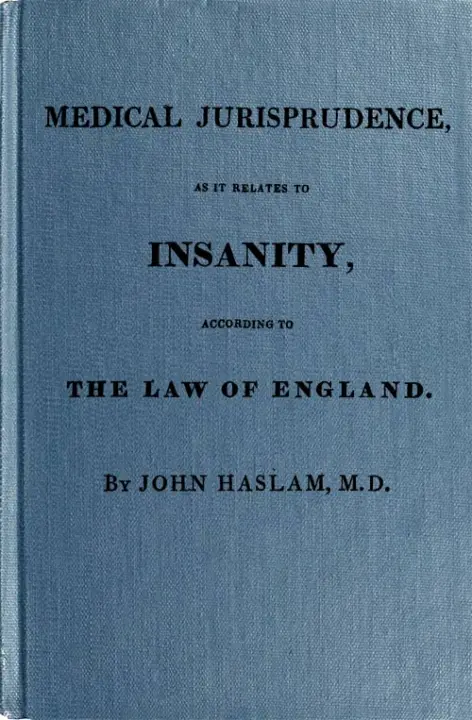
"Medical Jurisprudence as it Relates to Insanity, According to the Law of England" by John Haslam, M.D. is a scientific publication written in the early 19th century. The book delves into the intersection of medical knowledge and legal principles concerning the concept of insanity, particularly in the context of criminal behavior. Haslam aims to clarify the role of medical evidence in legal proceedings involving defendants who claim insanity as a defense, outlining the responsibilities of medical practitioners and the implications of their findings on the administration of justice. In his work, Haslam explores various aspects of insanity, discussing its manifestations, definitions, and the challenges faced by medical professionals when testifying in court. He emphasizes the complexities involved in distinguishing between sane and insane behavior, particularly when individuals are capable of rational thought on some topics while remaining deluded on others. The book further examines significant case studies that illustrate these complexities, such as the psychological profiles of those accused of crimes under delusions, as well as practical considerations for assessing a person's legal responsibility for their actions. Haslam's work remains a crucial resource for understanding the legal and medical nuances of insanity in the 19th century, providing a thorough examination of the obligations that medical experts have when interfacing with the legal system.
Introduction adapted from the source catalogue; source summaries may be automatically generated.
Free to read · English · 16,539 words · No account needed
MAKE TIME FOR A GOOD BOOK
On by default. Untick to stop anonymous reading totals. Each page counts after 10 seconds in view. How this works.
Anonymous counting is on unless you have switched it off.
However the maniac may direct the sallies of his violence and resentment against the lives of others, frequently of those to whom he is nearest allied, or bound by obligation and friendship: yet there is another feature which his disorder assumes, and which always secures the commiseration of mankind. It more frequently occurs in the deranged state of these pitiable persons that they seek to revenge on themselves the supposed crimes they have committed. In our own country, there are more lunatics who destroy themselves, than attempt the lives of others; and in these cases the Coroner’s jury has always agreed on a merciful interpretation. Indeed there are but few instances of the impotent folly of degrading the carcass, excepting where self-destruction has anticipated the rigour of the law.
It is of frequent occurrence, that persons labouring under insanity, although of exemplary lives and unblemished character, shall believe themselves guilty of the most atrocious crimes;—reputation, the dearest possession of the sound mind is sacrificed without a regret by the despairing lunatic;—he accuses himself of cowardice, of fraud, of secret murder, or of a turpitude at which man revolts:—and others blessed with opulence, and enjoying those comforts which render life desirable, become apprehensive of terminating their existence in the work-house. Sometimes the desire of death is so ardent, that they will perpetrate any crime in order to be arraigned and condemned at the bar of justice. Of this extraordinary perversion I shall take the liberty to relate a very striking instance.
A woman about 36 years of age, who had been well educated, but whose conduct had not been exempt from some irregularities, in consequence of intemperance and manifold disappointments, became affected with madness. She was by turns furious and melancholic, and conceived she had murdered one of her children, for which she ought to suffer death. She detailed the manner in which she had destroyed the child and the motives which actuated her, so circumstantially, and with so much plausibility and feeling, that if I had not known her child to be living I might have been deceived. By her own hands she had repeatedly endeavoured to terminate her existence, but was prevented by constant vigilance and due restraint. Her disposition to suicide was afterwards relinquished; but she still persisted that for the murder of the child she ought to suffer death, and requested to be sent to Newgate, in order to be tried, and undergo the sentence of the law:—indeed she appeared to derive consolation from the hope of becoming a public example, and expiating her supposed crime on the scaffold. While in this state, and with a hope of convincing her of its safety, the child was brought to visit her. When she beheld it there was a temporary burst of maternal affection; she kissed it, and for a few moments appeared to be delighted:—but a look of suspicion quickly succeeded, and this was shortly followed by a frown of indignation, which rendered the removal of the child a measure of wholesome necessity. Perhaps, in no instance, was the buoyancy of madness more conspicuous over reason, recollection, and feeling. She insisted they had attempted to impose on her a strange child, which bore a faint resemblance to her own; however, by such subterfuges she was not to be deceived; she had strangled the child until life had totally departed, and it was not in the order of nature that it should exist again. The effect of this interview was an exasperation of her disorder,—she became more cunning and malignant, and her desire for an ignominious death was augmented. To render this more certain, and accelerate her projected happiness, she enticed into her apartment a young female patient, to whom she appeared to be attached, and having previously platted some threads of her bed-quilt into a cord, she fixed it round the neck of the young woman and proceeded to strangle her. Fortunately some person entered the room, and unloosed the cord in time to save her. When this unhappy maniac was questioned concerning the motive which induced her to attempt the destruction of a person for whom she had manifested kindness; she very calmly replied, that as the murder of her own child was disbelieved, she wished to exhibit a convincing proof of the ferocity of her nature, that she might instantly be conveyed to Newgate, and hanged, which she desired as the greatest blessing. With considerable satisfaction I may add, that in a few months, notwithstanding her derangement had been of three years duration, this woman perfectly recovered, and for a considerable time has performed the duties of an important and respectable office.
Your reading position is saved on this browser. Take it to another device with a library code. Reading pages adapt to text, rather than matching a printed edition.
John Haslam
John Haslam
John Haslam
John Haslam
BEHIND THE BOOK
This eBook is for the use of anyone anywhere in the United States and most other parts of the world at no cost and with almost no restrictions whatsoever. You may copy it, give it away or re-use it under the terms of the Project Gutenberg License included with this eBook or online at www.gutenberg.org. If you are not located in the United States, you will have to check the laws of the country where you are located before using this eBook. Read the source licence.
The original source file, including credits and licence, is retained by this library. Request an original-format copy at no charge. Please include the book title and Project Gutenberg identifier #56656.
KEEP YOUR CURIOSITY GOING

Charles G. (Charles Griffith) Ross
Hannah Webster Foster

Emily Lawless
Edwin Hamlin Carr

Charles De Lano Hine
Andrew Ure