THE CLASSIC COLLECTION✦Sketches in BedlamCLASSIC FREE BOOKS
Sketches in Bedlam
John Haslam
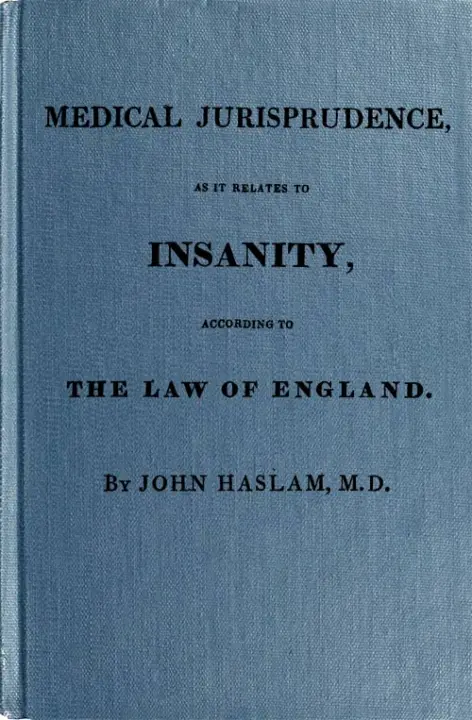
THE CLASSIC COLLECTION · 1817
"Medical Jurisprudence as it Relates to Insanity, According to the Law of England" by John Haslam, M.D. is a scientific publication written in the early 19th century. The book delves into the intersection of medical knowledge and legal principles concerning the concept of insanity, particularly in the context of criminal behavior. Haslam aims to clarify the role of medical evidence in legal proceedings involving defendants who claim insanity as a defense, outlining the responsibilities of medical practitioners and the implications of their findings on the administration of justice. In his work, Haslam explores various aspects of insanity, discussing its manifestations, definitions, and the challenges faced by medical professionals when testifying in court. He emphasizes the complexities involved in distinguishing between sane and insane behavior, particularly when individuals are capable of rational thought on some topics while remaining deluded on others. The book further examines significant case studies that illustrate these complexities, such as the psychological profiles of those accused of crimes under delusions, as well as practical considerations for assessing a person's legal responsibility for their actions. Haslam's work remains a crucial resource for understanding the legal and medical nuances of insanity in the 19th century, providing a thorough examination of the obligations that medical experts have when interfacing with the legal system.
Introduction adapted from the source catalogue; source summaries may be automatically generated.
Free to read · English · 16,539 words · No account needed
MAKE TIME FOR A GOOD BOOK
On by default. Untick to stop anonymous reading totals. Each page counts after 10 seconds in view. How this works.
Anonymous counting is on unless you have switched it off.
“I cannot assign any other cause of all this, than a continued rumination on the vexations I had suffered, which, though calmer, I could not forget, and the consequences of which I meditated to counteract: these meditations occupied my mind three hours after dinner, just when my digestion commenced. I consoled myself at last with respect to the disagreeable incident which had occasioned the first apparition, but the phantasms continued to increase and change in the most singular manner, though I had taken the proper medicine and found myself perfectly well. As when the first terror was over, I beheld the phantasms with great emotion taking them for what they really were, remarkable consequences of an indisposition, I endeavoured to collect myself as much as possible, that I might preserve a clear consciousness of the changes which should take place within myself; I observed these phantasms very closely, and frequently reflected on my antecedent thoughts to discover, if possible, by means of what association of ideas exactly these forms presented themselves to my imagination. I thought at times I had found a clue, but taking the whole together I could not make out any natural connexion between the occupations of my mind, my occupations, my regular thoughts, and the multifarious forms which now appeared to me, and now again disappeared. After repeated and close observations, and calm examination, I was unable to form any conclusion relative to the origin and continuation of the different phantasms which presented themselves to me. All that I could infer was, that while my nervous system was in such an irregular state, such phantasms would appear to me as if I actually saw and heard them; that these illusions were not modified by any known laws of reason, imagination, or the common association of ideas, and that probably other people who may have had similar apparitions were exactly in the same predicament. The origin of the individual forms which appeared to me, was undoubtedly founded on the nature of my mind, but the manner in which it was thus affected will probably remain for ever as inscrutable as the origin of thought and reflection. After the first day, the form of the deceased person no more appeared, but in its place there appeared many other phantasms, sometimes representing acquaintances, but mostly strangers: those whom I knew were composed of living and deceased persons, but the number of the latter was comparatively small. I observed the persons with whom I daily conversed did not appear as phantasms, these representing chiefly persons who lived at some distance from me. I attempted to produce at pleasure phantasms of persons, whom I knew by intensely reflecting on their countenance, shape, &c. but distinctly as I called to my lively imagination the respective shades of three of these persons, I still laboured in vain to make them appear to me as phantasms, though I had before involuntarily seen them in that manner, and perceived them some time after, when I least thought of them. The phantasms appeared to me contrary to my inclination, as if they were presented to me from without, like the phenomena of nature, though they existed no where but within my mind. I could at the same time distinguish between phantasms and real objects, and the calmness with which I examined them, enabled me to avoid the commission of the smallest mistake. I knew exactly when it only appeared to me that the door was opening and a phantasm entering the room, and when it actually opened, and a real person entered. These phantasms appeared equally clear and distinct at all times and under all circumstances, both when I was by myself and when I was in company; and as well in the day as at night, and in my own house as well as abroad; they were, however, less frequent when I was in the house of a friend, and rarely appeared to me in the street; when I shut my eyes these phantasms would sometimes disappear entirely, though there were instances when I beheld them with my eyes closed, yet when they disappeared on such occasions, they generally reappeared when I opened my eyes. I conversed sometimes with my physician and my wife of the phantasms which at the moment surrounded me; they appeared more frequently walking than at rest, nor were they constantly present. They frequently did not appear for some time, but always reappeared for a longer or a shorter period either singly or in company, the latter however being most frequently the case. I generally saw human forms of both sexes, but they usually appeared not to take the smallest notice of each other, moving as in a market place, where all are eager to press through the crowd; at times however they seemed to be transacting business with each other: I also saw several times people on horseback, dogs and birds. All these phantasms appeared to me in their natural size, and as distinct as if alive, exhibiting different shades of carnation in the uncovered parts, as well as in different colours and fashions in their dresses, though the colours seemed somewhat paler than in real nature, none of the figures appeared particularly terrible, comical, or disgusting, most of them being of an indifferent shape, and some having a pleasing appearance.
Your reading position is saved on this browser. Take it to another device with a library code. Reading pages adapt to text, rather than matching a printed edition.
John Haslam
John Haslam
John Haslam
John Haslam
BEHIND THE BOOK
This eBook is for the use of anyone anywhere in the United States and most other parts of the world at no cost and with almost no restrictions whatsoever. You may copy it, give it away or re-use it under the terms of the Project Gutenberg License included with this eBook or online at www.gutenberg.org. If you are not located in the United States, you will have to check the laws of the country where you are located before using this eBook. Read the source licence.
The original source file, including credits and licence, is retained by this library. Request an original-format copy at no charge. Please include the book title and Project Gutenberg identifier #56656.
KEEP YOUR CURIOSITY GOING

Charles G. (Charles Griffith) Ross
Hannah Webster Foster

Emily Lawless
Edwin Hamlin Carr

Charles De Lano Hine
Andrew Ure