The Mountainy Singer
Joseph Campbell
THE CLASSIC COLLECTION · 1911
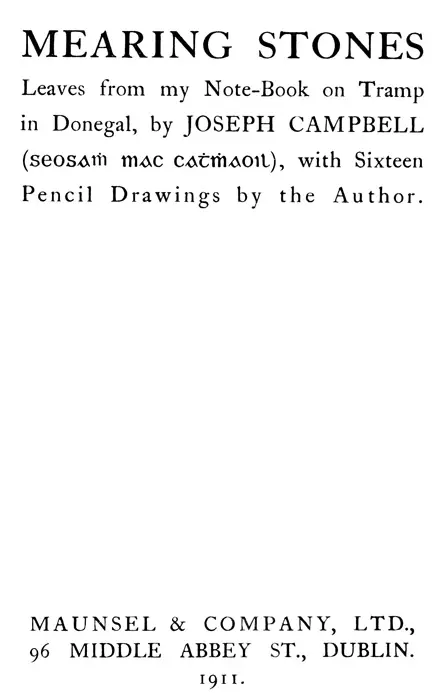
"Mearing Stones: Leaves from My Note-Book on Tramp in Donegal" by Joseph Campbell is a collection of reflective essays written in the early 20th century. The book captures the essence of the author's experiences while wandering through the picturesque landscapes of Donegal, Ireland, contemplating nature, culture, and the human experience. It provides a vivid portrayal of the region's austere beauty and the simple, yet rich lives of its inhabitants. In this evocative work, Campbell presents a series of observations and anecdotes from his travels, blending personal reflections with local folklore and commentary on the environment. The essays cover various aspects of life in Donegal, including encounters with the locals, descriptions of the stunning scenery, and philosophical musings on themes such as loneliness, connection, and the passage of time. Through his lyrical prose and detailed descriptions, Campbell invites readers to experience the enchanting landscapes and spirit of the people, establishing a deep connection with the land and its traditions.
Introduction adapted from the source catalogue; source summaries may be automatically generated.
Free to read · English · 15,300 words · No account needed
MAKE TIME FOR A GOOD BOOK
On by default. Untick to stop anonymous reading totals. Each page counts after 10 seconds in view. How this works.
Anonymous counting is on unless you have switched it off.
It is a lovely summer's day, warm and fragrant and sunny. We have just come from Mass at Carrick chapel, and are following the road that leads south by the harbour up to Teelin village. Numbers of people are on the road with us--mostly women and girls, for the men have remained behind to smoke and to talk over the week's happenings in the different ends of the parish. The groups go in ages--the old women with the old women, the marriageable girls with the marriageable girls, the younger girls with the girls of their own age. There is a crowd of little boys, too--active as goats, dressed in corduroys or homespuns, and discussing in Irish what they will do with themselves in the afternoon. Some will go bathing in the harbour, others will go up to the warren by Loch O'Mulligan to hunt rabbits, others will remain in the village to watch the men and bigger boys play at skittles in a cleared space by the high road. I pick up with a quiet-eyed lad--the makings of a priest or a scholar, by his look--and in a short time I am friends with the crowd. If one could see me behind I must look like the Pied Piper of Hamelin, so many children have I following alongside me and at my heels. They come to know by my talk that I am interested in Irish--an enthusiast, in fact--and they all want to tell me at once about the Feis at Teelin, and about the great prizes that were offered, and how one out of their own school, a little fellow of eight years, won first prize for the best telling of a wonder-tale in the vernacular. The quiet-eyed lad asks me would I like to see Bunglass and the great view to be had of Slieve League from the cliff-head. I tell him that I am going there, and in an instant the crowd is running out in front of us, shouting and throwing their caps in the air--delighted, I suppose, at the prospect of a scramble for coppers on the grass when we get to the end of our journey. For boys are boys the world over, let the propagandists carp as they will! and when I was young myself I would wrestle a ghost under a bed for a halfpenny--so my grandmother used to tell me, and she was a very wise and observant woman. We have come to Teelin village--a clean, whitewashed little place on a hill, built "all to one side like Clogher"--and from there we strike up to the right by a sort of rocky, grass-covered loaning which leads to the cliffs. We pass numbers of houses on the way, each with a group of gaily-dressed peasants sunning themselves at the door. The ascent is gradual at first, but as we go on it gets steeper, and after a while's climbing we begin to feel the sense of elevation and detachment. The air is delightfully warm, and the fragrance of sea and bracken and ling is in our hearts. In time we reach Carrigan Head, with its martello tower, seven hundred feet odd over the Atlantic. Southwards the blue waters of Donegal Bay spread themselves, with just the slightest ripple on their surface, glinting in the warm sunlight. In the distance the heights of Nephin Beag and Croagh Patrick in Mayo are faintly discernible, and westwards the illimitable ocean stretches to the void. From Carrigan Head we follow a rough mountain trail, and in a short time reach Loch O'Mulligan, a lonely freshwater tarn, lying under the shadow of Slieve League. Back of the loch a grassy hill rises. We climb this, the younger boys leading about fifty yards in front, jumping along the short grass and over the stones like goats. Arrived at a point called in Irish Amharc Mór, or "Great View," a scene of extraordinary beauty bursts on us. We are standing on Scregeighter, the highest of the cliffs of Bunglass. A thousand and twenty-four feet below us, in a sheer drop, the blue waters of Bunglass advance and recede--blue as a sapphire, shading into emerald and white where they break on the spit of grass-covered rock rising like a sceilg-draoidheachta, or "horn of wizardy," out of the narrow bay. Right opposite us is Slieve League, its carn a thousand feet higher than the point on which we stand. In the precipitous rock-face, half-way up, is a scarped streak called Nead an Iolair, or the Eagle's Nest. The colouring is wonderfully rich and varied--black, grey, violet, brown, red, green--due, one would think, to the complex stratification and to the stains oozing from the soft ores, clays, and mosses impinging between the layers. We step back from the cliff-edge, and sit down on a flat slab of stone, the better to enjoy the view, and the boys spread themselves out in various attitudes over the short grass before and behind us. They are conversing among themselves in Irish, speaking very rapidly, and with an intonation that is as un-English as it can possibly be. The thickened l's and thrilled r's are especially noticeable. To hear these children speak Irish the way they do makes one feel that the language of Niall Naoi Giallach is not dead yet, and has, indeed, no signs of dying.
Your reading position is saved on this browser. Take it to another device with a library code. Reading pages adapt to text, rather than matching a printed edition.
Joseph Campbell
BEHIND THE BOOK
This eBook is for the use of anyone anywhere in the United States and most other parts of the world at no cost and with almost no restrictions whatsoever. You may copy it, give it away or re-use it under the terms of the Project Gutenberg License included with this eBook or online at www.gutenberg.org. If you are not located in the United States, you will have to check the laws of the country where you are located before using this eBook. Read the source licence.
The original source file, including credits and licence, is retained by this library. Request an original-format copy at no charge. Please include the book title and Project Gutenberg identifier #41250.
KEEP YOUR CURIOSITY GOING
Wilfrid Scawen Blunt
Wilfrid Scawen Blunt

E. W. (Edgar Watson) Howe

David Patterson (Spirit) Hatch

David Patterson (Spirit) Hatch

David Patterson (Spirit) Hatch