The Mountainy Singer
Joseph Campbell
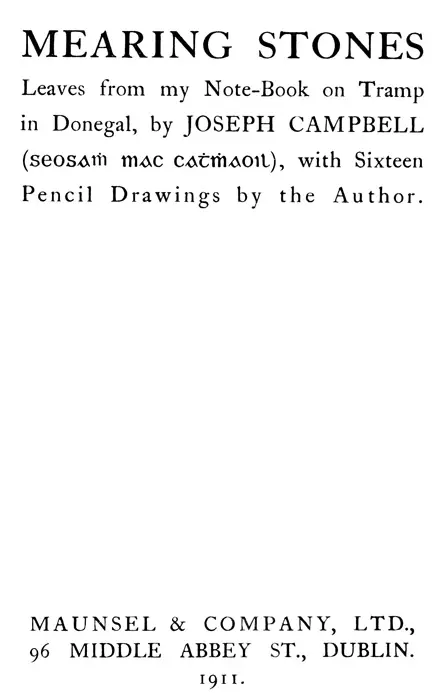
THE CLASSIC COLLECTION · 1911
"Mearing Stones: Leaves from My Note-Book on Tramp in Donegal" by Joseph Campbell is a collection of reflective essays written in the early 20th century. The book captures the essence of the author's experiences while wandering through the picturesque landscapes of Donegal, Ireland, contemplating nature, culture, and the human experience. It provides a vivid portrayal of the region's austere beauty and the simple, yet rich lives of its inhabitants. In this evocative work, Campbell presents a series of observations and anecdotes from his travels, blending personal reflections with local folklore and commentary on the environment. The essays cover various aspects of life in Donegal, including encounters with the locals, descriptions of the stunning scenery, and philosophical musings on themes such as loneliness, connection, and the passage of time. Through his lyrical prose and detailed descriptions, Campbell invites readers to experience the enchanting landscapes and spirit of the people, establishing a deep connection with the land and its traditions.
Introduction adapted from the source catalogue; source summaries may be automatically generated.
Free to read · English · 15,300 words · No account needed
MAKE TIME FOR A GOOD BOOK
On by default. Untick to stop anonymous reading totals. Each page counts after 10 seconds in view. How this works.
Anonymous counting is on unless you have switched it off.
"My old mother's ailing this twelvemonth back," said a man to me to-day. "I'm afeard she'll go wi' the leaves."
A day of wind and light, blown rain, with the sun shining through it in spells. Aighe river below me, brown and clear, foaming through mossed stones to the sea. Trout rising from it now and again to the gnats that skim its surface. Glengesh mountain in the middle distance--a black, splendid bulk--dropping to the Nick of the Bealach on the left. Meadows in foreground bright with marigolds, with here and there by the mearings tufts of king-fern, wild iris and fairy-thimble.
To lie on one's loin in the sun is all very well, but walking is better. It is over the hill the wonders are.
Saturday. It is about half-past seven o'clock in the evening. The rain, which kept at it pitilessly all the afternoon, has cleared off, and we have left the little whitewashed inn at Glen-Columcille refreshed, and in high fettle, for the further six miles that has to be done before we reach Carrick, where we mean to spend the night. We had arrived at Glen two hours before in a weary enough condition physically after our tramp over the hills from Ardara, and we had almost resolved on the advice of the hostess of the inn--a slow, deliberate, slatternly sort of woman--to put up with her for the night; but it is wonderful what a rest and a meal and, incidentally, a slatternly hostess does, and so we finally decided to go on to Carrick. We follow the road up by the telegraph posts, and after a stiffish climb of half a mile or more, reach the plateau head. We are now about five hundred feet over sea level. Turning round to have a last look at the place, we see the chapel--a plain white cruciform building, with a queer detached belfry--the little grey, straggling village street (some of the houses with slate roofs, some with thatch), the crosses standing up like gallan-stones on every side of it, the deep valley-bottom green as an emerald, Ballard mountain silhouetted against the sunset, and the vast Atlantic tumbling through mist on the yellow strand beyond. The air smells deliciously of peat. In Donegal one notices the smell of peat everywhere; in fact, if I were asked to give an impression of the county in half a dozen words I should say: "Black hills, brown rivers, and peat." The road is fairly level now, and we continue our course in a south-easterly direction. A wild waste of moorland stretches on every side of us, brightened here and there by little freshwater lakes, out of which we see the trout jumping in hundreds--Loch Unshagh, Loch Unna, Loch Divna, and another quite near the road, where we got, at the expense of wet feet and knees, some lovely specimens of the lilium aureum, or golden lily, which grows, I think, on every little shallow and flat and bywater in South Donegal. After an hour of pleasant walking the road begins to drop and the rain to fall again. Slieve League is on our right, but we can only see the lower slopes of it, for the cairn is completely covered with driving mist. The wind has risen, and the rain beats coolingly on our cheeks, and exasperatingly, at times, down our necks. We pass a shepherd on the road making for Malin Mór, a shawled figure with a lantern, and several groups of boys and asses with creels bringing turf into the stackers; and farther on a side-car zig-zagging up hill on its way to the Glen. There are two occupants, a priest--presumably the curate of Glen parish going over for Sunday's Mass--and the driver. It is quite dark now, and the rain increases in intensity. Tramping in a mountainy country is a delightful sport--none better! But it is on such a night and at the end of such a journey as this that one begins to see that it has a bad as well as a good side to it. The rain is coming down in sheets, our clothes are soaked through, the darkness is intense, the roads are shockingly muddy, we are tired out walking, and still we have another stiff mile to go before we see the friendly lights of the inn at Carrick. Two of us--R. M. and myself--stop at a bridge to have a look at the ordnance sheet which has stood us in such good stead all through our journey. Torrential rain beating on a map--even a "cloth-mounted, water-proofed" one like ours--doesn't improve it; but we have qualms about our direction. We think we should have arrived at Carrick ere this, and we just want to make sure that our direction is right, and that we haven't taken a wrong turning in the darkness. After some trouble we manage to get a match lighted. The first misfires on the damp emery, the second blows out, the third is swallowed up in rain pouring like a spout through the branches overhead, the fourth . . . . "Carrick! Carrick! Carrick!" The frenzied cries of the advance guard tell us that the town is in view. We put up our map resignedly, shaking great blabs of water out of it, and push ahead. In five minutes we have passed the chapel, with its square tower looming up darkly in the fog, and in another two we are safe in the inn parlour, enjoying a supper of hot coffee, muffins, and poached eggs.
Your reading position is saved on this browser. Take it to another device with a library code. Reading pages adapt to text, rather than matching a printed edition.
Joseph Campbell
BEHIND THE BOOK
This eBook is for the use of anyone anywhere in the United States and most other parts of the world at no cost and with almost no restrictions whatsoever. You may copy it, give it away or re-use it under the terms of the Project Gutenberg License included with this eBook or online at www.gutenberg.org. If you are not located in the United States, you will have to check the laws of the country where you are located before using this eBook. Read the source licence.
The original source file, including credits and licence, is retained by this library. Request an original-format copy at no charge. Please include the book title and Project Gutenberg identifier #41250.
KEEP YOUR CURIOSITY GOING
Wilfrid Scawen Blunt
Wilfrid Scawen Blunt

E. W. (Edgar Watson) Howe

David Patterson (Spirit) Hatch

David Patterson (Spirit) Hatch

David Patterson (Spirit) Hatch