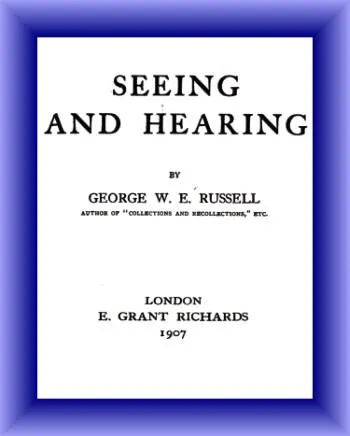
Seeing and Hearing
George William Erskine Russell
THE CLASSIC COLLECTION · 1904
"Matthew Arnold" by George William Erskine Russell is a literary biography written in the early 20th century. The book explores the life and work of Matthew Arnold, a prominent figure in Victorian literature, focusing on his influence as a critic, poet, and educator. It aims to offer insights into Arnold's character, writings, and the significant impact he had on the intellectual landscape of his time. The opening of the book presents a preface in which the author justifies his undertaking of Arnold's biography, acknowledging that Arnold himself desired to avoid a conventional biography. Instead, the text takes a critical approach, emphasizing Arnold's correspondence and the nuances of his character that have been overlooked in previous analyses. The author introduces Arnold's literary contributions and the complexity of his views on life, education, and literature, while also hinting at Arnold’s personal struggles and relationships, establishing a foundation for understanding the author's critique of sociopolitical and literary issues in the context of Victorian England.
Introduction adapted from the source catalogue; source summaries may be automatically generated.
Free to read · English · 59,850 words · No account needed
MAKE TIME FOR A GOOD BOOK
On by default. Untick to stop anonymous reading totals. Each page counts after 10 seconds in view. How this works.
Anonymous counting is on unless you have switched it off.
So much for his first deliberate attempt in the way of social criticism. It was levelled, we observe, at the thoughts and doings of the great Middle Class, and it is natural to ask why that class was so specially the target for his scorn. To that class, as he was fond of declaring, half in fun and half in earnest, he himself belonged. "I always thought my marriage," he used to say, "such a perfect marriage of the Middle Classes--a schoolmaster's son and a judge's daughter." In the preface to the Essays in Criticism, he spoke of "the English Middle Class, of which I am myself a feeble unit." He used to declare that his feeling towards his brethren of the Middle Class was that of St. Paul towards his brethren of Israel: "My heart's desire and prayer for them is that they may be saved." In Culture and Anarchy he was constrained to admit that "through circumstances which will perhaps one day be known, if ever the affecting history of my conversion comes to be written, I have, for the most part, broken with the ideas and the tea-meetings of my own class"; but he found that he had not, by that conversion, come much nearer to the ideas and works of the Aristocracy or the Populace.
He admired the fine manners, the governing faculty, the reticent and dignified habit, of the Aristocracy. He deplored its limitations and its obduracy, its "little culture and no ideas." He made fun of it when its external manifestations touched the region of the ludicrous--"Everybody knows Lord Elcho's[24] appearance, and how admirably he looks the part of our governing classes; to my mind, indeed, the mere cock of his lordship's hat is one of the finest and most aristocratic things we have." In a more serious vein he taught--and enraged the Guardian by teaching--that, "ever since the advent of Christianity, the prince of this world is judged"; and that wealth and rank and dignified ease are bound to justify themselves for their apparent inconsistency with the Christian ideal. He pitied the sorrows of the "people who suffer," the "dim, common populations," the "poor who faint alway"; but he pitied them from above. He certainly did not enter into their position; did not share their ideas, or feel their sorrows as part of his own experience. In an amazing passage he says that, when we snatch up a vehement opinion in ignorance and passion, when we long to crush an adversary by sheer violence, when we are envious, when we are brutal, when "we add our voices to swell a blind clamour against some unpopular personage," when "we trample savagely on the fallen," then we find in our own bosom "the eternal spirit of the Populace." That a spirit so hideous, so infernal as is here described, is the eternal spirit of fallen humanity may be painfully true; but to say that it is the special or characteristic spirit of "the Populace" is to show that one has no genuine sympathy and no real acquaintance with the life and heart of the poor. So far, then, his account of his own transition is true. He had "broken with the ideas of his own class, and had not come much nearer to the ideas and works of Aristocracy or the Populace." But the work of his life had brought him into close and continuous contact with the great Middle Class, which practically had the whole management of Elementary Education in its hands. He knew the members of that class, as he said, "experimentally." He slept in their houses, and ate at their tables, and observed at close quarters their books, their amusements, and their social life. Thus he judged of their civilization by intimate acquaintance, and found it eminently distasteful and defective. From 1832 to 1867 the Middle Class had governed England, manipulating the Aristocracy through the medium of the House of Commons; and the Aristocracy, though still occupying the place of visible dignity, had its eye nervously fixed on the movement, actual and impending, of the Middle Class. This system of government by the predominance of the Middle Class, was not only distasteful to culture, but was actually a source of danger to the State when it came to be applied to Foreign Affairs. "That makes the difference between Lord Grenville and Lord Granville." So it was to the shortcomings of the Middle Class, from which he professed to be sprung and which he so intimately knew, that he first addressed his social criticism. The essay on "My Countrymen" immediately attracted notice. It was fresh, it was lively, it put forth a new view, it gaily ran counter to the great mass of current prejudice. He was frankly pleased by the way in which it was received. It was noticed and quoted and talked about. He reported to his mother that it was thought "witty and suggestive," "timely and true." Carlyle "almost wholly approved of it," and Bright was "full of it." He did not expect it to be liked by people who belonged to "the old English time, of which the greatness and success was so immense and indisputable that no one who flourished when it was at its height could ever lose the impression of it," or realize how far we had fallen in Continental esteem. His friend Lingen was "indignant" because he thought the essay exalted the Aristocracy at the expense of the Middle Class; and the Whig newspapers were "almost all unfavourable, because it tells disagreeable truths to the class which furnishes the great body of what is called the Liberal interest." From the foreign side came a criticism in the Pall Mall Gazette, "professing to be by a Frenchman," but "I am sure it is by a woman I know something of in Paris, a half Russian, half Englishwoman, married to a Frenchman." The first part of this criticism "is not good, and perhaps when the second part appears I shall write a short and light letter by way of reply." That "short and light letter" appeared in the Pall Mall of March 20, 1866. It dealt with the respective but not incompatible claims of Culture and Liberty--the former so defective in England, the latter so abundant--and it contained this aspiration for Englishmen of the Middle Class. "I do not wish them to be the cafe-haunting, dominoes-playing Frenchmen, but some third thing: neither the Frenchmen nor their present selves."
Your reading position is saved on this browser. Take it to another device with a library code. Reading pages adapt to text, rather than matching a printed edition.
George William Erskine Russell
George William Erskine Russell
George William Erskine Russell
George William Erskine Russell
BEHIND THE BOOK
This eBook is for the use of anyone anywhere in the United States and most other parts of the world at no cost and with almost no restrictions whatsoever. You may copy it, give it away or re-use it under the terms of the Project Gutenberg License included with this eBook or online at www.gutenberg.org. If you are not located in the United States, you will have to check the laws of the country where you are located before using this eBook. Read the source licence.
The original source file, including credits and licence, is retained by this library. Request an original-format copy at no charge. Please include the book title and Project Gutenberg identifier #16745.
KEEP YOUR CURIOSITY GOING
John L. Ransom

Herman W. Mudgett

Harriet Monroe
Daniel Dulany Addison
Charles Lanman

Harold Rosher