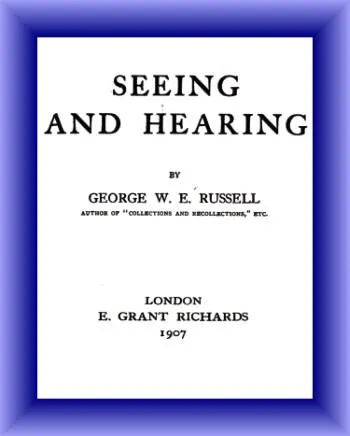
Seeing and Hearing
George William Erskine Russell
THE CLASSIC COLLECTION · 1904
"Matthew Arnold" by George William Erskine Russell is a literary biography written in the early 20th century. The book explores the life and work of Matthew Arnold, a prominent figure in Victorian literature, focusing on his influence as a critic, poet, and educator. It aims to offer insights into Arnold's character, writings, and the significant impact he had on the intellectual landscape of his time. The opening of the book presents a preface in which the author justifies his undertaking of Arnold's biography, acknowledging that Arnold himself desired to avoid a conventional biography. Instead, the text takes a critical approach, emphasizing Arnold's correspondence and the nuances of his character that have been overlooked in previous analyses. The author introduces Arnold's literary contributions and the complexity of his views on life, education, and literature, while also hinting at Arnold’s personal struggles and relationships, establishing a foundation for understanding the author's critique of sociopolitical and literary issues in the context of Victorian England.
Introduction adapted from the source catalogue; source summaries may be automatically generated.
Free to read · English · 59,850 words · No account needed
MAKE TIME FOR A GOOD BOOK
On by default. Untick to stop anonymous reading totals. Each page counts after 10 seconds in view. How this works.
Anonymous counting is on unless you have switched it off.
But it was one of his amiable traits that, whenever he read a book which pleased him, he immediately began to share his pleasure with his friends. In the year 1880, he writes to his colleague, Mr. Fitch, "I have this year been reading David Copperfield for the first time.[13] Mr. Creakle's School at Blackheath is the type of our English Middle Class Schools, and our Middle Class is satisfied that so it should be."
It would seem that he made this rather belated acquaintance with Dickens' masterpiece, through reading it aloud to one of his children who was laid up with a swelled face. But, however introduced to his notice, the book made a deep impression on him. In the following June he contributed to the Nineteenth Century an article on Ireland styled "The Incompatibles." In that article he suggests that the Irish dislike of England arises in part from the fact that "the Irish do not much come across our aristocracy, exhibiting that factor of civilization, the power of manners, which has undoubtedly a strong attraction for them. What they do come across, and what gives them the idea they have of our civilization and its promise, is our Middle Class."
The mention, so frequent in his writings, of "our Middle Class," seems to demand a definition; and, admitting that in this country the Middle Class has no naturally defined limits, and that it is difficult to say who properly belong to it and who do not, he adopts an educational test. The Middle Class means the people who are brought up at a particular kind of school, and to illustrate that kind of school he has recourse to his newly-discovered treasure. "Much as I have published, I do not think it has ever yet happened to me to comment in print upon any production of Charles Dickens. What a pleasure to have the opportunity of praising a work so sound, a work so rich in merit, as David Copperfield!... Of the contemporary rubbish which is shot so plentifully all round us, we can, indeed, hardly read too little. But to contemporary work so good as David Copperfield we are in danger of perhaps not paying respect enough, of reading it (for who could help reading it?) too hastily, and then putting it aside for something else and forgetting it. What treasures of gaiety, invention, life, are in that book! what alertness and resource! what a soul of good nature and kindness governing the whole! Such is the admirable work which I am now going to call in evidence. Intimately, indeed, did Dickens know the Middle Class; he was bone of its bone and flesh of its flesh. Intimately he knew its bringing-up. With the hand of a master he has drawn for us a type of the teachers and trainers of its youth, a type of its places of education. Mr. Creakle and Salem House are immortal. The type itself, it is to be hoped, will perish; but the drawing of it which Dickens has given cannot die. Mr. Creakle, the stout gentleman with a bunch of watch-chain and seals, in an armchair, with the fiery face and the thick veins in his forehead; Mr. Creakle sitting at his breakfast with the cane, and a newspaper, and the buttered toast before him, will sit on, like Theseus, for ever. For ever will last the recollection of Salem House, and of the 'daily strife and struggle' there; the recollection 'of the frosty mornings when we were rung out of bed, and the cold, cold smell of the dark nights when we were rung into bed again; of the evening schoolroom dimly lighted and indifferently warmed, and the morning schoolroom which was nothing but a great shivering-machine; of the alternation of boiled beef with roast beef, and boiled mutton with roast mutton; of clods of bread and butter, dog's-eared lesson-books, cracked slates, tear-blotted copy-books, canings, rulerings, hair-cuttings, rainy Sundays, suet puddings, and a dirty atmosphere of ink surrounding all.' By the Middle Class I understand those who are brought up at establishments more or less like Salem House, and by educators more or less like Mr. Creakle. And the great mass of the Middle part of our community, the part which comes between those who labour with their hands, on the one side, and people of fortune on the other, is brought up at establishments of this kind, although there is a certain portion broken off at the top which is educated at better. But the great mass are both badly taught, and are also brought up on a lower plane than is right, brought up ignobly. And this deteriorates their standard of life, their civilization."
Your reading position is saved on this browser. Take it to another device with a library code. Reading pages adapt to text, rather than matching a printed edition.
George William Erskine Russell
George William Erskine Russell
George William Erskine Russell
George William Erskine Russell
BEHIND THE BOOK
This eBook is for the use of anyone anywhere in the United States and most other parts of the world at no cost and with almost no restrictions whatsoever. You may copy it, give it away or re-use it under the terms of the Project Gutenberg License included with this eBook or online at www.gutenberg.org. If you are not located in the United States, you will have to check the laws of the country where you are located before using this eBook. Read the source licence.
The original source file, including credits and licence, is retained by this library. Request an original-format copy at no charge. Please include the book title and Project Gutenberg identifier #16745.
KEEP YOUR CURIOSITY GOING
John L. Ransom

Herman W. Mudgett

Harriet Monroe
Daniel Dulany Addison
Charles Lanman

Harold Rosher