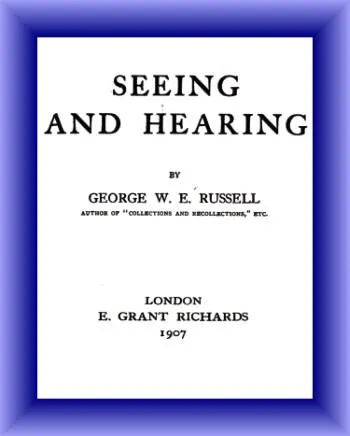
Seeing and Hearing
George William Erskine Russell
THE CLASSIC COLLECTION · 1904
"Matthew Arnold" by George William Erskine Russell is a literary biography written in the early 20th century. The book explores the life and work of Matthew Arnold, a prominent figure in Victorian literature, focusing on his influence as a critic, poet, and educator. It aims to offer insights into Arnold's character, writings, and the significant impact he had on the intellectual landscape of his time. The opening of the book presents a preface in which the author justifies his undertaking of Arnold's biography, acknowledging that Arnold himself desired to avoid a conventional biography. Instead, the text takes a critical approach, emphasizing Arnold's correspondence and the nuances of his character that have been overlooked in previous analyses. The author introduces Arnold's literary contributions and the complexity of his views on life, education, and literature, while also hinting at Arnold’s personal struggles and relationships, establishing a foundation for understanding the author's critique of sociopolitical and literary issues in the context of Victorian England.
Introduction adapted from the source catalogue; source summaries may be automatically generated.
Free to read · English · 59,850 words · No account needed
MAKE TIME FOR A GOOD BOOK
On by default. Untick to stop anonymous reading totals. Each page counts after 10 seconds in view. How this works.
Anonymous counting is on unless you have switched it off.
We all remember that he poked fun at those misguided Wordsworthians who seek to glorify their master by claiming for him an "ethical system as distinctive and capable of exposition as Bishop Butler's," and "a scientific system of thought." But surely we find in his own poetry a sustained doctrine of self-mastery, duty, and pursuit of truth, which is essentially ethical, and, in its form, as nearly "scientific" and systematic as the nature of poetry permits. And this doctrine is conveyed, not by positive, hortatory, or didactic methods, but by Criticism--the calm praise of what commends itself to his judgment, the gentle but decisive rebuke of whatever offends or darkens or misleads. Of him it may be truly said, as he said of Goethe, that
He took the suffering human race,
He read each wound, each weakness clear;
And struck his finger on the place,
And said: Thou ailest here, and here.
His deepest conviction about "the suffering human race" would seem to have been that its worst miseries arise from a too exalted estimate of its capacities. Men are perpetually disappointed and disillusioned because they expect too much from human life and human nature, and persuade themselves that their experience, here and hereafter, will be, not what they have any reasonable grounds for expecting, but what they imagine or desire. The true philosophy is that which
Neither makes man too much a god,
Nor God too much a man.
Wordsworth thought it a boon to "feel that we are greater than we know": Arnold thought it a misfortune. Wordsworth drew from the shadowy impressions of the past the most splendid intimations of the future. Against such vain imaginings Arnold set, in prose, the "inexorable sentence" in which Butler warned us to eschew pleasant self-deception; and, in verse, the persistent question--
Say, what blinds us, that we claim the glory
Of possessing powers not our share?
He rebuked
Wishes unworthy of a man full-grown.
He taught that there are
Joys which were not for our use designed.
He warned discontented youth not to expect greater happiness from
advancing years, because
one thing only has been lent
To youth and age in common--discontent.
Friendship is a broken reed, for
Our vaunted life is one long funeral,
and even Hope is buried with the "faces that smiled and fled."
Death, at least in some of its aspects, seemed to him the
Stern law of every mortal lot,
Which man, proud man, finds hard to bear;
And builds himself I know not what
Of second life I know not where.
And yet, in gleams of happier insight, he saw the man who "flagged not
in this earthly strife,"
Your reading position is saved on this browser. Take it to another device with a library code. Reading pages adapt to text, rather than matching a printed edition.
George William Erskine Russell
George William Erskine Russell
George William Erskine Russell
George William Erskine Russell
BEHIND THE BOOK
This eBook is for the use of anyone anywhere in the United States and most other parts of the world at no cost and with almost no restrictions whatsoever. You may copy it, give it away or re-use it under the terms of the Project Gutenberg License included with this eBook or online at www.gutenberg.org. If you are not located in the United States, you will have to check the laws of the country where you are located before using this eBook. Read the source licence.
The original source file, including credits and licence, is retained by this library. Request an original-format copy at no charge. Please include the book title and Project Gutenberg identifier #16745.
KEEP YOUR CURIOSITY GOING
John L. Ransom

Herman W. Mudgett

Harriet Monroe
Daniel Dulany Addison
Charles Lanman

Harold Rosher