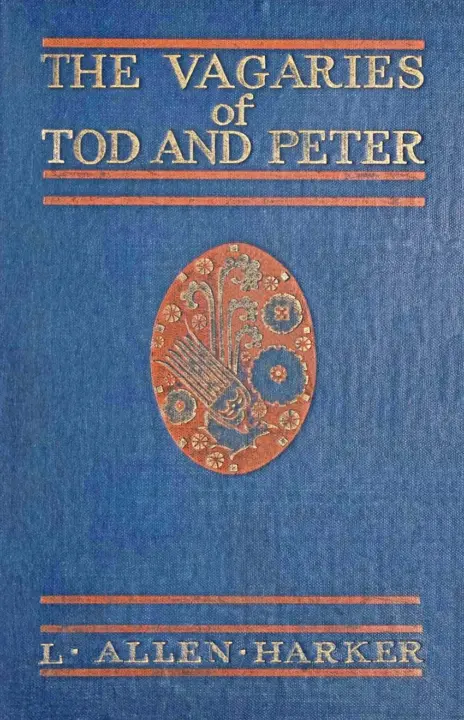
The Vagaries of Tod and Peter
L. Allen (Lizzie Allen) Harker
THE CLASSIC COLLECTION · 1910
"Master and Maid" by Mrs. L. Allen Harker is a novel written in the early 20th century. The story centers around Tony Bevan, a housemaster at Hamchester College, and his unexpected guest, Lallie Clonmell, who arrives to stay while her father goes big-game shooting in India. The narrative explores themes of youthful exuberance, responsibility, and the subtle dynamics of relationships within the school environment. The beginning of the novel introduces us to Tony Bevan and his prefects enjoying dinner when Lallie arrives unexpectedly, radiating charm and charisma despite her exhaustion from travel. Tony's initial surprise and worry about her unanticipated visit unfold as he realizes Lallie is not only close to him due to their shared past but is also spirited and independent. As the evening progresses, readers witness Lallie's seamless integration into the setting, her interactions with Tony and the other boys, and her strong personality that contrasts with Tony's more serious demeanor. The opening captures the essence of a lively school life and sets the stage for the complexities that will arise between the characters.
Introduction adapted from the source catalogue; source summaries may be automatically generated.
Free to read · English · 56,737 words · No account needed
MAKE TIME FOR A GOOD BOOK
On by default. Untick to stop anonymous reading totals. Each page counts after 10 seconds in view. How this works.
Anonymous counting is on unless you have switched it off.
"I wonder," Miss Foster said thoughtfully, when she had seated herself, "whether your father has fully considered Mr. Bevan's many responsibilities. A house like this--" Miss Foster paused.
"It seems a comfortable house," Lallie suggested helpfully, "though 'tis a bit cold. Shall I set a match to the fire?" and Lallie flew to the little table--but the matches were gone.
"Pray don't," Miss Foster exclaimed, "I never start fires before the
first of October."
"But if it's cold?" Lallie expostulated.
"That, Miss Clonmell, is my invariable rule."
"But it might be warm on the first of October."
"If it is warm on the first of October I shall certainly not have a
fire."
"But we've had a fire every night since I came."
"I thought the room smelt rather stuffy," Miss Foster said coldly. "Won't you sit down, Miss Clonmell? You look so uncomfortable standing there."
Lallie sat down obediently, and unconsciously folded her hands in the devout attitude in which she had been wont to listen to the discourses of the Mother Superior in her convent.
"It would be well," Miss Foster continued, in a head voice, "if, before we go any farther, I explain to you how rigid--necessarily rigid--rules must be in a house of this description. It will save trouble and futile argument afterwards. You must see, yourself, that the arrangements in a College boarding-house containing fifty boys and over a dozen servants can't chop and change; the ordinary routine can't be relaxed as in an ordinary private house--though in the best managed private houses things are almost equally regular."
"But why should people be colder in a College house than in any other sort, if they can afford a fire?" Lallie persisted. "Tony liked the fire."
"I never argue," Miss Foster observed, with superior finality; "we will change the subject. How is your brother getting on at Woolwich? I hope he is settling down well."
"I don't know about 'settling,' Miss Foster, we're not a very settled family, but he's well and happy, and the dearest boy. Didn't you think him a dear boy, and isn't he good to look at?"
"From what I remember of your brother he was quite good-looking--fair, wasn't he? You are not in the least like him."
"No, indeed, more's the pity," Lallie said simply. "He is the image of Dad. You've met my father, I think, Miss Foster?"
"I believe your father stayed a night here some time last winter, but I don't remember him very distinctly. We see so many parents, you know, and it's hard to keep them separate in one's mind unless they have very definite qualities, or are distinguished people."
Your reading position is saved on this browser. Take it to another device with a library code. Reading pages adapt to text, rather than matching a printed edition.
L. Allen (Lizzie Allen) Harker
L. Allen (Lizzie Allen) Harker
L. Allen (Lizzie Allen) Harker
L. Allen (Lizzie Allen) Harker
BEHIND THE BOOK
This eBook is for the use of anyone anywhere in the United States and most other parts of the world at no cost and with almost no restrictions whatsoever. You may copy it, give it away or re-use it under the terms of the Project Gutenberg License included with this eBook or online at www.gutenberg.org. If you are not located in the United States, you will have to check the laws of the country where you are located before using this eBook. Read the source licence.
The original source file, including credits and licence, is retained by this library. Request an original-format copy at no charge. Please include the book title and Project Gutenberg identifier #54504.
KEEP YOUR CURIOSITY GOING
Coulson Kernahan

Maurice Baring
Frances Wright
Cécile Tormay

Frederic Jesup Stimson

W. H. P. (William Henry Pope) Jarvis