THE CLASSIC COLLECTION✦Glimpses of Bengal Selected from the letters of Sir Rabindranath Tagore, 1885 to 1895CLASSIC FREE BOOKS
Glimpses of Bengal Selected from the letters of Sir Rabindranath Tagore, 1885 to 1895
Rabindranath Tagore
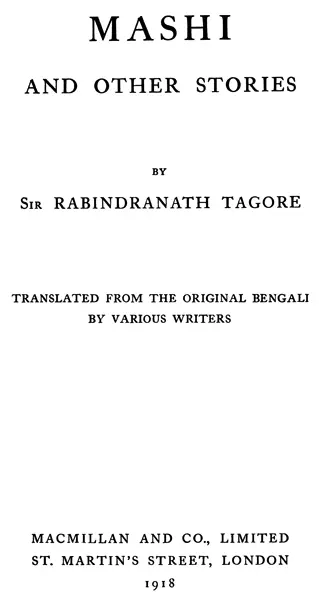
THE CLASSIC COLLECTION · 1918
"Mashi, and Other Stories" by Rabindranath Tagore is a collection of short stories written in the early 20th century. The book delves into the lives and emotions of characters, exploring themes such as love, sacrifice, and the complexities of human relationships. One of the main narratives revolves around the poignant experiences of Jotin, a terminally ill man, and his interactions with his wife Mani and his maternal aunt Mashi. The opening of "Mashi" introduces us to Jotin, who is struggling with his illness, and his wife Mani, who is torn between her obligations to him and her desire to attend her sister's ceremony. As Jotin reflects on his relationship with Mani, the narrative captures the tension between love and duty, underscored by feelings of jealousy and longing. Through conversations laden with emotional depth, the reader is drawn into Jotin's inner world, where he grapples with the implications of his impending death and the desires of those around him. The interplay of these intricate emotions lays a compelling foundation for the stories that follow in this poignant collection, inviting readers to explore the profound connections that define human experiences.
Introduction adapted from the source catalogue; source summaries may be automatically generated.
Free to read · English · 37,242 words · No account needed
MAKE TIME FOR A GOOD BOOK
On by default. Untick to stop anonymous reading totals. Each page counts after 10 seconds in view. How this works.
Anonymous counting is on unless you have switched it off.
Mashi imagined once more that Jotin was sleeping, when he cried out
suddenly:
'I know you thought that I was not happy with Mani, and therefore you were angry with her. But, Mashi, happiness is like those stars. They don't cover all the darkness; there are gaps between. We make mistakes in life and we misunderstand, and yet there remain gaps through which truth shines. I do not know whence comes this gladness that fills my heart to-night.'
Mashi began gently to soothe Jotin's brow, her tears unseen in the dark.
'I was thinking, Mashi, she's so young! What will she do when I
am----?'
'Young, Jotin? She's old enough. I too was young when I lost the idol of my life, only to find him in my heart for ever. Was that any loss, do you think? Besides, is happiness absolutely necessary?'
'Mashi, it seems as if just when Mani's heart shows signs of awakening
I have to----'
'Don't you worry about that, Jotin. Isn't it enough if her heart
awakes?'
Suddenly Jotin recollected the words of a village minstrel's song which he had heard long before:
O my heart! you woke not when the man of my heart came to my door. At the sound of his departing steps you woke up. Oh, you woke up in the dark!
'Mashi, what is the time now?'
'About nine.'
'So early as that! Why, I thought it must be at least two or three o'clock. My midnight, you know, begins at sundown. But why did you want me to sleep, then?'
'Why, you know how late last night you kept awake talking; so to-day you must get to sleep early.'
'Is Mani asleep?'
'Oh no, she's busy making some soup for you.'
'You don't mean to say so, Mashi? Does she----?'
'Certainly! Why, she prepares all your food, the busy little woman.'
'I thought perhaps Mani could not----'
'It doesn't take long for a woman to learn such things. With the need
it comes of itself.'
'The fish soup, that I had in the morning, had such a delicate flavour, I thought you had made it.'
'Dear me, no! Surely you don't think Mani would let me do anything for you? Why, she does all your washing herself. She knows you can't bear anything dirty about you. If only you could see your sitting-room, how spick and span she keeps it! If I were to let her haunt your sick-room, she would wear herself out. But that's what she really wants to do.'
'Is Mani's health, then----?'
Your reading position is saved on this browser. Take it to another device with a library code. Reading pages adapt to text, rather than matching a printed edition.
Rabindranath Tagore
Rabindranath Tagore
Rabindranath Tagore
Rabindranath Tagore
BEHIND THE BOOK
This eBook is for the use of anyone anywhere in the United States and most other parts of the world at no cost and with almost no restrictions whatsoever. You may copy it, give it away or re-use it under the terms of the Project Gutenberg License included with this eBook or online at www.gutenberg.org. If you are not located in the United States, you will have to check the laws of the country where you are located before using this eBook. Read the source licence.
The original source file, including credits and licence, is retained by this library. Request an original-format copy at no charge. Please include the book title and Project Gutenberg identifier #34757.
KEEP YOUR CURIOSITY GOING
Coulson Kernahan

Maurice Baring
Frances Wright
Cécile Tormay

Frederic Jesup Stimson

W. H. P. (William Henry Pope) Jarvis