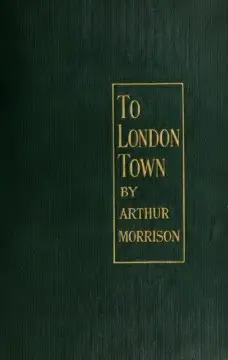
To London Town
Arthur Morrison
THE CLASSIC COLLECTION · 1894
"Martin Hewitt, Investigator" by Arthur Morrison is a collection of detective stories written in the late 19th century. The stories revolve around Martin Hewitt, a clever private detective known for his keen observational skills and extraordinary faculties, as he tackles various cases ranging from robberies to more complex crimes. The opening narrative introduces us to Hewitt's character and the peculiar circumstances surrounding a series of robberies at a country estate, setting the tone for his investigative adventures. The opening of the book begins with a recounting of a notorious robbery case involving a series of thefts that have taken place at Lenton Croft. We meet Sir James Norris, the owner of the estate, who is desperate to solve the mysterious incidents where valuable jewelry has been stolen under seemingly impossible circumstances, leaving behind only a spent match as a clue. As Hewitt is summoned to investigate, he quickly establishes a comprehensive understanding of the events leading up to the thefts, questioning Sir James about each incident. This chapter sets up an intriguing premise, demonstrating the methodical approach Hewitt takes as he begins to unravel the threads of the case, further entrenching readers in the mysteries that await in this detective series.
Introduction adapted from the source catalogue; source summaries may be automatically generated.
Free to read · English · 56,627 words · No account needed
MAKE TIME FOR A GOOD BOOK
On by default. Untick to stop anonymous reading totals. Each page counts after 10 seconds in view. How this works.
Anonymous counting is on unless you have switched it off.
"Yes, so he did. I saw Cortis when he first broke the old 2.46 mile record." And straightway Hewitt plunged into a whirl of talk of bicycles, tricycles, records, racing cyclists, Hillier, and Synyer and Noel Whiting, Taylerson and Appleyard--talk wherein the young man opposite bore an animated share, while I was left in the cold.
Our new friend, it seems, had himself been a prominent racing bicyclist a few years back, and was presently, at Hewitt's request, exhibiting a neat gold medal that hung at his watch-guard. That was won, he explained, in the old tall bicycle days, the days of bad tracks, when every racing cyclist carried cinder scars on his face from numerous accidents. He pointed to a blue mark on his forehead, which, he told us, was a track scar, and described a bad fall that had cost him two teeth, and broken others. The gaps among his teeth were plain to see as he smiled.
Presently the waiter brought dessert, and the young man opposite took an apple. Nut-crackers and a fruit-knife lay on our side of the stand, and Hewitt turned the stand to offer him the knife.
"No, thanks," he said; "I only polish a good apple, never peel it. It's a mistake, except with thick-skinned foreign ones."
And he began to munch the apple as only a boy or a healthy athlete can. Presently he turned his head to order coffee. The waiter's back was turned, and he had to be called twice. To my unutterable amazement Hewitt reached swiftly across the table, snatched the half-eaten apple from the young man's plate and pocketed it, gazing immediately, with an abstracted air, at a painted Cupid on the ceiling.
Our neighbor turned again, looked doubtfully at his plate and the table-cloth about it, and then shot a keen glance in the direction of Hewitt. He said nothing, however, but took his coffee and his bill, deliberately drank the former, gazing quietly at Hewitt as he did it, paid the latter, and left.
Immediately Hewitt was on his feet and, taking an umbrella, which stood near, followed. Just as he reached the door he met our late neighbor, who had turned suddenly back.
"Your umbrella, I think?" Hewitt asked, offering it.
"Yes, thanks." But the man's eye had more than its former hardness, and his jaw muscles tightened as I looked. He turned and went. Hewitt came back to me. "Pay the bill," he said, "and go back to your rooms; I will come on later. I must follow this man--it's the Foggatt case." As he went out I heard a cab rattle away, and immediately after it another.
Your reading position is saved on this browser. Take it to another device with a library code. Reading pages adapt to text, rather than matching a printed edition.
Arthur Morrison
Arthur Morrison
Arthur Morrison
Arthur Morrison
BEHIND THE BOOK
This eBook is for the use of anyone anywhere in the United States and most other parts of the world at no cost and with almost no restrictions whatsoever. You may copy it, give it away or re-use it under the terms of the Project Gutenberg License included with this eBook or online at www.gutenberg.org. If you are not located in the United States, you will have to check the laws of the country where you are located before using this eBook. Read the source licence.
The original source file, including credits and licence, is retained by this library. Request an original-format copy at no charge. Please include the book title and Project Gutenberg identifier #11252.
KEEP YOUR CURIOSITY GOING
Coulson Kernahan

Maurice Baring
Frances Wright
Cécile Tormay

Frederic Jesup Stimson

W. H. P. (William Henry Pope) Jarvis