THE CLASSIC COLLECTION✦The boys’ book of buccaneersCLASSIC FREE BOOKS
The boys’ book of buccaneers
A. Hyatt (Alpheus Hyatt) Verrill
THE CLASSIC COLLECTION · 1916
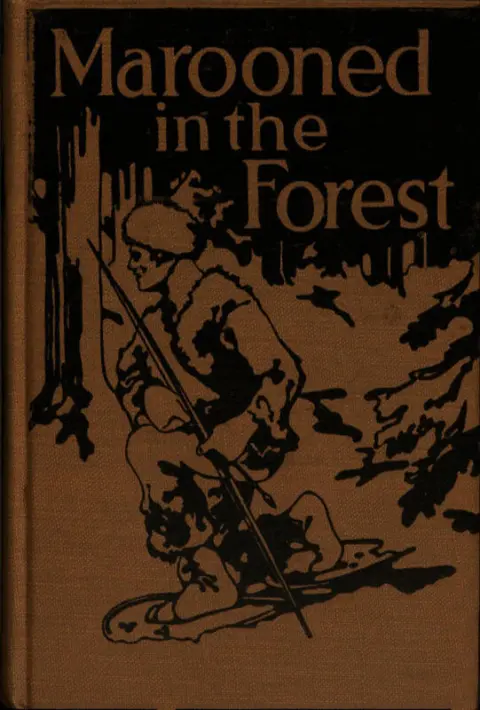
"Marooned in the Forest: The Story of a Primitive Fight for Life" by A. Hyatt Verrill is a novel written in the early 20th century. The narrative follows the harrowing journey of a modern-day Crusoe who finds himself stranded in the wilderness after a canoe accident. The story explores themes of survival, self-reliance, and the deep connection with nature as the protagonist learns to adapt to his harsh environment. The opening of the book introduces the protagonist who, after an unexpected capsize in a river, finds himself struggling to survive alone in the wilderness without food, fire, or shelter. The perilous moments leading to his near-drowning set the stage for a profound transformation as he awakens on the bank of the river, realizing he must rely on his ingenuity to endure. He begins to gather materials to make fire and gradually learns to forage for food, using survival techniques that reflect his knowledge of woodcraft and nature. Throughout this initial portion, the reader gains insight into his desperate yet determined mindset as he tackles the immediate challenges of shelter, food, and warmth, establishing a foundation for the gripping adventure that lies ahead.
Introduction adapted from the source catalogue; source summaries may be automatically generated.
Free to read · English · 51,075 words · No account needed
MAKE TIME FOR A GOOD BOOK
On by default. Untick to stop anonymous reading totals. Each page counts after 10 seconds in view. How this works.
Anonymous counting is on unless you have switched it off.
However, if I was to have a shelter at all it behooved me to begin at once, and I started forth to select a site for my home. I found a sheltered, dry knoll with good drainage a short distance from the river and with plenty of building material in the form of balsam firs, pines, and birches near at hand. I first selected two young trees, about five feet apart, and from these I cut the lower branches, leaving the stubs projecting a few inches. Across two of these I placed a light spruce pole and from the ends of this I laid other poles extending back at an angle to the ground.
This all sounds very simple and easy, now that I come to write it down, but as a matter of fact it required hours of hard, back-breaking, hand-blistering work, and by the time this much was accomplished I was faint with hunger. I succeeded in finding and eating a few mussels, but I had no time to devote to frog-hunting, and hurried back to my house-building. Across the two slanting poles other lighter poles were placed, and over these the broad “fans” of fir were spread like shingles, the lowest layer being placed first with each succeeding layer overlapping the last. This was comparatively easy work, for the twigs were small and easy to cut, and by late afternoon I had a shack which, though not by any means complete, was far better than nothing but the blue sky for a shelter.
I had an hour or two of daylight left, and determined to look for a likely spot for frogs. I dared not walk far into the forest for fear of losing my way in the fading afternoon light, but even a tramp of a few hundred yards away from the river was enough to convince me that there were no swamps or ponds in the vicinity, for the ground was quite hilly and rocky. Deciding that my only chance lay in finding stray frogs in the pools of the river, I walked down-stream for some distance, searching carefully wherever there was a backwater or a puddle of water along the shore. I found a number of mussels, which I pocketed, but no sign of frogs until I had traveled perhaps half a mile from my fire. At this point a small brook fell in a tiny cascade over the bank into the river, and, clambering up, I found that the little stream ran through an open vale or glade luxuriant with ferns, brush, and rank-growing plants. The stones over which it flowed were dark with a coating of moss, and in the deep, still pools between the boulders I caught glimpses of great speckled trout lurking in the shadows. It was an ideal trout-brook and I tried my best to spear one of the beautiful fish, but without success. However, I was rather pleased at my discovery, for even without fishing-tackle I felt confident that I could dam up one of the pools, bail out the water, and catch the trout with my hands. But there was no time for this just then. In the hope of finding a frog I went on up the brook. I had all but given up in despair when I reached a second miniature waterfall, and above this cascade I came upon a little pond surrounded by alders and birches. It was a cool, shady spot and the dark, black water flecked with patches of green weeds and lily-pads gave promise of frogs. Hardly had I reached the edge of the pool when I spied a fine bullfrog squatting among the weeds, and a moment later he had been successfully speared. I was delighted with the success of my crude weapon and crept cautiously around the pond, seeking more victims. Frogs were plentiful and were very tame, for probably man had never disturbed them, and before the growing dusk warned me that it was time to return to my camp I had obtained seven fine, big hoppers. As I was making my way toward the brook and the cascade I was startled by some good-sized creature which sprang from the grass at the border of the pond and plunged into the water. A moment later I saw a furry, brown head followed by a silvery, rippling wake, cleaving the placid surface of the pond, and realized that the animal which had caused my momentary fright was merely a harmless muskrat. I stopped and watched the creature for several moments and longed to be able to secure him, for I well knew that muskrats are edible and are even esteemed a delicacy. More than once I had eaten their tender, white meat when cooked by Joe. It was useless to give the matter any consideration, however, for without a gun the muskrat was far beyond my reach, and reluctantly I proceeded on my way.
Your reading position is saved on this browser. Take it to another device with a library code. Reading pages adapt to text, rather than matching a printed edition.
A. Hyatt (Alpheus Hyatt) Verrill
A. Hyatt (Alpheus Hyatt) Verrill
A. Hyatt (Alpheus Hyatt) Verrill
A. Hyatt (Alpheus Hyatt) Verrill
BEHIND THE BOOK
This eBook is for the use of anyone anywhere in the United States and most other parts of the world at no cost and with almost no restrictions whatsoever. You may copy it, give it away or re-use it under the terms of the Project Gutenberg License included with this eBook or online at www.gutenberg.org. If you are not located in the United States, you will have to check the laws of the country where you are located before using this eBook. Read the source licence.
The original source file, including credits and licence, is retained by this library. Request an original-format copy at no charge. Please include the book title and Project Gutenberg identifier #61427.
KEEP YOUR CURIOSITY GOING
Coulson Kernahan

Maurice Baring
Frances Wright
Cécile Tormay

Frederic Jesup Stimson

W. H. P. (William Henry Pope) Jarvis