
Health: Five Lay Sermons to Working-People
John Brown
THE CLASSIC COLLECTION · 1863
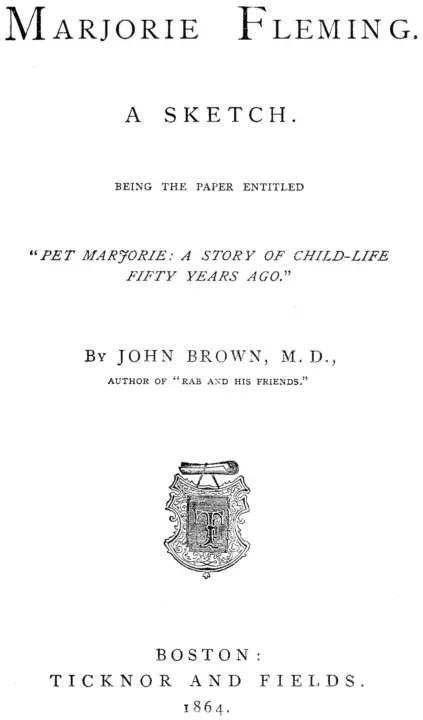
"Marjorie Fleming : a sketch : being the paper entitled 'Pet Marjorie, a story…'" by John Brown, M.D., is a biographical account written in the mid-1800s. The book serves as a gentle, affectionate portrait of Marjorie Fleming, a precocious Scottish child from the early 19th century, whose life was both brief and remarkable. Through the inclusion of her diaries, letters, poems, and recollections from those who loved her, John Brown crafts a loving memorial that is both literary and historical, offering insight into the innocence and depth of a child’s world during the Georgian and early Victorian eras. The main topic of the book is the life, personality, and writing of young Marjorie Fleming, celebrated for her wit, emotion, and singular charm. The narrative follows Marjorie’s short life, highlighting her vivid imagination, passion for learning, and strong affections—particularly for her family, her friend Isabella, and the famous author Sir Walter Scott, who was personally acquainted with her. The book presents Marjorie’s writings, revealing her curious mind, moral struggles, childish humor, and the intense love that defined her relationships. Brown describes her daily life, inner thoughts, struggles with temperament, and exposure to literature, all drawn from her childish yet sophisticated journal entries and letters. The account concludes with Marjorie’s untimely death from illness at the age of eight, and the deep grief experienced by those around her. Ultimately, the book is both a touching biography and a literary homage to childhood genius and affection lost too soon.
Introduction adapted from the source catalogue; source summaries may be automatically generated.
Free to read · English · 10,379 words · No account needed
MAKE TIME FOR A GOOD BOOK
On by default. Untick to stop anonymous reading totals. Each page counts after 10 seconds in view. How this works.
Anonymous counting is on unless you have switched it off.
Didn’t he face “the angry airt,” and make her bield his bosom, and into his own room with her, and lock the door, and out with the warm, rosy, little wifie, who took it all with great composure! There the two remained for three or more hours, making the house ring with their laughter; you can fancy the big man’s and Maidie’s laugh. Having made the fire cheery, he set her down in his ample chair, and, standing sheepishly before her, began to say his lesson, which happened to be--“Ziccotty, diccotty, dock, the mouse ran up the clock, the clock struck wan, down the mouse ran, ziccotty, diccotty, dock.” This done repeatedly till she was pleased, she gave him his new lesson, gravely and slowly, timing it upon her small fingers,--he saying it after her,--
“Wonery, twoery, tickery, seven;
Alibi, crackaby, ten, and eleven;
Pin, pan, musky, dan;
Tweedle-um, twoddle-um,
Twenty-wan; eerie, orie, ourie,
You, are, out.”
He pretended to great difficulty, and she rebuked him with most comical gravity, treating him as a child. He used to say that when he came to Alibi Crackaby he broke down, and pin-Pan, Musky-dan, Tweedle-um, Twoddle-um made him roar with laughter. He said Musky-Dan especially was beyond endurance, bringing up an Irishman and his hat fresh from the Spice Islands and odoriferous Ind; she getting quite bitter in her displeasure at his ill behavior and stupidness.
Then he would read ballads to her in his own glorious way, the two getting wild with excitement over Gil Morrice or the Baron of Smailholm; and he would take her on his knee, and make her repeat Constance’s speeches in King John, till he swayed to and fro, sobbing his fill. Fancy the gifted little creature, like one possessed, repeating,--
“For I am sick, and capable of fears,--
Oppressed with wrong, and, therefore, full of fears;
A widow, husbandless, subject to fears;
A woman, naturally born to fears.”
“If thou, that bidst me be content, wert grim, Ugly, and slanderous to thy mother’s womb,-- Lame, foolish, crooked, swart, prodigious--.”
Or, drawing herself up “to the height of her great argument,”--
“I will instruct my sorrows to be proud,
For grief is proud, and makes his owner stout.
Here I and sorrow sit.”
Scott used to say that he was amazed at her power over him, saying to Mrs. Keith, “She’s the most extraordinary creature I ever met with, and her repeating of Shakespeare overpowers me as nothing else does.”
Your reading position is saved on this browser. Take it to another device with a library code. Reading pages adapt to text, rather than matching a printed edition.
BEHIND THE BOOK
This eBook is for the use of anyone anywhere in the United States and most other parts of the world at no cost and with almost no restrictions whatsoever. You may copy it, give it away or re-use it under the terms of the Project Gutenberg License included with this eBook or online at www.gutenberg.org. If you are not located in the United States, you will have to check the laws of the country where you are located before using this eBook. Read the source licence.
The original source file, including credits and licence, is retained by this library. Request an original-format copy at no charge. Please include the book title and Project Gutenberg identifier #75718.
KEEP YOUR CURIOSITY GOING

David Patterson (Spirit) Hatch

David Patterson (Spirit) Hatch

David Patterson (Spirit) Hatch

Ralph Waldo Emerson

Maurice Baring
Oscar Wilde & James McNeill Whistler