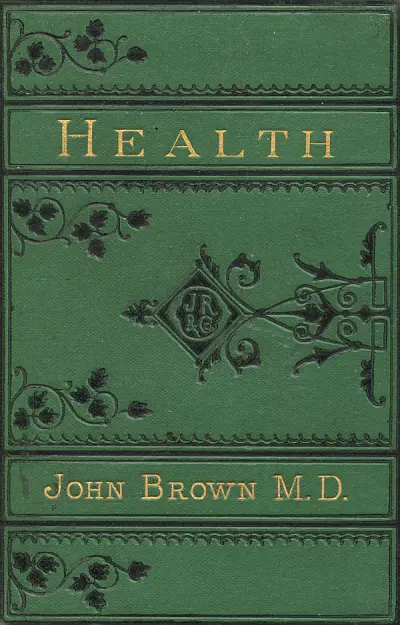
Health: Five Lay Sermons to Working-People
John Brown
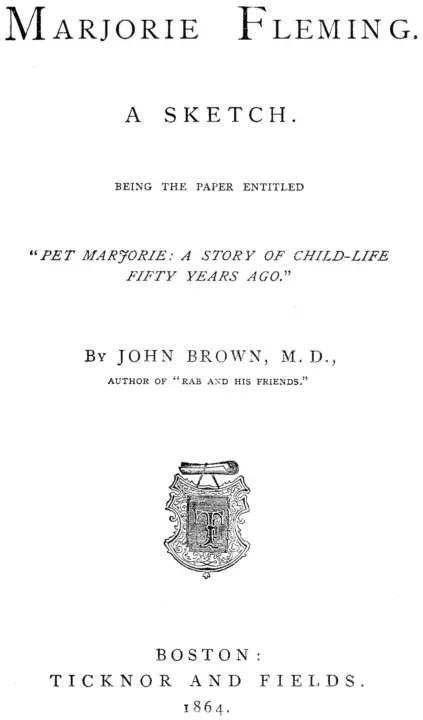
THE CLASSIC COLLECTION · 1863
"Marjorie Fleming : a sketch : being the paper entitled 'Pet Marjorie, a story…'" by John Brown, M.D., is a biographical account written in the mid-1800s. The book serves as a gentle, affectionate portrait of Marjorie Fleming, a precocious Scottish child from the early 19th century, whose life was both brief and remarkable. Through the inclusion of her diaries, letters, poems, and recollections from those who loved her, John Brown crafts a loving memorial that is both literary and historical, offering insight into the innocence and depth of a child’s world during the Georgian and early Victorian eras. The main topic of the book is the life, personality, and writing of young Marjorie Fleming, celebrated for her wit, emotion, and singular charm. The narrative follows Marjorie’s short life, highlighting her vivid imagination, passion for learning, and strong affections—particularly for her family, her friend Isabella, and the famous author Sir Walter Scott, who was personally acquainted with her. The book presents Marjorie’s writings, revealing her curious mind, moral struggles, childish humor, and the intense love that defined her relationships. Brown describes her daily life, inner thoughts, struggles with temperament, and exposure to literature, all drawn from her childish yet sophisticated journal entries and letters. The account concludes with Marjorie’s untimely death from illness at the age of eight, and the deep grief experienced by those around her. Ultimately, the book is both a touching biography and a literary homage to childhood genius and affection lost too soon.
Introduction adapted from the source catalogue; source summaries may be automatically generated.
Free to read · English · 10,379 words · No account needed
MAKE TIME FOR A GOOD BOOK
On by default. Untick to stop anonymous reading totals. Each page counts after 10 seconds in view. How this works.
Anonymous counting is on unless you have switched it off.
The second was William Clerk,--the Darsie Latimer of Redgauntlet; “a man,” as Scott says, “of the most acute intellects and powerful apprehension,” but of more powerful indolence, so as to leave the world with little more than the report of what he might have been,--a humorist as genuine, though not quite so savagely Swiftian as his brother Lord Eldin, neither of whom had much of that commonest and best of all the humors, called good.
The third we all know. What has he not done for every one of us? Who else ever, except Shakespeare, so diverted mankind, entertained and entertains a world so liberally, so wholesomely? We are fain to say, not even Shakespeare, for his is something deeper than diversion, something higher than pleasure, and yet who would care to split this hair?
Had any one watched him closely before and after the parting, what a change he would see! The bright, broad laugh, the shrewd, jovial word, the man of the Parliament House and of the world, and, next step, moody, the light of his eye withdrawn, as if seeing things that were invisible; his shut mouth, like a child’s, so impressionable, so innocent, so sad: he was now all within, as before he was all without; hence his brooding look. As the snow blattered in his face, he muttered, “How it raves and drifts! On-ding o’ snaw--ay, that’s the word--on-ding--.” He was now at his own door, “Castle Street, No. 39.” He opened the door, and went straight to his den; that wondrous workshop, where, in one year, 1823, when he was fifty-two, he wrote Peveril of the Peak, Quentin Durward, and St. Ronan’s Well, besides much else. We once took the foremost of our novelists, the greatest, we would say, since Scott, into this room, and could not but mark the solemnizing effect of sitting where the great magician sat so often and so long, and looking out upon that little shabby bit of sky, and that back green where faithful Camp lies.[1]
He sat down in his large, green morocco elbow-chair, drew himself close to his table, and glowered and gloomed at his writing apparatus, “a very handsome old box, richly carved, lined with crimson velvet, and containing ink-bottles, taper-stand, etc., in silver, the whole in such order that it might have come from the silversmith’s window half an hour before.” He took out his paper, then, starting up angrily, said, “‘Go spin, you jade, go spin.’ No, d-- it, it won’t do:--
Your reading position is saved on this browser. Take it to another device with a library code. Reading pages adapt to text, rather than matching a printed edition.
BEHIND THE BOOK
This eBook is for the use of anyone anywhere in the United States and most other parts of the world at no cost and with almost no restrictions whatsoever. You may copy it, give it away or re-use it under the terms of the Project Gutenberg License included with this eBook or online at www.gutenberg.org. If you are not located in the United States, you will have to check the laws of the country where you are located before using this eBook. Read the source licence.
The original source file, including credits and licence, is retained by this library. Request an original-format copy at no charge. Please include the book title and Project Gutenberg identifier #75718.
KEEP YOUR CURIOSITY GOING

David Patterson (Spirit) Hatch

David Patterson (Spirit) Hatch

David Patterson (Spirit) Hatch

Ralph Waldo Emerson

Maurice Baring
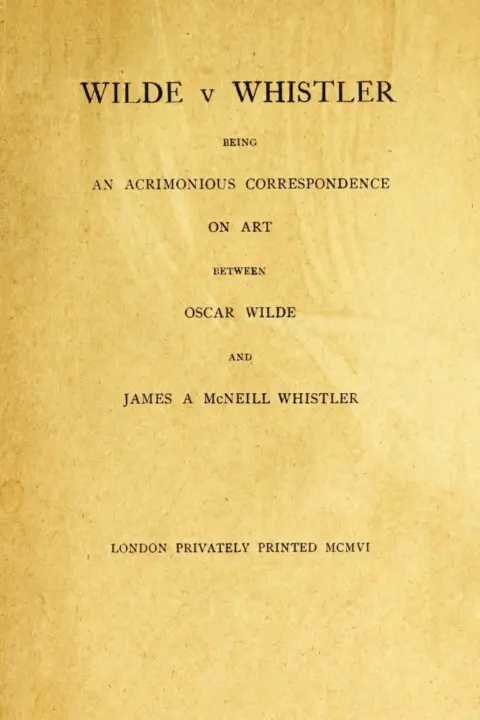
Oscar Wilde & James McNeill Whistler