Health: Five Lay Sermons to Working-People
John Brown
THE CLASSIC COLLECTION · 1863
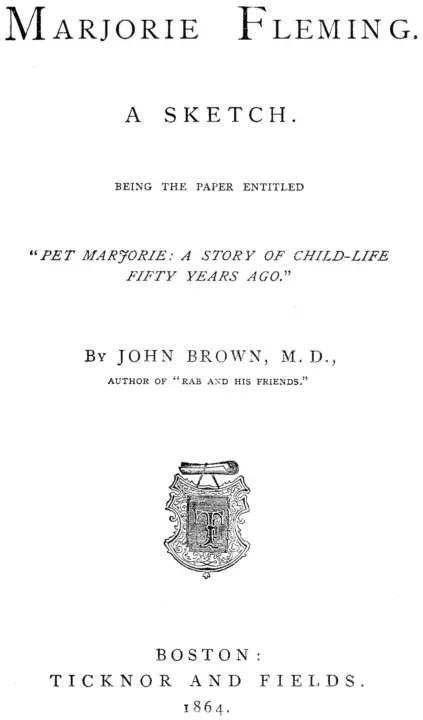
"Marjorie Fleming : a sketch : being the paper entitled 'Pet Marjorie, a story…'" by John Brown, M.D., is a biographical account written in the mid-1800s. The book serves as a gentle, affectionate portrait of Marjorie Fleming, a precocious Scottish child from the early 19th century, whose life was both brief and remarkable. Through the inclusion of her diaries, letters, poems, and recollections from those who loved her, John Brown crafts a loving memorial that is both literary and historical, offering insight into the innocence and depth of a child’s world during the Georgian and early Victorian eras. The main topic of the book is the life, personality, and writing of young Marjorie Fleming, celebrated for her wit, emotion, and singular charm. The narrative follows Marjorie’s short life, highlighting her vivid imagination, passion for learning, and strong affections—particularly for her family, her friend Isabella, and the famous author Sir Walter Scott, who was personally acquainted with her. The book presents Marjorie’s writings, revealing her curious mind, moral struggles, childish humor, and the intense love that defined her relationships. Brown describes her daily life, inner thoughts, struggles with temperament, and exposure to literature, all drawn from her childish yet sophisticated journal entries and letters. The account concludes with Marjorie’s untimely death from illness at the age of eight, and the deep grief experienced by those around her. Ultimately, the book is both a touching biography and a literary homage to childhood genius and affection lost too soon.
Introduction adapted from the source catalogue; source summaries may be automatically generated.
Free to read · English · 10,379 words · No account needed
MAKE TIME FOR A GOOD BOOK
On by default. Untick to stop anonymous reading totals. Each page counts after 10 seconds in view. How this works.
Anonymous counting is on unless you have switched it off.
This is beautiful: “I am very sorry to say that I forgot God--that is to say I forgot to pray to-day and Isabella told me that I should be thankful that God did not forget me--if he did, O what become of me if I was in danger and God not friends with me--I must go to unquenchable fire and if I was tempted to sin--how could I resist it O no I will never do it again--no no--if I can help it.” (Canny wee wifie!) “My religion is greatly falling off because I dont pray with so much attention when I am saying my prayers, and my charecter is lost among the Braehead people. I hope I will be religious again--but as for regaining my charecter I despare for it.” (Poor little ‘habit and repute’!)
Her temper, her passion, and her “badness” are almost daily confessed and deplored: “I will never again trust to my own power, for I see that I cannot be good without God’s assistance,--I will not trust in my own selfe, and Isa’s health will be quite ruined by me,--it will indeed.” “Isa has giving me advice, which is, that when I feal Satan beginning to tempt me, that I flea him and he would flea me.” “Remorse is the worst thing to bear, and I am afraid that I will fall a marter to it.”
Poor dear little sinner! Here comes the world again: “In my travels I met with a handsome lad named Charles Balfour Esq., and from him I got ofers of marage--offers of marage, did I say? Nay plenty heard me.” A fine scent for “breach of promise”!
This is abrupt and strong: “The Divil is curced and all works. ’Tis a fine work Newton on the profecies. I wonder if there is another book of poems comes near the Bible. The Divil always girns at the sight of the Bible.” “Miss Potune” (her “simpliton” friend) “is very fat; she pretends to be very learned. She says she saw a stone that dropt from the skies; but she is a good Christian.” Here come her views on church government: “An Annibabtist is a thing I am not a member of--I am a Pisplekan (Episcopalian) just now, and” (O you little Laodicean and Latitudinarian!) “a Prisbeteran at Kirkcaldy!”--(Blandula! Vagula! cœlum et animum mutas quæ trans mare [i. e. trans Bodotriam]-curris!)--“my native town.” “Sentiment is not what I am acquainted with as yet, though I wish it, and should like to practise it.” (!) “I wish I had a great, great deal of gratitude in my heart, in all my body.” “There is a new novel published, named Self-Control” (Mrs. Brunton’s)--“a very good maxim forsooth!” This is shocking: “Yesterday a marrade man, named Mr. John Balfour, Esq., offered to kiss me, and offered to marry me, though the man” (a fine directness this!) “was espused, and his wife was present and said he must ask her permission; but he did not. I think he was ashamed and confounded before 3 gentlemen--Mr. Jobson and 2 Mr. Kings.” “Mr. Banester’s” (Bannister’s) “Budjet is to-night; I hope it will be a good one. A great many authors have expressed themselves too sentimentally.” You are right, Marjorie. “A Mr. Burns writes a beautiful song on Mr. Cunhaming, whose wife desarted him--truly it is a most beautiful one.” “I like to read the Fabulous historys, about the histerys of Robin, Dickey, flapsay, and Peccay, and it is very amusing, for some were good birds and others bad, but Peccay was the most dutiful and obedient to her parients.” “Thomson is a beautiful author, and Pope, but nothing to Shakespear, of which I have a little knolege. Macbeth is a pretty composition, but awful one.” “The Newgate Calender is very instructive.” (!) “A sailor called here to say farewell; it must be dreadful to leave his native country when he might get a wife; or perhaps me, for I love him very much. But O I forgot, Isabella forbid me to speak about love.” This antiphlogistic regimen and lesson is ill to learn by our Maidie, for here she sins again: “Love is a very papithatick thing” (it is almost a pity to correct this into pathetic), “as well as troublesome and tiresome--but O Isabella forbid me to speak of it.” Here are her reflections on a pine-apple: “I think the price of a pine-apple is very dear: it is a whole bright goulden guinea, that might have sustained a poor family.” Here is a new vernal simile: “The hedges are sprouting like chicks from the eggs when they are newly hatched or as the vulgar say, clacked.” “Doctor Swift’s works are very funny; I got some of them by heart.” “Moreheads sermons are I hear much praised but I never read sermons of any kind; but I read novelettes and my Bible, and I never forget it, or my prayers.” Bravo Marjorie!
Your reading position is saved on this browser. Take it to another device with a library code. Reading pages adapt to text, rather than matching a printed edition.
BEHIND THE BOOK
This eBook is for the use of anyone anywhere in the United States and most other parts of the world at no cost and with almost no restrictions whatsoever. You may copy it, give it away or re-use it under the terms of the Project Gutenberg License included with this eBook or online at www.gutenberg.org. If you are not located in the United States, you will have to check the laws of the country where you are located before using this eBook. Read the source licence.
The original source file, including credits and licence, is retained by this library. Request an original-format copy at no charge. Please include the book title and Project Gutenberg identifier #75718.
KEEP YOUR CURIOSITY GOING

David Patterson (Spirit) Hatch

David Patterson (Spirit) Hatch

David Patterson (Spirit) Hatch

Ralph Waldo Emerson

Maurice Baring

Oscar Wilde & James McNeill Whistler