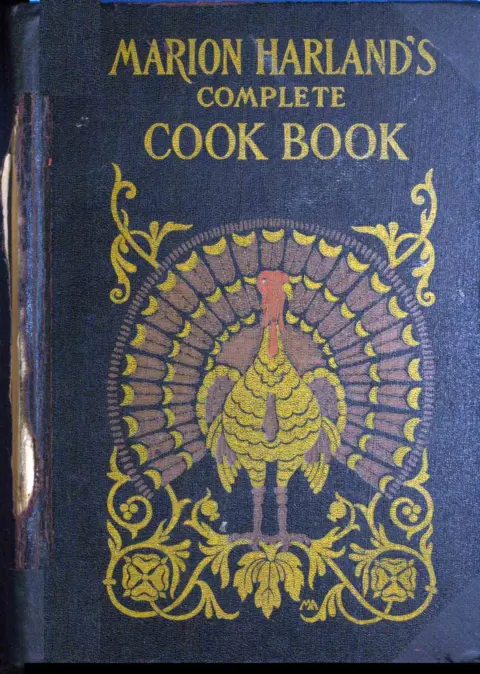
Marion Harland’s Complete Cook Book A Practical and Exhaustive Manual of Cookery and Housekeeping
Marion Harland
THE CLASSIC COLLECTION · 1884
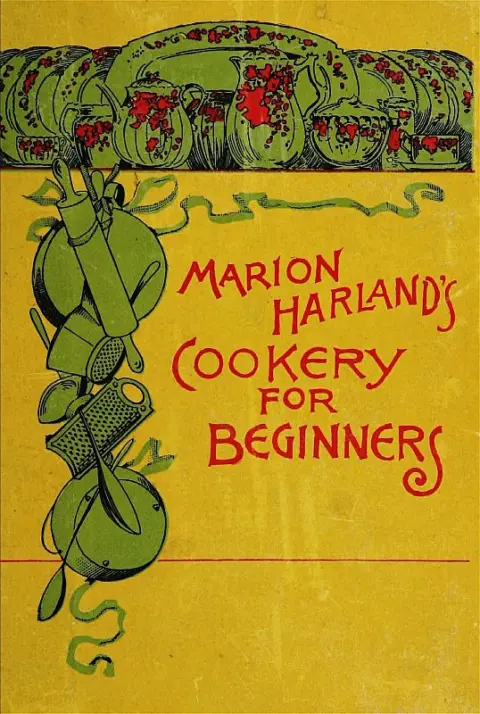
"Marion Harland's Cookery for Beginners" by Marion Harland is a practical cookery guide written in the late 19th century. This work serves as a comprehensive introduction to cooking for novice housekeepers, focusing on basic culinary techniques and recipes essential for daily meal preparation. The book emphasizes the importance of mastering fundamental cooking skills, particularly bread-making, to ensure healthful and satisfying dining experiences. The opening of the guide begins with a discussion on the significance of good bread in culinary practices, positing it as a fundamental skill for any cook. Harland introduces her readers to the process of making homemade yeast and the first loaf of bread, providing detailed instructions and practical tips to ensure success. She stresses the importance of ingredient quality and the proper technique, assuring beginners that even with less-than-perfect materials, practice will lead to satisfactory results. Overall, the initial section sets a foundational tone for the subsequent lessons in the book, aiming to encourage confidence and competence in kitchen endeavors.
Introduction adapted from the source catalogue; source summaries may be automatically generated.
Free to read · English · 26,591 words · No account needed
MAKE TIME FOR A GOOD BOOK
On by default. Untick to stop anonymous reading totals. Each page counts after 10 seconds in view. How this works.
Anonymous counting is on unless you have switched it off.
Four tablespoonfuls of butter, cut up and rolled in
flour.
One tablespoonful of cornstarch wet and dissolved in
cold water.
One lump of white sugar.
Three quarts of cold water will be needed.
Parboil the sliced potatoes fifteen minutes in enough hot water to cover them well. Drain this off and throw it away. Put potatoes, tomatoes, onion, celery and parsley on in three quarts of cold water, and cook gently two hours.
Then rub them all through a colander, return the soup to the pot, drop in the sugar, season to taste with pepper and salt, boil up once and take off the scum before adding the floured butter, and when this is dissolved, the cornstarch.
Stir two minutes over the fire, and your soup is ready for the table. Very good it will prove, too, if the directions be exactly followed.
When celery is out of season, you can use instead of it, a little essence of celery, or, what is better, celery salt.
ONE of the most comico-pathetico true stories I know is that of a boy, the youngest of a large family, who, having always sat at the second table, knew nothing experimentally of the choicer portions of chicken or turkey. Being invited out to dinner as the guest of a playmate, he was asked, first of all present, “what part of the turkey he preferred.”
“The carker” (carcass), “and a little of the stuff” (stuffing), “if you please,” replied the poor little fellow, with prompt politeness.
It was his usual ration, and in his ignorance, he craved nothing
better.
The pupil in cookery who enjoys tossing up entrées, and devising dainty rechauffés, but cannot support the thought of handling raw chickens and big-boned joints of butcher’s meat, is hardly wiser than he.
It is a common fallacy to believe that this branch of the culinary art is uninteresting drudgery, fit only for the hands of the very plain hired cook.
Another mistake, almost as prevalent, lies in supposing that she can, of course, perform the duty properly. There is room for intelligent skill in so simple a process as roasting a piece of meat, nor is the task severe or repulsive. Practically, it is far more important to know how to do this well, than to be proficient in cake, jelly, and pudding making.
Roast Beef.
Have a steady, moderate fire in the stove-grate. Increase the heat when the meat is thoroughly warmed.
Your reading position is saved on this browser. Take it to another device with a library code. Reading pages adapt to text, rather than matching a printed edition.
Marion Harland
Marion Harland
Marion Harland
Marion Harland
BEHIND THE BOOK
This eBook is for the use of anyone anywhere in the United States and most other parts of the world at no cost and with almost no restrictions whatsoever. You may copy it, give it away or re-use it under the terms of the Project Gutenberg License included with this eBook or online at www.gutenberg.org. If you are not located in the United States, you will have to check the laws of the country where you are located before using this eBook. Read the source licence.
The original source file, including credits and licence, is retained by this library. Request an original-format copy at no charge. Please include the book title and Project Gutenberg identifier #49155.
KEEP YOUR CURIOSITY GOING

Charles G. (Charles Griffith) Ross
Hannah Webster Foster

Emily Lawless
Edwin Hamlin Carr

Charles De Lano Hine
Andrew Ure