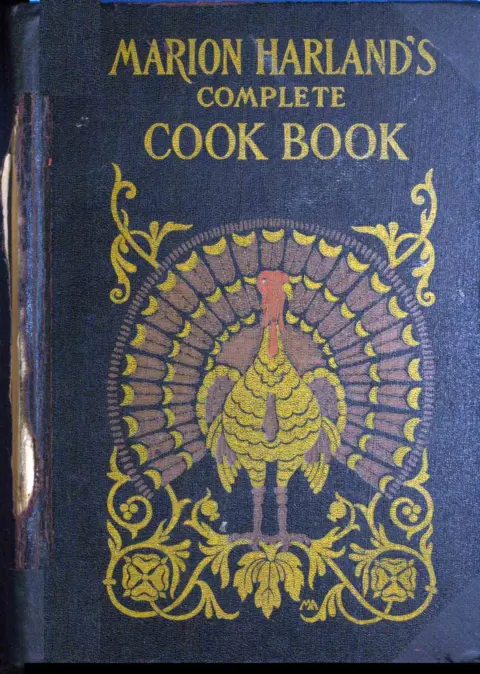
Marion Harland’s Complete Cook Book A Practical and Exhaustive Manual of Cookery and Housekeeping
Marion Harland
THE CLASSIC COLLECTION · 1910
"Marion Harland's Autobiography: The Story of a Long Life" by Marion Harland is a personal memoir written in the early 20th century. This work captures the intricate tapestry of the author’s life, weaving together her experiences that span the Old South and the reformation through the Civil War. It reflects on her upbringing, family lineage, personal relationships, and the societal changes she witnessed over the decades. At the start of the autobiography, Harland introduces herself and her family background, detailing her ancestors and the historical context of her family's roots in America. She recalls her father's beginnings and her mother's genteel lineage while providing vivid anecdotes, such as her father's Revolutionary War service. The opening chapters create a foundation of warmth, nostalgia, and nostalgia for a bygone era, as Harland's storytelling reveals the depth of her connections with familial and historical legacies, setting a personal tone for the narrative that will unfold.
Introduction adapted from the source catalogue; source summaries may be automatically generated.
Free to read · English · 152,645 words · No account needed
MAKE TIME FOR A GOOD BOOK
On by default. Untick to stop anonymous reading totals. Each page counts after 10 seconds in view. How this works.
Anonymous counting is on unless you have switched it off.
Grateful for the unlooked-for gentleness, I rallied to tell the story simply and without excitement. When I had finished, he made no immediate reply, and I looked up timidly.
“I really saw it, father, just as I have said! At least, I believe I
did!”
“I know it, my child. But we will talk no more of it to-night. I will go to your room with you.”
He preceded me with the lamp. When we were in my chamber, he looked under the bed (how did he guess that I should do it as soon as his back was turned, if he had not?). Then he carried the light into the small dressing-room behind the chamber. I heard him open the doors of a wardrobe that stood there, and try the fastenings of a window.
“There is nothing to harm you here,” he said, coming back, and speaking as gently as before. “Now, try not to think of what you believe you saw. Say your prayers and go to bed, like a good, brave girl!”
He kissed me again, putting his arm around me and, holding me to him tenderly, said “Good-night,” and went out.
I was ashamed of my fright—heartily ashamed! Yet I was afraid to look in the mirror while I undid and combed my hair and put on my night-cap. When, at last, I dared put out the light, I scurried across the floor, plunged into bed, and drew the blankets tightly over my head.
My father looked sympathizingly at my heavy eyes next morning when I came down to prayers. After breakfast he took me aside and told me to keep what I had seen to myself.
“Neither your mother nor I will speak of it in the hearing of the children and servants. You may, of course, take your sister into your confidence. She may be trusted. But my opinion is that the fewer who know of a thing that seems unaccountable, the better. And your sister is more nervous than you.”
Thus it came about that nothing was said to Mea, and that we three who knew of the visitation did not discuss it, and tried honestly not to think of it.
Until, perhaps a month after my fright, about nine o’clock, one wet night, my mother entered the chamber where my father and I were talking over political news, as we still had a habit of doing, and said, hurriedly, glancing nervously behind her:
“I have seen Virginia’s ghost!”
She saw it, just as I had described, issuing from the closed door and gliding away close to the wall, then vanishing at the Venetian door.
Your reading position is saved on this browser. Take it to another device with a library code. Reading pages adapt to text, rather than matching a printed edition.
Marion Harland
Marion Harland
Marion Harland
Marion Harland
BEHIND THE BOOK
This eBook is for the use of anyone anywhere in the United States and most other parts of the world at no cost and with almost no restrictions whatsoever. You may copy it, give it away or re-use it under the terms of the Project Gutenberg License included with this eBook or online at www.gutenberg.org. If you are not located in the United States, you will have to check the laws of the country where you are located before using this eBook. Read the source licence.
The original source file, including credits and licence, is retained by this library. Request an original-format copy at no charge. Please include the book title and Project Gutenberg identifier #49003.
KEEP YOUR CURIOSITY GOING
Cécile Tormay

Moritz Busch
John L. Ransom
Frances Wright
Cécile Tormay

Mabel Potter Daggett