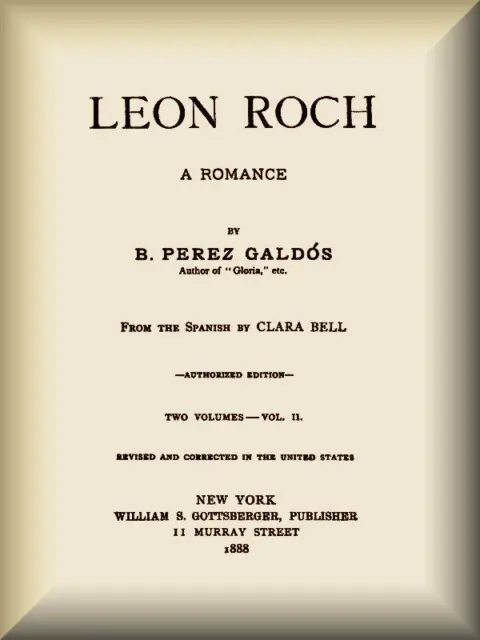
Leon Roch: A Romance, vol. 2 (of 2)
Benito Pérez Galdós
THE CLASSIC COLLECTION · 1883
"Marianela" by Benito Pérez Galdós is a Spanish novel written in 1878. In the fictional town of Socartes, a poor orphan girl named Marianela loves Pablo, a blind boy who believes she is beautiful because of her voice. When a famous doctor offers Pablo the chance to regain his sight, their relationship faces an uncertain future. The story explores themes of inner and outer beauty, examining how perception shapes love and identity in unexpected ways.
Introduction adapted from the source catalogue; source summaries may be automatically generated.
Free to read · English · 60,390 words · No account needed
MAKE TIME FOR A GOOD BOOK
On by default. Untick to stop anonymous reading totals. Each page counts after 10 seconds in view. How this works.
Anonymous counting is on unless you have switched it off.
“You are as God made you--and if you fell into the hands of any one who knew how to treat you, you would work very well.”
“No, Señor, no indeed,” she repeated as energetically as though it were in her own praise that she spoke, “I am no good to any one--only in the way.”
“Then you are a mere vagabond?”
“No, Señor, for I attend on Pablo.”
“And who is Pablo?”
“That young blind gentleman, whom you met in La Terrible. I have been his guide for the last year and a half. I take him everywhere; we go for long walks in the fields.”
“He seems a good fellow, this Pablo.”
Nela again stood still and looked up at the doctor, and her face glowed with enthusiasm as she exclaimed:
“Holy Virgin! He is the best and dearest creature in the whole world! Poor fellow!--and he is cleverer without eyes than all those who can see.”
“Yes, I liked your master. Does he belong to the place?”
“Yes, Señor; he is the only son of Don Francisco Penáguilas, a very kind and very rich gentleman who lives in the houses at Aldeacorba.”
“Tell me, why are you called Nela? What does it mean?”
The child shrugged her shoulders, and after a pause, she said:
“My mother’s name was María Canela, and so she was called Nela; they say it is a dog’s name. My name is María.”
“Mariquita.”
“María Nela they call me, or sometimes Canela’s girl, and some say Marianela, and some merely Nela.”
“And your master, is he fond of you?”
“Yes, Señor; he is very good to me. He says he sees with my eyes, for I take him everywhere, and tell him what everything is like.”
“Everything that he cannot see?” The stranger seemed much interested in
this conversation.
“Yes--I tell him everything. He asks me what a star is like, and I tell him all about it in such a way that it is the same to him as if he could see it. I explain it all--what the planets are like, and the clouds, and the sky, and the water, and the lightning, the weather-cocks, the butterflies, the mists, the snails, and the shapes and faces of men and animals. I tell him what is ugly and what is pretty, and so he gets to understand everything.”
“I see; your work is no trifle. What is ugly and what is pretty! There is nothing.... You decide upon that question? Tell me, can you read?”
“No, Señor.--I tell you I am good for nothing.”
Your reading position is saved on this browser. Take it to another device with a library code. Reading pages adapt to text, rather than matching a printed edition.
Benito Pérez Galdós
Benito Pérez Galdós
Benito Pérez Galdós
BEHIND THE BOOK
This eBook is for the use of anyone anywhere in the United States and most other parts of the world at no cost and with almost no restrictions whatsoever. You may copy it, give it away or re-use it under the terms of the Project Gutenberg License included with this eBook or online at www.gutenberg.org. If you are not located in the United States, you will have to check the laws of the country where you are located before using this eBook. Read the source licence.
The original source file, including credits and licence, is retained by this library. Request an original-format copy at no charge. Please include the book title and Project Gutenberg identifier #48818.
KEEP YOUR CURIOSITY GOING
Coulson Kernahan

Maurice Baring
Frances Wright
Cécile Tormay

Frederic Jesup Stimson

W. H. P. (William Henry Pope) Jarvis