THE CLASSIC COLLECTION✦The Hansa TownsCLASSIC FREE BOOKS
The Hansa Towns
Helen Zimmern
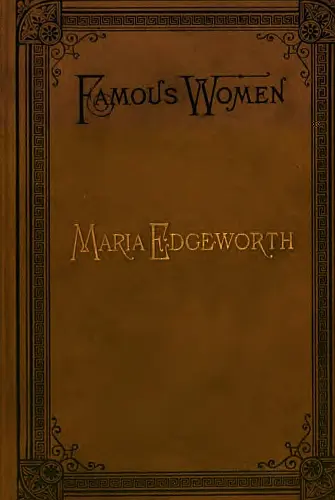
THE CLASSIC COLLECTION · 1883
"Maria Edgeworth" by Helen Zimmern is a biographical account written in the late 19th century. The work explores the life and contributions of Maria Edgeworth, a significant figure in the world of literature known for her children's literature and social commentary. It delves into her lineage, family influences, and early life experiences, setting the stage for her future literary achievements. The opening of this biography introduces Maria Edgeworth's heritage and the impact of her father, Richard Lovell Edgeworth, on her upbringing. It discusses her family's Irish roots and her father's progressive educational ideals, which shaped Maria’s intellect and creativity. Through anecdotes and letters, the narrative highlights her childhood environment, her mischievous nature, and the solid moral foundations set by her family. This foundation not only fueled her literary ambitions but also inspired a lifelong engagement with themes of education and social responsibility, as evidenced by her later works.
Introduction adapted from the source catalogue; source summaries may be automatically generated.
Free to read · English · 78,302 words · No account needed
MAKE TIME FOR A GOOD BOOK
On by default. Untick to stop anonymous reading totals. Each page counts after 10 seconds in view. How this works.
Anonymous counting is on unless you have switched it off.
It would be easy to bring forward testimony regarding the fervent admiration bestowed on Miss Edgeworth by her contemporaries. She certainly missed, but she only just missed, the highest greatness. Did Madame de Stael put her sure finger on the cause when she said, after reading Fashionable Tales and expressing her great admiration, "Que Miss Edgeworth etait digne de l'enthousiasme, mais qu'elle s'est perdue dans la triste utilite?" Yet to preach utility was held by Miss Edgeworth as a duty; but for this she might perhaps never have written at all, since no pecuniary needs drove her to authorship. And allowing for this moral strain in her works, and the blemishes that result thence, which compared with all she achieved are but trivial, in estimating her work as a whole, we may well afford to change what Chateaubriand called "the petty and meagre criticism of defects for the comprehensive and prolific criticism of beauties." We must not look for features such as she cannot furnish, any more than we should seek for figs upon an apple-tree. There are certain things Miss Edgeworth can do, and do inimitably; there are others entirely foreign to her sphere. Her novels have been described as a sort of essence of common sense, and even more happily it has been said that it was her genius to be wise. We must be content to take that which she can offer; and since she offers so much, why should we not be content? Miss Edgeworth wrote of ordinary human life, and not of tremendous catastrophes or highly romantic incidents. Hers was no heated fancy. She had no comprehension of those fiery passions, those sensibilities that burn like tinder at contact with the feeblest spark; she does not believe in chance, that favorite of so many novelists; neither does she deal in ruined castles, underground galleries nor spectres, as was the fashion in her day. In her stories events mostly occur as in sober and habitual fact. In avoiding the stock-in-trade of her contemporaries she boldly struck out a line of her own which answers in some respects to the modern realistic novel, though devoid, of course, of its anatomical and physiological character. She used materials which her predecessors had scorned as worthless. She endeavored to show that there is a poetry in self-restraint as well as in passion, though at the very time she wrote it was the fashion to sneer at this, and to laud as fine that self-forgetfulness, that trampling down of all obstacles, no matter of what nature, sung by Byron and Shelley. She permitted just that amount of tenderness which the owner could keep under due control. She had no taste for what was named the grandeur, beauty and mystery of crime. She seldom devoted her attention to crimes at all, but gave it to those minor virtues and vices that contribute more largely to our daily sufferings or enjoyments. The novels of her day were too apt to bring forward angels or monsters, and though she also erred at times in the former respect, yet on the whole she departed from it, and was among the first to strike out that path since so successfully trodden, especially by female novelists, and notably by George Eliot--that of interesting us in persons moving in the common walks of men. In her Popular and Moral Tales she was encumbered like a clergyman in his sermon, and hence a too solemn and rather stifling air of moral reflection is apt to pervade. That she overcame it as much as she did, that her novels are as attractive and readable as they are, is to the credit of her genius, which not even Mr. Edgeworth could wholly overlay and stifle, and she thus with few exceptions triumphed over that tendency to the "goody," from which it seems so difficult for works intended for edification to keep themselves exempt. Next to her children's and Irish tales she is most excellent in her studies from fashionable life. Her heroes and heroines moving in the dismal round of inanities, miscalled diversions, are portraits touched up with nice care in detail, with a keen eye for subtleties and demi-tints. She loved to expose the false and mawkish doctrines thought fit for women. Her fashionable heroines followed the sentimental teachings of Rousseau and Mrs. Chapone, and held that the highest mission of woman is to please, and that she should be not only excused but commended if she employed every art to compass that end. High-mindedness was a factor unknown or at least unadmitted in their philosophy; fashion governed all; to be in the fashion was the main object of their lives. Miss Edgeworth did not condemn this too mercilessly or from too lofty a platform. Her morality, though unexceptionable, is never austere; she allows and even sanctions worldly wisdom within certain limits; she was too much a woman of the world herself to set up Utopian or ascetic standards. To make conscience agree with the demands of polite opinion was admitted to be a desirable and important factor. After all, we are all more or less affected by the mental atmosphere in which we live; none of us can wholly get outside the spiritual air that environs us, and see things from different points of view; and Miss Edgeworth could do so less than many, because she was less highly endowed with sympathetic imagination. Thus her shortcomings are, in her case, more than in that of many others, the fault of her surroundings and education. For, placed immediately under Mr. Edgeworth's personal influence, his powers of suasion and plausible presentment, it was not easy to escape, and his daughter never questioned his final wisdom or desired such escape. In a critical reading of her books it is amusing to note how ever and again her father crops forth. Thus her heroes constantly ask what manner of education the young lady of their choice has received, because as "prudent men" they feel that only on this can they base their future hopes of happiness. And yet, strangely enough, with this absolute faith in the power of education is combined a belief that nothing, not even this almighty thing, can overcome the fact that if a girl be the daughter of a woman who has at any time forgotten herself, no matter how good the education may have been, no matter that this parent may have died at her birth or the child never lived beside her, Miss Edgeworth's heroes regard her as necessarily lost--consider that it is impossible she should continue in the straight path. They will stifle their strongest feelings; make themselves and the girl miserable rather than marry her. A special instance of this occurs in the Absentee, where Lord Colambre prefers to break off his engagement with his adored cousin, the charming and high-spirited Grace Nugent, rather than wed her after he hears a rumor that her mother has not been legally married to her father. Hence a deus ex machina has to be evoked, who, like all such gods, cuts the Gordian knot in bungling fashion. After attributing all possibilities to education, there is quite a comic inconsistency in this method of visiting the offenses of the wrong-doer upon the victim. But Miss Edgeworth, or rather her father, appeared to have no comprehension of the fact that misfortunes of birth most frequently act on the children as a deterrent; so that they make, as it were, hereditary expiation. But here appears the want of tenderness in Miss Edgeworth's work--a quantity she owned as a woman and lacked as an author. The two were certainly curiously different at times. But though not tender, she is always amiable and kindly, even though she does not look far beneath the surface and never deals with the soul. Unknown to her were its silent tragedies, its conflicts, hopes and fears. Those feelings that did not manifest themselves in life or action were beyond her range of comprehension. She had a genius for observing such things as can be observed; the lower depths are never stirred by herself or her characters. But it was her genius for observation, her power for reproducing what she had seen, that made her greatness--a greatness limited in its extent, but none the less greatness of its kind. Her works fully merit the admiration they have so long enjoyed.
Your reading position is saved on this browser. Take it to another device with a library code. Reading pages adapt to text, rather than matching a printed edition.
BEHIND THE BOOK
This eBook is for the use of anyone anywhere in the United States and most other parts of the world at no cost and with almost no restrictions whatsoever. You may copy it, give it away or re-use it under the terms of the Project Gutenberg License included with this eBook or online at www.gutenberg.org. If you are not located in the United States, you will have to check the laws of the country where you are located before using this eBook. Read the source licence.
The original source file, including credits and licence, is retained by this library. Request an original-format copy at no charge. Please include the book title and Project Gutenberg identifier #33268.
KEEP YOUR CURIOSITY GOING
John L. Ransom

Herman W. Mudgett

Harriet Monroe
Daniel Dulany Addison
Charles Lanman

Harold Rosher