THE CLASSIC COLLECTION✦The Hansa TownsCLASSIC FREE BOOKS
The Hansa Towns
Helen Zimmern
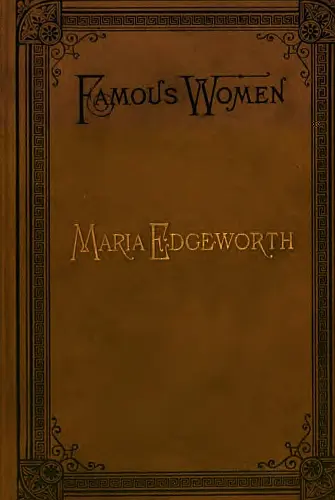
THE CLASSIC COLLECTION · 1883
"Maria Edgeworth" by Helen Zimmern is a biographical account written in the late 19th century. The work explores the life and contributions of Maria Edgeworth, a significant figure in the world of literature known for her children's literature and social commentary. It delves into her lineage, family influences, and early life experiences, setting the stage for her future literary achievements. The opening of this biography introduces Maria Edgeworth's heritage and the impact of her father, Richard Lovell Edgeworth, on her upbringing. It discusses her family's Irish roots and her father's progressive educational ideals, which shaped Maria’s intellect and creativity. Through anecdotes and letters, the narrative highlights her childhood environment, her mischievous nature, and the solid moral foundations set by her family. This foundation not only fueled her literary ambitions but also inspired a lifelong engagement with themes of education and social responsibility, as evidenced by her later works.
Introduction adapted from the source catalogue; source summaries may be automatically generated.
Free to read · English · 78,302 words · No account needed
MAKE TIME FOR A GOOD BOOK
On by default. Untick to stop anonymous reading totals. Each page counts after 10 seconds in view. How this works.
Anonymous counting is on unless you have switched it off.
Richard Lovell Edgeworth was born at Bath in 1744, and spent his early years partly in England, partly in Ireland, receiving a careful education. In his youth he was known as "a gay philosopher," in the days when the word philosopher was still used in its true sense of a lover of wisdom. Light-hearted and gay, good-humored and self-complacent; possessed of an active and cultivated mind, just and fearless, but troubled with neither loftiness nor depth of feeling, Richard Lovell Edgeworth was nevertheless a remarkable personage, when the time at which he lived is taken into account. He foresaw much of the progress our own century has made, clearly indicated some of its features, and actually achieved for agriculture and industry a multitude of inventions, modest as far as the glory of the world attaches to them, but none the less useful for the services they render. Many of his ideas, rejected as visionary and impracticable when he first promulgated them, have now become the common property of mankind. He was no mere theorist; when he had established a theory he loved to put it into practice, and as his theories ranged over many and wide fields, so did his experiments. Even in late life, when most persons care only to cultivate repose, he threw himself, with all the ardor of youth, into schemes of improvement for the good of Ireland; for he was sincerely devoted to her true welfare, and held in contempt the mock patriotism that looks only to popularity. In early life he sowed a certain quantity of wild oats, the result of the super-abundant animal spirits that distinguished him, and at the age of sixteen contracted a mock-marriage, which his father found needful to have annulled by a process of law. After this escapade he was entered at Corpus Christi, Oxford, as a gentleman commoner. During his residence he became intimate with the family of Mr. Elers, a gentleman of German descent, who resided at Black Bourton, and was father to several pretty girls. Mr. Elers had previously warned the elder Edgeworth against introducing into his home circle the gay and gallant Richard, remarking that he could give his daughters no fortunes that would make them suitable matches for this young gentleman. Mr. Edgeworth, however, turned a deaf ear to the warning, and the result was that the collegian became so intimate at the house, and in time so entangled by the court he had paid to one of the daughters, that, although he had meanwhile seen women he liked better, he could not honorably extricate himself. In later life he playfully said: "Nothing but a lady ever did turn me aside from my duty." He certainly was all his days peculiarly susceptible to female charms, and, had opportunity been afforded him, might have rivalled Henry VIII. in the number of his wives. This second marriage gave as little satisfaction to his father as the first, but the elder Edgeworth wisely recognized the fact that he was himself not wholly blameless in the matter. He, therefore, a few months after the ceremony had been performed at Gretna Green, gave his consent to a formal re-marriage by license. Thus, before he was twenty, Richard Lovell Edgeworth was a husband and a father. The marriage entered upon so hastily proved unfortunate; the pair were totally unsuited to one another; and though Mrs. Edgeworth appears to have been a worthy woman, to judge from the few and somewhat ungenerous allusions her husband makes to her in his biography, they did not sympathize intellectually--a point he might have discovered before marriage. The consequence was that he sought sympathy and pleasure elsewhere. He divided his time between Ireland, London and Lichfield. The latter city was the centre of a somewhat prim, self-conscious, exclusive literary coterie, in which Dr. Darwin, the singer of the Botanic Garden, Miss Anna Seward, the "Swan of Lichfield," and the eccentric wife-trainer, Thomas Day, the author of Sanford and Merton, were conspicuous figures. They were most of them still in their youthful hey-day, unknown to fame, and, as yet, scarcely aspiring towards it. Here, in this, to him, congenial circle of eager and ardent young spirits, Richard Lovell Edgeworth loved to disport himself; now finding a sympathetic observer of his mechanical inventions in Mr. Watt, Dr. Darwin or Mr. Wedgwood; now flirting with the fair Anna. He must have posed as a bachelor, for he relates how, on one occasion, when paying compliments to Miss Seward, Mrs. Darwin took the opportunity of drinking "Mrs. Edgeworth's health," a name that caused manifest surprise to the object of his affections. Here, too, he became imbued with the educational theories of Rousseau, which clung to him, in a modified degree, throughout his life, and according to which, in their most pronounced form, he educated his eldest son. Here, further, at the age of twenty-six, he met the woman he was to love most deeply. From the moment he saw Miss Honora Sneyd, Mr. Edgeworth became enamored, and in his attentions to her he does not seem to have borne in mind the fact that he was a married man.
Your reading position is saved on this browser. Take it to another device with a library code. Reading pages adapt to text, rather than matching a printed edition.
BEHIND THE BOOK
This eBook is for the use of anyone anywhere in the United States and most other parts of the world at no cost and with almost no restrictions whatsoever. You may copy it, give it away or re-use it under the terms of the Project Gutenberg License included with this eBook or online at www.gutenberg.org. If you are not located in the United States, you will have to check the laws of the country where you are located before using this eBook. Read the source licence.
The original source file, including credits and licence, is retained by this library. Request an original-format copy at no charge. Please include the book title and Project Gutenberg identifier #33268.
KEEP YOUR CURIOSITY GOING
John L. Ransom

Herman W. Mudgett

Harriet Monroe
Daniel Dulany Addison
Charles Lanman

Harold Rosher