
Love and liberty
Alexandre Dumas
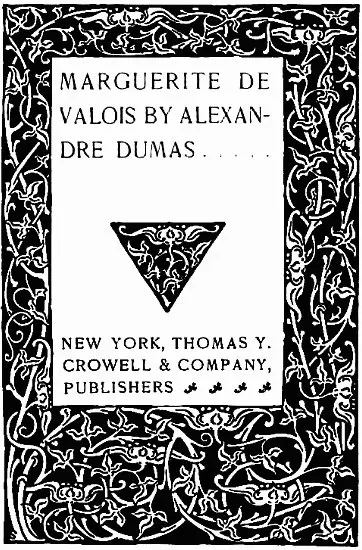
THE CLASSIC COLLECTION · 1900
"Marguerite de Valois" by Alexandre Dumas and Auguste Maquet is a historical novel written in 1845. Set during the French Wars of Religion in 1572 Paris, it follows Marguerite de Valois, daughter of Henry II, whose marriage to Protestant Prince Henri de Bourbon is meant to bring peace. But her mother, Catherine de Medici, schemes to orchestrate the St. Bartholomew's Day Massacre. As court intrigues multiply and poisonings follow, Margot begins a dangerous affair with the soldier La Môle while Catherine plots to secure power for her own son.
Introduction adapted from the source catalogue; source summaries may be automatically generated.
Free to read · English · 203,835 words · No account needed
MAKE TIME FOR A GOOD BOOK
On by default. Untick to stop anonymous reading totals. Each page counts after 10 seconds in view. How this works.
Anonymous counting is on unless you have switched it off.
"In fact, Madame de Lorraine had warned me; I had begged him not to leave the Louvre. Has he done so?"
"No, no, madame, he is in the Louvre; but if he is not here"--
"He is not here!"
"Oh!" cried Madame de Sauve, with an outburst of agony, "then he is a dead man, for the queen mother has sworn his destruction!"
"His destruction! ah," said Marguerite, "you terrify me--impossible!"
"Madame," replied Madame de Sauve, with that energy which passion alone can give, "I tell you that no one knows where the King of Navarre is."
"And where is the queen mother?"
"The queen mother sent me to find Monsieur de Guise and Monsieur de Tavannes, who were in her oratory, and then dismissed me. Then--pardon me, madame--I went to my room and waited as usual."
"For my husband, I suppose."
"He did not come, madame. Then I sought for him everywhere and asked every one for him. One soldier told me he thought he had seen him in the midst of the guards who accompanied him, with his sword drawn in his hand, some time before the massacre began, and the massacre has begun an hour ago."
"Thanks, madame," said Marguerite; "and although perhaps the sentiment which impels you is an additional offence toward me,--yet, again, I thank you!"
"Oh, forgive me, madame!" she said, "and I will return to my apartments stronger for your pardon, for I dare not follow you, even at a distance."
Marguerite extended her hand to her.
"I will go to Queen Catharine," she said. "Return to your room. The King of Navarre is under my protection; I have promised him my alliance and I will be faithful to my promise."
"But suppose you cannot obtain access to the queen mother, madame?"
"Then I will go to my brother Charles, and I will speak to him."
"Go, madame, go," said Charlotte, leaving Marguerite room to pass, "and may God guide your majesty!"
Marguerite darted down the corridor, but when she reached the end of it she turned to make sure that Madame de Sauve was not lingering behind. Madame de Sauve was following her.
The Queen of Navarre saw her go upstairs to her own apartment, and then she herself went toward the queen's chamber.
Your reading position is saved on this browser. Take it to another device with a library code. Reading pages adapt to text, rather than matching a printed edition.
Alexandre Dumas
Alexandre Dumas & Auguste Maquet
Alexandre Dumas
Alexandre Dumas
BEHIND THE BOOK
This eBook is for the use of anyone anywhere in the United States and most other parts of the world at no cost and with almost no restrictions whatsoever. You may copy it, give it away or re-use it under the terms of the Project Gutenberg License included with this eBook or online at www.gutenberg.org. If you are not located in the United States, you will have to check the laws of the country where you are located before using this eBook. Read the source licence.
The original source file, including credits and licence, is retained by this library. Request an original-format copy at no charge. Please include the book title and Project Gutenberg identifier #33609.
KEEP YOUR CURIOSITY GOING
Cécile Tormay

Moritz Busch
Coulson Kernahan
John L. Ransom

Maurice Baring
Frances Wright