
Love and liberty
Alexandre Dumas
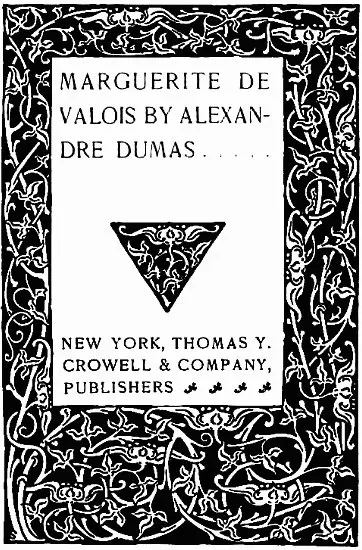
THE CLASSIC COLLECTION · 1900
"Marguerite de Valois" by Alexandre Dumas and Auguste Maquet is a historical novel written in 1845. Set during the French Wars of Religion in 1572 Paris, it follows Marguerite de Valois, daughter of Henry II, whose marriage to Protestant Prince Henri de Bourbon is meant to bring peace. But her mother, Catherine de Medici, schemes to orchestrate the St. Bartholomew's Day Massacre. As court intrigues multiply and poisonings follow, Margot begins a dangerous affair with the soldier La Môle while Catherine plots to secure power for her own son.
Introduction adapted from the source catalogue; source summaries may be automatically generated.
Free to read · English · 203,835 words · No account needed
MAKE TIME FOR A GOOD BOOK
On by default. Untick to stop anonymous reading totals. Each page counts after 10 seconds in view. How this works.
Anonymous counting is on unless you have switched it off.
"Yes, yes, you are right," said Charles, "and I am grateful to you for saying this, Henriot, for truly you have suffered a great deal under my reign without counting the fact that it was during my reign that your poor mother died. But you must have seen that I was often driven? Sometimes I have resisted, but oftener I have yielded from very fatigue. But, as you said, let us not talk of the past. Now it is the present which concerns me; it is the future which frightens me."
And the poor King hid his livid face in his emaciated hands.
After a moment's silence he shook his head as if to drive away all gloomy thoughts, thus causing a shower of blood to fall about him.
"We must save the state," he continued in a low tone, leaning towards
Henry. "We must prevent its falling into the hands of fanatics or
women."
As we have just said, Charles uttered these words in a low tone, yet Henry thought he heard behind the headboard something like a dull exclamation of anger. Perhaps some opening made in the wall at the instigation of Charles himself permitted Catharine to hear this final conversation.
"Of women?" said the King of Navarre to provoke an explanation.
"Yes, Henry," said Charles, "my mother wishes the regency until my brother returns from Poland. But mind what I tell you, he will not come back."
"Why not?" cried Henry, whose heart gave a joyful leap.
"No, he cannot return," continued Charles, "because his subjects will
not let him leave."
"But," said Henry, "do you not suppose, brother, that the queen mother has already written to him?"
"Yes, but Nancey stopped the courier at Château Thierry, and brought me the letter, in which she said I was to die. I wrote to Varsovia myself, my letter reached there, I am sure, and my brother will be watched. So, in all probability, Henry, the throne will be vacant."
A second sound louder than the first was heard in the alcove.
"She is surely there," thought Henry, "and is listening."
Charles heard nothing.
"Now," he continued, "I am dying without male heir." Then he stopped. A sweet thought seemed to light up his face, and, laying his hand on the King of Navarre's shoulder:
"Alas!" said he, "do you remember, Henriot, the poor little boy I showed you one evening sleeping in his silken cradle, watched over by an angel? Alas! Henriot, they will kill him!"
"Oh, sire!" cried Henry, whose eyes filled with tears, "I swear to you that I will watch over him all the days and nights of my life. Command me, my King."
Your reading position is saved on this browser. Take it to another device with a library code. Reading pages adapt to text, rather than matching a printed edition.
Alexandre Dumas
Alexandre Dumas & Auguste Maquet
Alexandre Dumas
Alexandre Dumas
BEHIND THE BOOK
This eBook is for the use of anyone anywhere in the United States and most other parts of the world at no cost and with almost no restrictions whatsoever. You may copy it, give it away or re-use it under the terms of the Project Gutenberg License included with this eBook or online at www.gutenberg.org. If you are not located in the United States, you will have to check the laws of the country where you are located before using this eBook. Read the source licence.
The original source file, including credits and licence, is retained by this library. Request an original-format copy at no charge. Please include the book title and Project Gutenberg identifier #33609.
KEEP YOUR CURIOSITY GOING
Cécile Tormay

Moritz Busch
Coulson Kernahan
John L. Ransom

Maurice Baring
Frances Wright