
Love and liberty
Alexandre Dumas
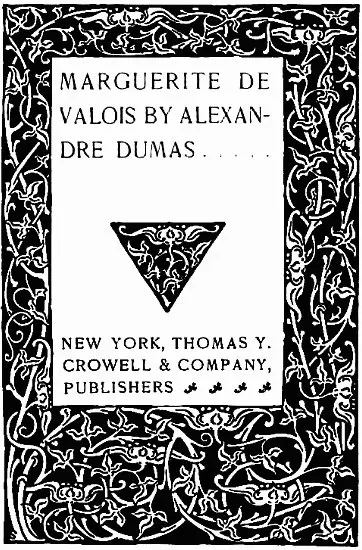
THE CLASSIC COLLECTION · 1900
"Marguerite de Valois" by Alexandre Dumas and Auguste Maquet is a historical novel written in 1845. Set during the French Wars of Religion in 1572 Paris, it follows Marguerite de Valois, daughter of Henry II, whose marriage to Protestant Prince Henri de Bourbon is meant to bring peace. But her mother, Catherine de Medici, schemes to orchestrate the St. Bartholomew's Day Massacre. As court intrigues multiply and poisonings follow, Margot begins a dangerous affair with the soldier La Môle while Catherine plots to secure power for her own son.
Introduction adapted from the source catalogue; source summaries may be automatically generated.
Free to read · English · 203,835 words · No account needed
MAKE TIME FOR A GOOD BOOK
On by default. Untick to stop anonymous reading totals. Each page counts after 10 seconds in view. How this works.
Anonymous counting is on unless you have switched it off.
"No, madame, they are here; but it is a sad sight, and one which I could have spared you by wrapping up in my cloak that for which you have come."
Marguerite and Henriette looked at each other.
"No," said the queen, who had read in her friend's eye the same thought as in her own; "no, show us the way and we will follow."
Caboche took the torch and opened an oaken door at the top of a short stairway, which led to an underground chamber. At that instant a current of air blew some sparks from the torch and brought to the princesses an ill-smelling odor of dampness and blood. Henriette, white as an alabaster statue, leaned on the arm of her less agitated friend; but at the first step she swayed.
"I can never do it," said she.
"When one loves truly, Henriette," replied the queen, "one loves beyond
death."
It was a sight both horrible and touching presented by the two women, glowing with youth, beauty, and jewels, as they bent their heads beneath the foul, chalky ceiling, the weaker leaning on the stronger, the stronger clinging to the arm of the hangman.
They reached the final step. On the floor of the cellar lay two human forms covered with a wide cloth of black serge.
Caboche raised a corner of it, and, lowering the torch:
"See, madame," said he.
In their black clothes lay the two young men, side by side, in the strange symmetry of death. Their heads had been placed close to their bodies, from which they seemed to be separated only by a bright red circle about the neck. Death had not disunited their hands, for either from chance or the kind care of the hangman the right hand of La Mole rested in Coconnas's left hand.
There was a look of love under the lids of La Mole, and a smile of scorn under those of Coconnas.
Marguerite knelt down by the side of her lover, and with hands that sparkled with gems gently raised the head she had so greatly loved.
The Duchesse de Nevers leaned against the wall, unable to remove her eyes from that pale face on which so often she had gazed for pleasure and for love.
"La Mole! Dear La Mole!" murmured Marguerite.
"Annibal! Annibal!" cried the duchess, "so beautiful! so proud! so brave! Never again will you answer me!"
And her eyes filled with tears.
This woman, so scornful, so intrepid, so insolent in happiness; this woman who carried scepticism as far as absolute doubt, passion to the point of cruelty; this woman had never thought of death.
Marguerite was the first to move.
Your reading position is saved on this browser. Take it to another device with a library code. Reading pages adapt to text, rather than matching a printed edition.
Alexandre Dumas
Alexandre Dumas & Auguste Maquet
Alexandre Dumas
Alexandre Dumas
BEHIND THE BOOK
This eBook is for the use of anyone anywhere in the United States and most other parts of the world at no cost and with almost no restrictions whatsoever. You may copy it, give it away or re-use it under the terms of the Project Gutenberg License included with this eBook or online at www.gutenberg.org. If you are not located in the United States, you will have to check the laws of the country where you are located before using this eBook. Read the source licence.
The original source file, including credits and licence, is retained by this library. Request an original-format copy at no charge. Please include the book title and Project Gutenberg identifier #33609.
KEEP YOUR CURIOSITY GOING
Cécile Tormay

Moritz Busch
Coulson Kernahan
John L. Ransom

Maurice Baring
Frances Wright