
Love and liberty
Alexandre Dumas
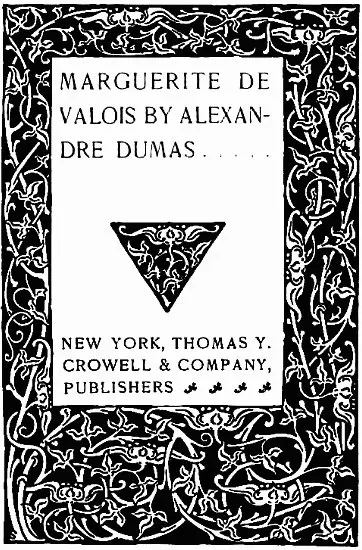
THE CLASSIC COLLECTION · 1900
"Marguerite de Valois" by Alexandre Dumas and Auguste Maquet is a historical novel written in 1845. Set during the French Wars of Religion in 1572 Paris, it follows Marguerite de Valois, daughter of Henry II, whose marriage to Protestant Prince Henri de Bourbon is meant to bring peace. But her mother, Catherine de Medici, schemes to orchestrate the St. Bartholomew's Day Massacre. As court intrigues multiply and poisonings follow, Margot begins a dangerous affair with the soldier La Môle while Catherine plots to secure power for her own son.
Introduction adapted from the source catalogue; source summaries may be automatically generated.
Free to read · English · 203,835 words · No account needed
MAKE TIME FOR A GOOD BOOK
On by default. Untick to stop anonymous reading totals. Each page counts after 10 seconds in view. How this works.
Anonymous counting is on unless you have switched it off.
"Maître," said he, "do us the kindness to stop a moment opposite the Rue
Tizon."
Caboche nodded in assent, and drew rein at the place indicated.
Aided by Coconnas, La Mole raised himself with an effort, and with eyes blinded by tears gazed at the small house, silent and mute, deserted as a tomb. A groan burst from him, and in a low voice he murmured:
"Adieu, adieu, youth, love, life!"
And his head fell forward on his breast.
"Courage," said Coconnas; "we may perhaps find all this above."
"Do you think so?" murmured La Mole.
"I think so, because the priest said so; and above all, because I hope so. But do not faint, my friend, or these staring wretches will laugh at us."
Caboche heard the last words and whipping his horse with one hand he extended the other, unseen by any one, to Coconnas. It contained a small sponge saturated with a powerful stimulant, and La Mole, after smelling it and rubbing his forehead with it, felt himself revived and reanimated.
"Ah!" said La Mole, "I am better," and he kissed the reliquary, which he
wore around his neck.
As they turned a corner of the quay and reached the small edifice built by Henry II. they saw the scaffold rising bare and bloody on its platform above the heads of the crowd.
"Dear friend," said La Mole, "I wish I might be the first to die."
Coconnas again touched the hangman's shoulder.
"What is it, my gentleman?" said the latter, turning around.
"My good fellow," said Coconnas, "you will do what you can for me, will you not? You said you would."
"Yes, and I repeat it."
"My friend has suffered more than I and consequently has less
strength"--
"Well?"
"Well, he says that it would cause him too much pain to see me die first. Besides, if I were to die before him he would have no one to support him on the scaffold."
"Very well," said Caboche, wiping away a tear with the back of his hand; "be easy, it shall be as you wish."
"And with one blow, eh?" said the Piedmontese in a low tone.
"With one blow."
"That is well. If you have to make up for it, make up on me."
The tumbril stopped. They had arrived. Coconnas put on his hat.
A murmur like that of the waves at sea reached the ears of La Mole. He strove to rise, but strength failed him. Caboche and Coconnas supported him under the arms.
Your reading position is saved on this browser. Take it to another device with a library code. Reading pages adapt to text, rather than matching a printed edition.
Alexandre Dumas
Alexandre Dumas & Auguste Maquet
Alexandre Dumas
Alexandre Dumas
BEHIND THE BOOK
This eBook is for the use of anyone anywhere in the United States and most other parts of the world at no cost and with almost no restrictions whatsoever. You may copy it, give it away or re-use it under the terms of the Project Gutenberg License included with this eBook or online at www.gutenberg.org. If you are not located in the United States, you will have to check the laws of the country where you are located before using this eBook. Read the source licence.
The original source file, including credits and licence, is retained by this library. Request an original-format copy at no charge. Please include the book title and Project Gutenberg identifier #33609.
KEEP YOUR CURIOSITY GOING
Cécile Tormay

Moritz Busch
Coulson Kernahan
John L. Ransom

Maurice Baring
Frances Wright