
Love and liberty
Alexandre Dumas
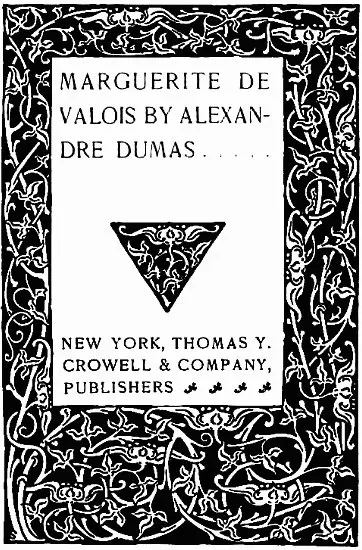
THE CLASSIC COLLECTION · 1900
"Marguerite de Valois" by Alexandre Dumas and Auguste Maquet is a historical novel written in 1845. Set during the French Wars of Religion in 1572 Paris, it follows Marguerite de Valois, daughter of Henry II, whose marriage to Protestant Prince Henri de Bourbon is meant to bring peace. But her mother, Catherine de Medici, schemes to orchestrate the St. Bartholomew's Day Massacre. As court intrigues multiply and poisonings follow, Margot begins a dangerous affair with the soldier La Môle while Catherine plots to secure power for her own son.
Introduction adapted from the source catalogue; source summaries may be automatically generated.
Free to read · English · 203,835 words · No account needed
MAKE TIME FOR A GOOD BOOK
On by default. Untick to stop anonymous reading totals. Each page counts after 10 seconds in view. How this works.
Anonymous counting is on unless you have switched it off.
"Wretches!" shouted he, in a paroxysm of fury, straining the bed and the cords so that the tormentors themselves drew back. "Wretches! torture me, twist me, break me to pieces, but you shall know nothing, I swear! Ah! you think, do you, that it is with pieces of wood and steel that a gentleman of my name is made to speak? Go ahead! I defy you!"
"Prepare to write, clerk," said the judge.
"Yes, prepare," shouted Coconnas; "and if you write everything I am going to tell you you infamous hangmen, you will be kept busy. Write! write!"
"Have you anything you wish to confess?" asked the judge in his calm
voice.
"Nothing; not a word! Go to the devil!"
"You had better reflect, monsieur. Come, executioner, adjust the boot."
At these words the man, who until then had stood motionless, the ropes in his hand, stepped forward from the pillar and slowly approached Coconnas, who turned and made a grimace at him.
It was Maître Caboche, the executioner of the provostship of Paris.
A look of sad surprise showed itself on the face of Coconnas, who, instead of crying out and growing agitated, lay without moving, unable to take his eyes from the face of the forgotten friend who appeared at that moment.
Without moving a muscle of his face, without showing that he had ever seen Coconnas anywhere except on the rack, Caboche placed two planks between the limbs of the victim, two others outside of his limbs, and bound them securely together by means of the rope he held in his hand.
This was the arrangement called the "boot."
For ordinary torture six wedges were inserted between the two planks, which, on being forced apart, crushed the flesh.
For severe torture ten wedges were inserted, and then the planks not only broke the flesh but the bones.
The preliminaries over, Maître Caboche slipped the end of the wedge between the two planks, then, mallet in hand, bent on one knee and looked at the judge.
"Do you wish to speak?" said the latter.
"No," resolutely answered Coconnas, although he felt the perspiration rise to his brow and his hair begin to stand on end.
"Proceed, then," said the judge. "Insert the first wedge."
Caboche raised his arm, with its heavy mallet, and struck the wedge a tremendous blow, which gave forth a dull sound. The rack shook.
Your reading position is saved on this browser. Take it to another device with a library code. Reading pages adapt to text, rather than matching a printed edition.
Alexandre Dumas
Alexandre Dumas & Auguste Maquet
Alexandre Dumas
Alexandre Dumas
BEHIND THE BOOK
This eBook is for the use of anyone anywhere in the United States and most other parts of the world at no cost and with almost no restrictions whatsoever. You may copy it, give it away or re-use it under the terms of the Project Gutenberg License included with this eBook or online at www.gutenberg.org. If you are not located in the United States, you will have to check the laws of the country where you are located before using this eBook. Read the source licence.
The original source file, including credits and licence, is retained by this library. Request an original-format copy at no charge. Please include the book title and Project Gutenberg identifier #33609.
KEEP YOUR CURIOSITY GOING
Cécile Tormay

Moritz Busch
Coulson Kernahan
John L. Ransom

Maurice Baring
Frances Wright