
Love and liberty
Alexandre Dumas
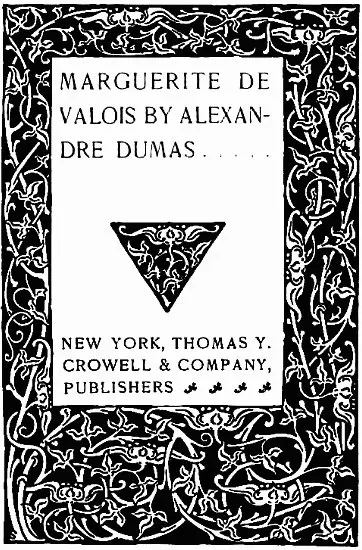
THE CLASSIC COLLECTION · 1900
"Marguerite de Valois" by Alexandre Dumas and Auguste Maquet is a historical novel written in 1845. Set during the French Wars of Religion in 1572 Paris, it follows Marguerite de Valois, daughter of Henry II, whose marriage to Protestant Prince Henri de Bourbon is meant to bring peace. But her mother, Catherine de Medici, schemes to orchestrate the St. Bartholomew's Day Massacre. As court intrigues multiply and poisonings follow, Margot begins a dangerous affair with the soldier La Môle while Catherine plots to secure power for her own son.
Introduction adapted from the source catalogue; source summaries may be automatically generated.
Free to read · English · 203,835 words · No account needed
MAKE TIME FOR A GOOD BOOK
On by default. Untick to stop anonymous reading totals. Each page counts after 10 seconds in view. How this works.
Anonymous counting is on unless you have switched it off.
Coconnas and La Mole shuddered and glanced at each other.
"You think we are condemned to death, then?"
"Certainly. You, too, must think so."
"Why should we think so?" asked La Mole.
"Certainly; otherwise you would not have arranged everything for your
escape."
"Do you know, there is reason in what he says!" said Coconnas to La
Mole.
"Yes; and what I know besides is that we are playing a close game,
apparently."
"But do you think I am risking nothing?" said the turnkey. "If in a moment of excitement monsieur should make a mistake"--
"Well! by Heaven! I wish I were in your place," said Coconnas, slowly, "and had to deal with no hand but this; with no sword except the one which is to graze you."
"Condemned to death!" murmured La Mole, "why, that is impossible!"
"Impossible!" said the turnkey, naïvely, "and why?"
"Hush!" said Coconnas, "I think some one is opening the lower door."
"To your cells, gentlemen, to your cells!" cried the jailer, hurriedly.
"When do you think the trial will take place?" asked La Mole.
"To-morrow, or later. But be easy; those who must be informed shall be."
"Then let us embrace each other and bid farewell to these walls."
The two friends rushed into each other's arms and then returned to their cells, La Mole sighing, Coconnas singing.
Nothing new happened until seven o'clock. Night fell dark and rainy over the prison of Vincennes, a perfect night for flight. The evening meal was brought to Coconnas, who ate with his usual appetite, thinking of the pleasure he would feel in being soaked in the rain, which was pattering against the walls, and already preparing himself to fall asleep to the dull, monotonous murmur of the wind, when suddenly it seemed to him that this wind, to which he occasionally listened with a feeling of melancholy never before experienced by him until he came to prison, whistled more strangely than usual under the doors, and that the stove roared with a louder noise than common. This had happened every time one of the cells above or opposite him was opened. It was by this noise that Annibal always knew the jailer was coming from La Mole's cell.
But this time it was in vain that Coconnas remained with eye and ear
alert.
The moments passed; no one came.
"This is strange," said Coconnas, "La Mole's door has been opened and not mine. Could La Mole have called? Can he be ill? What does it mean?"
With a prisoner everything is a cause for suspicion and anxiety, as everything is a cause for joy and hope.
Your reading position is saved on this browser. Take it to another device with a library code. Reading pages adapt to text, rather than matching a printed edition.
Alexandre Dumas
Alexandre Dumas & Auguste Maquet
Alexandre Dumas
Alexandre Dumas
BEHIND THE BOOK
This eBook is for the use of anyone anywhere in the United States and most other parts of the world at no cost and with almost no restrictions whatsoever. You may copy it, give it away or re-use it under the terms of the Project Gutenberg License included with this eBook or online at www.gutenberg.org. If you are not located in the United States, you will have to check the laws of the country where you are located before using this eBook. Read the source licence.
The original source file, including credits and licence, is retained by this library. Request an original-format copy at no charge. Please include the book title and Project Gutenberg identifier #33609.
KEEP YOUR CURIOSITY GOING
Cécile Tormay

Moritz Busch
Coulson Kernahan
John L. Ransom

Maurice Baring
Frances Wright